
Słupno: Cultural Traces from Several Centuries
Accommodation in Słupno
Słupno’s cultural history is reflected in very different traces: a wooden church dating from 1753, a medieval hillfort from the 11th century, historic 19th-century buildings and a memorial site for an event in August 1942. This range offers several perspectives on the town. It spans an early medieval trace, sacred architecture, and buildings and remembrance from more recent times. This is worth considering when planning your trip if you do not want to reduce culture to a single type of building. In Słupno, different questions stand side by side: How old is a place? What type of structure is identified? And what event does a memorial commemorate?
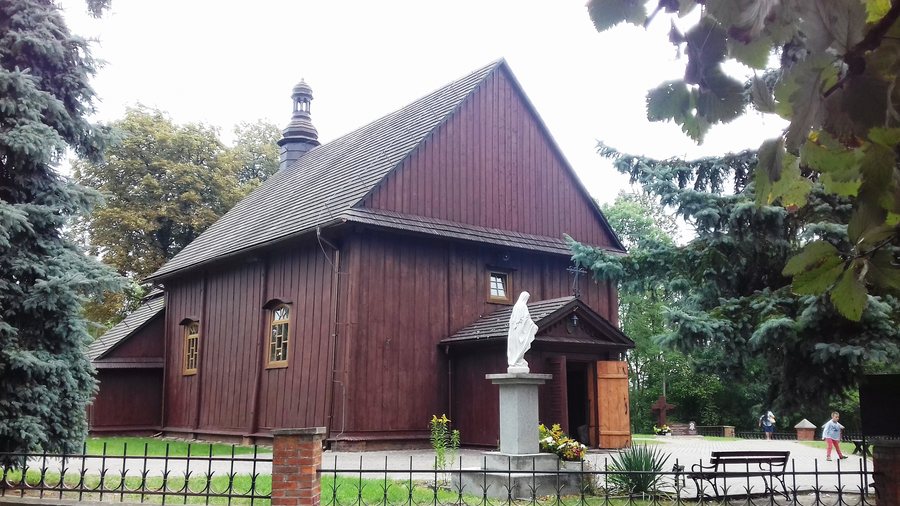
Comparing the Church and Hillfort Across Time
The wooden church of pw. św. Aniołów Stróżów in Słupno dates from 1753. The medieval hillfort, dating from the 11th century, lies southwest of the church, on the banks of the Słupianka stream. This places two clearly different dates side by side: the hillfort is many centuries older than the church. The church is dated to a specific year, while the hillfort is dated to a century. Their locations are also described differently: the church can be identified by its name and construction, while the hillfort is also identified by its position on the streambank southwest of the church. This comparison provides a clear chronological point of reference for a first look at Słupno’s culture. At the same time, these are two distinct historical remains: a wooden place of worship and a medieval hillfort, not two parts of the same building history.
A Memorial to Remembrance
A large, fenced-off memorial stands in the woods on Kościelna Street. It is located at the place where, in August 1942, twenty residents of Słupno, bound with barbed wire, were hanged. The date and its connection to local residents make the memorial a specific place of remembrance, not a general historical backdrop. Alongside older architectural remains, it gives local history a serious human dimension. If you are exploring Słupno’s cultural history with children, this chapter can be clearly distinguished from the history of its buildings and approached in its own respectful context.
Historic 19th-Century Buildings
Słupno has a rectory dating from the mid-19th century. A wooden house from the first half of the 19th century adds to the picture of its historic buildings. The dates invite a comparison: the wooden house belongs to an earlier period of the century, while the rectory dates from its middle. Together with the 1753 church, they provide several dated examples of buildings, without implying that their functions or histories are the same. Their descriptions also emphasize different features: the church stands out for its wooden construction, the rectory is identified by its function, and the other house by its material. Słupno thus has several types of historic buildings, distinguished by their construction, names and dates.
Using Cultural Interests to Guide Your Choice of Location
Cultural history can be a practical consideration when choosing where to stay. If you are particularly interested in the passage of time, the hillfort and wooden church offer a clear comparison. If you would like to compare different 19th-century buildings, the wooden house and rectory provide a different focus. The memorial offers a distinctly different perspective on remembrance. When looking for a holiday apartment in Słupno, you can therefore first consider whether these cultural topics match your travel interests. This lets the town’s history guide your decision without conflating its individual buildings or its place of remembrance.
Discover More Destinations
Discover more destinations: Maszewo Duże, Płock, Cierszewo, Wyszogród, Dobrzyków, Kozłowo, Rogozino, Grabina
Return to the main travel overview: Płock.

