
Dobrzyków – Church, Art and Routes
Accommodation in Dobrzyków
Dobrzyków combines several centuries of ecclesiastical art with distinctive trees and two routes described in different ways. The Church of the Nativity of the Blessed Virgin Mary and the two common ash trees are located in the same place; at the same time, named routes begin in or pass through Dobrzyków. As you plan your trip, you can consider culture and route itineraries as different reasons to get to know the village better.
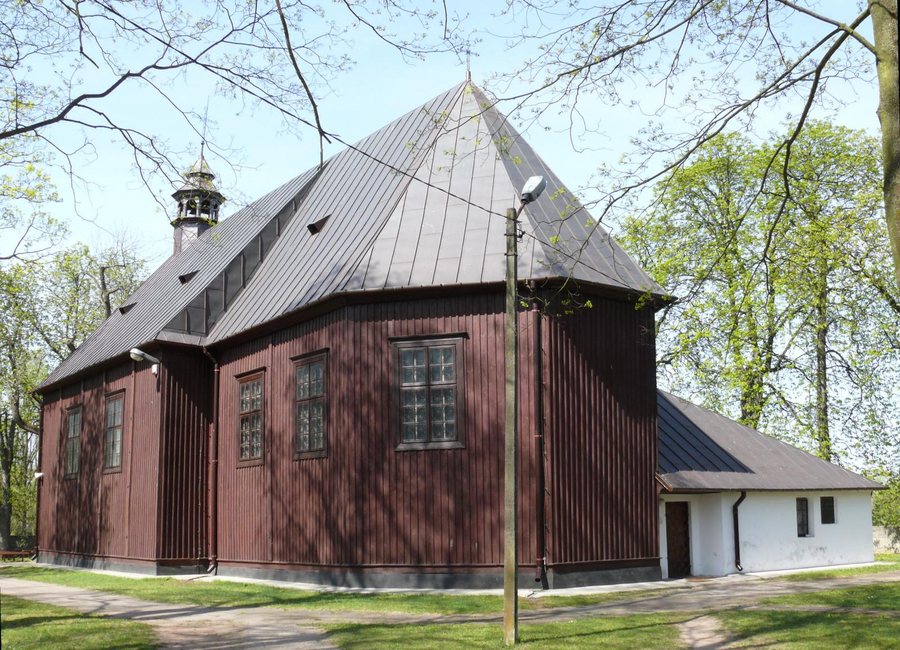 File:Kościół pw. Narodzenia NMP w Dobrzykowie (gm. Gąbin).jpg
Photo: MazowieckiPielgrzym via Wikimedia Commons, CC BY-SA 4.0
The Church of the Nativity of the Blessed Virgin Mary and its works of art
The Church of the Nativity of the Blessed Virgin Mary brings together furnishings from several centuries. The main altar dates from the 18th century and was transferred here from the dissolved Norbertine convent in Płock. Its origins give the altar a specific historical connection to Płock. Late Gothic figures of the Madonna and Saint John from the early 16th century stand at the chancel arch. The stone baptismal font with a wooden cover also dates from the first half of the 16th century.
Other details highlight different periods: Saint Anne with the Virgin and Child is depicted on the curtain of the main altarpiece, a work from the first half of the 19th century. The late Renaissance hanging lamp, known as the Meluzyna, in the shape of a stag’s head, dates from the late 16th century. Together, these details do not form a single, uniform style, but offer a glimpse of different periods and forms of ecclesiastical art. Two other structures also shape the area around the church: a wooden bell tower stands in front of it, and a brick chapel dating from the mid-19th century stands behind it.
The church is also a pilgrimage destination and the site of local Marian indulgence festivals. This gives the artworks a religious context that goes beyond their dates and design. For culturally minded travellers, the church is therefore a special focal point when choosing where to stay.
Two routes with different points of reference
The yellow Szlak główny Kotliny Płockiej begins in Dobrzyków. A municipal planning document from 2008 describes its route continuing past Lakes Ciechomickie and Górskie, through Grabina and Łąck, past Lake Sendeń, Krzywy Kołek, Trzcianno and Nowy Duninów, and on to Włocławek. The description traces the route through a succession of named places and bodies of water. If you include this route in your travel plans, check the current markings and trail conditions beforehand.
The Szlak Środkowej Wisły has a different point of reference: its stated total length is 47.3 kilometres. It runs between Wyszogród and Płock along the Vistula River and passes through Dobrzyków. The two routes can therefore be considered using different information: for the yellow route, the focus is on its course through several named places; for the Szlak Środkowej Wisły, the length, endpoints and riverside course are specified. This can help you compare the routes based on the kind of information that matters for your travel decision.
Ash trees by the church and choosing a destination
Two common ash trees stand by the church and are listed as natural monuments in a municipal planning document adopted in 2008. Their trunk circumferences are 355 and 360 centimetres; both trees are 25 metres tall. These precise measurements make nature-watching a specific stop: the protected ash trees are not somewhere in the surrounding area, but right by the church. Here, a natural monument and religious heritage stand side by side.
If you are looking for a holiday apartment, local attractions and the routes passing through the area can guide your choice of Dobrzyków as a destination. Culture enthusiasts will find several distinctive details in one church, from the origins of the main altar to the stag-headed Meluzyna. Those more interested in routes can choose between the yellow route, with its succession of places, and the 47.3-kilometre Szlak Środkowej Wisły. The two ash trees also add a precisely located natural feature to the picture of the village. Which of these aspects tips the balance for you depends on whether you want to focus your stay more on ecclesiastical art, the routes described here, or both.
Discover more destinations: Łąck, Koszelówka, Cierszewo, Kozłowo, Wola Łącka, Maszewo Duże, Płock, Słupno.
Return to the main travel overview: Płock.

