
Wierzbanowa: Landscape and Historical Monuments
Accommodation in Wierzbanowa
Wierzbanowa combines a precisely described mountain setting with historical monuments. The village lies in the valley of the Krzyworzeka and on the slopes of Ciecień and Wierzbanowska Góra. It is also located at the transition between Beskid Średni and Beskid Wyspowy. This offers two distinct perspectives for planning your trip: the specific landscape and the religious and architectural traces of the place.
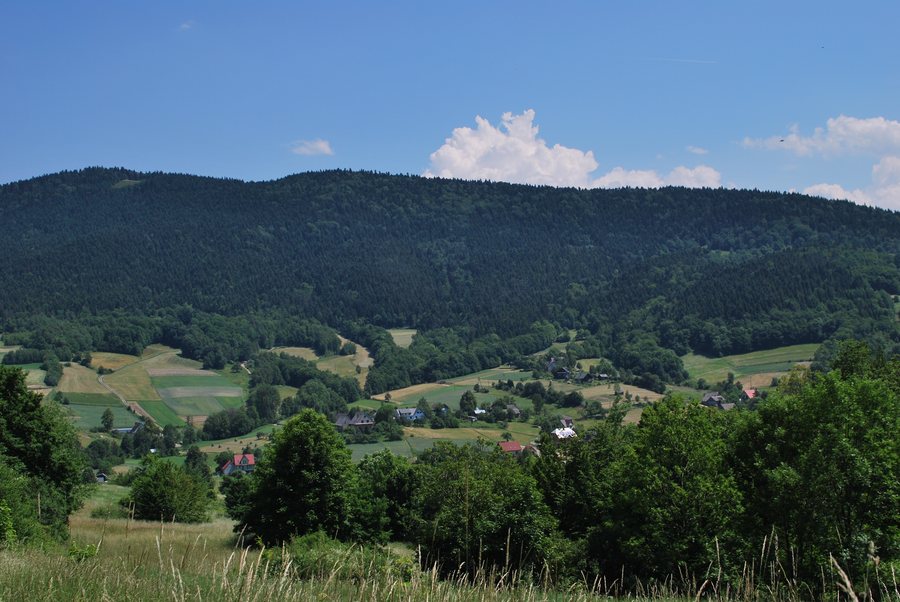 Wierzbanowa village (view from W), Myślenice county, Lesser Poland Voivodeship, Poland
Photo: Zygmunt Put Zetpe0202 via Source, CC BY-SA 4.0
Valley, slopes and mountain transition
The location can be understood on two scales. The Krzyworzeka valley and the slopes of Ciecień and Wierzbanowska Góra describe the immediate terrain. Beskid Średni and Beskid Wyspowy, by contrast, place Wierzbanowa within a broader regional context. When choosing destinations in the Beskids, you can distinguish between specific landscape features and the location at the transition between two mountain regions. These reference points make the village’s geographical setting easy to picture without reducing it to a single mountain or region.
Religious monuments and their dates
Along the road to Wiśniowa stand a roadside statue of Saint John of Nepomuk from 1847 and a roadside statue of the crucified Christ from 1864. Their shared roadside setting connects the two subjects, while their depictions and dates distinguish them. Another roadside statue stands at Przełęcz Wierzbanowska: it depicts the Immaculate Conception of Mary, dates from 1885 and is rather simple. Its location at the pass and its Marian subject set it apart from the two statues along the road to Wiśniowa. Wierzbanowa also has a small brick chapel dedicated to the Crucifixion of the Lord, dating from the 19th century. The chapel presents the Crucifixion motif in a different architectural form from the roadside statue.
The chronology also helps distinguish the monuments. The three roadside statues mentioned are dated 1847, 1864 and 1885, spanning 38 years of the 19th century. The chapel is also assigned to the 19th century. Together, these details provide a specific time frame for the religious subjects without assigning all the buildings a single year of origin.
Wooden houses and a school building
Some wooden houses from the early 20th century have decorated gables. This adds another perspective on local architectural history alongside the religious statues and brick chapel: here, the houses themselves and their gable decorations take centre stage. A school building from the early 20th century adds another type of building to this architectural picture. The wooden houses and school building belong to the same general period, but differ in their construction and the specific features highlighted. Together with the chapel, they can be distinguished by material, building type and date.
Considering Wierzbanowa as a travel destination
When looking for a holiday apartment, you can assess Wierzbanowa based on the aspects that matter to you when choosing a place to stay: its location at the transition between two Beskid regions, the named terrain features, or the village’s religious and architectural highlights. This lets you evaluate the destination through its specific landscape and historical connections rather than just by a general regional name. Which of these aspects matters most for your trip depends on what you value when choosing a destination.
Discover more destinations: Pcim, Siepraw, Glichów, Głogoczów, Osieczany, Skomielna Czarna, Stróza, Gruszów.
Return to the main travel overview: Myślenice.
Compare hotels and holiday rentals in Wierzbanowa by price and availability for your travel dates.
Advertisement · We may receive a commission if you book.
