
Pcim: Church, Kliszczak Tradition and Hiking Route
Accommodation in Pcim
Pcim can be explored through various facets: a church dating from the early 19th century, folklore associated with the Kliszczaks, a regional ensemble and a hiking route give the place a distinctive cultural and active profile. A protected natural monument is another special feature. When choosing your holiday apartment, consider which of these interests you want to shape your stay in Pcim.
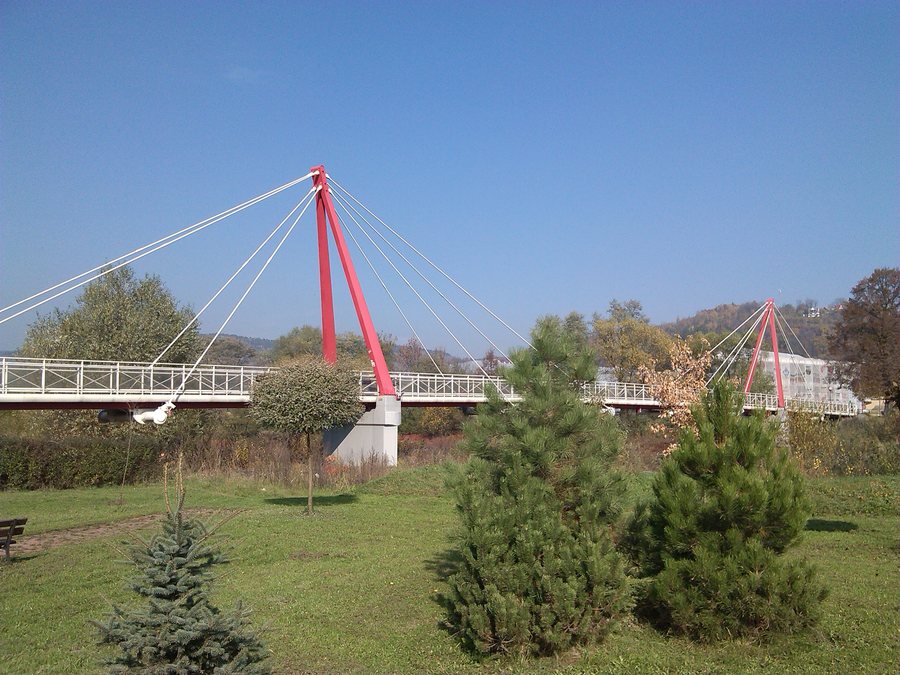 Pedestrian bridge over Raba river in Pcim
Photo: Wojciech Biegun via Wikimedia Commons, CC BY-SA 3.0
Pedestrian bridge over Raba river in Pcim
Photo: Wojciech Biegun via Wikimedia Commons, CC BY-SA 3.0
Church Architecture and Local History
The Church of St Nicholas the Bishop was built between 1810 and 1829 in the Josephine model church style. Its architecture includes a façade tower flanked by volutes. This gives travellers interested in a place’s architectural history, as well as nature and outdoor activities, a tangible point of reference. The lengthy construction period and distinctive stylistic feature make the church a cultural topic in its own right in Pcim.
If you like to combine your trip with regional stories and traditions, you can complement this architectural focus with the town’s folkloric connections. Pcim thus offers different ways to discover its culture side by side: a historic church and events that draw on the customs of an ethnographic group.
Folklore and Regional Traditions
The Święto Kliszczaka takes place in Pcim as an open-air folklore event. It draws on the traditions and customs of the Kliszczaks, an ethnographic group. The group’s connection is central: the festival is not simply about folklore in general, but about a specific regional tradition. Those interested in cultural topics can therefore also explore Pcim through its Kliszczak connections.
The regional ensemble “Pcimianie” was founded in 1970 at the Klub Rolnika. The reason and purpose for its founding was to recreate a traditional regional wedding. Today, the ensemble takes part in the cultural life of the municipality and performs at events including harvest festivals, the Święto Kliszczaka, and the Festival of Baked Potatoes and Korpiele in Kudłacze. These occasions illustrate the range of the traditions referenced: from wedding customs and harvest festivals to events whose names feature regional foods. When planning your trip, you can decide whether you would most like to connect Pcim with architectural history, folklore or the ensemble’s performance traditions.
Natural Monument and Hiking Route
The mountain elm “Halniak” is another of Pcim’s notable features. It is designated as a natural monument and has been protected since 1970. Alongside the cultural topics, there is therefore a natural monument with its own history of protection. Those wishing to bring together different interests during their stay will find another distinct point of reference here—without this implying a particular route or itinerary.
For outdoor activity, the Łysina–Pcim hiking route is a specific option. In the stated direction, the route is listed as taking 3 hours, with an ascent of 166 metres and a descent of 718 metres. In the opposite direction, the walking time is 3 hours 30 minutes. These figures show how the travel time differs by direction; for the first direction, the ascent and descent are also listed separately. Compare the figures when deciding whether this hiking route suits your plans for your stay. The walking time in the opposite direction is listed separately and should not be treated as the same as the time for the other direction.
If you choose Pcim as a base for your travel interests, you can give different weight to its cultural topics and the hiking route. Discover more local pages here: Dobczyce, Krzywaczka, Krzyszkowice, Wiśniowa, Gruszów, Jawornik, Siepraw, Osieczany.
For the broader travel overview: Myślenice.

