
Culture and History
The bell tower of the church of Saint-Marsal houses a mechanical pendulum clock, made in 1924 by Abadie & Parayre, clockmakers from Perpignan. At the summit lies the Dolmen du Serrat de las Fonts; its capstone has seven cup marks. Between Pla de l’Abella and Pou de Florentich, the wheel ruts cut into the rock from the Roman road are still fully visible.
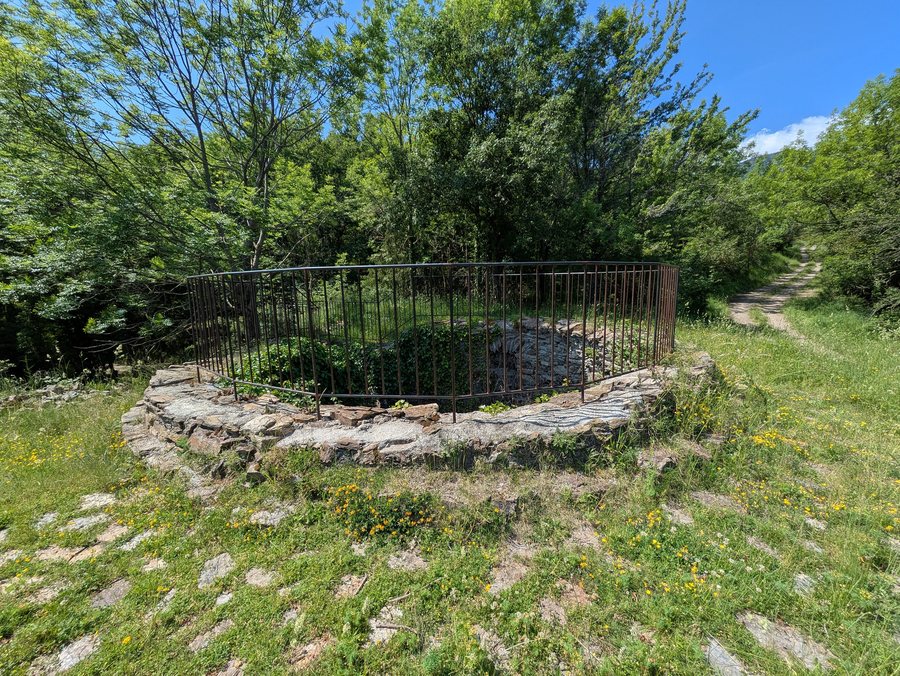
A protective railing was installed at the Puits à glace in 2021 to secure the ice shaft. Along the former La Pinouse-Formentere railway line, the remains of numerous structures are also still visible.
Nature
Saint-Marsal is one of the municipalities in the ZNIEFF natural area Massif des Aspres, a type 2 continental ZNIEFF. Under the 1930 law, the Massif des Aspres is designated both as a registered site and as a classified site.
Hiking
The Tour de Batère remains a hub for hiking trails. The hike „La Torre de Batera et la voie romaine“ begins by crossing the centre of Saint-Marsal and is a 13.0 km out-and-back route.
The highest point of this hike is at the Torre de Batera, a signal tower. From there, an exceptional view opens up over the Vallespir Valley and the Roussillon plain.
The circular hike „Ronde du Fer“ begins in Saint-Marsal and is 18.3 km long. It leads from Saint-Marsal through a beautiful beech forest up to the Torre de Batera.
Geographical Location
Saint-Marsal can be reached via the D618, which connects the valleys of the Tech and the Têt from Amélie-les-Bains to Bouleternère.

