
Discover regional specialities
Find accommodation
Regional specialities can make a holiday more memorable when the product, season and place fit together. A market, farm shop, bakery or restaurant may be enough for a useful introduction; you do not need to plan a long food tour.
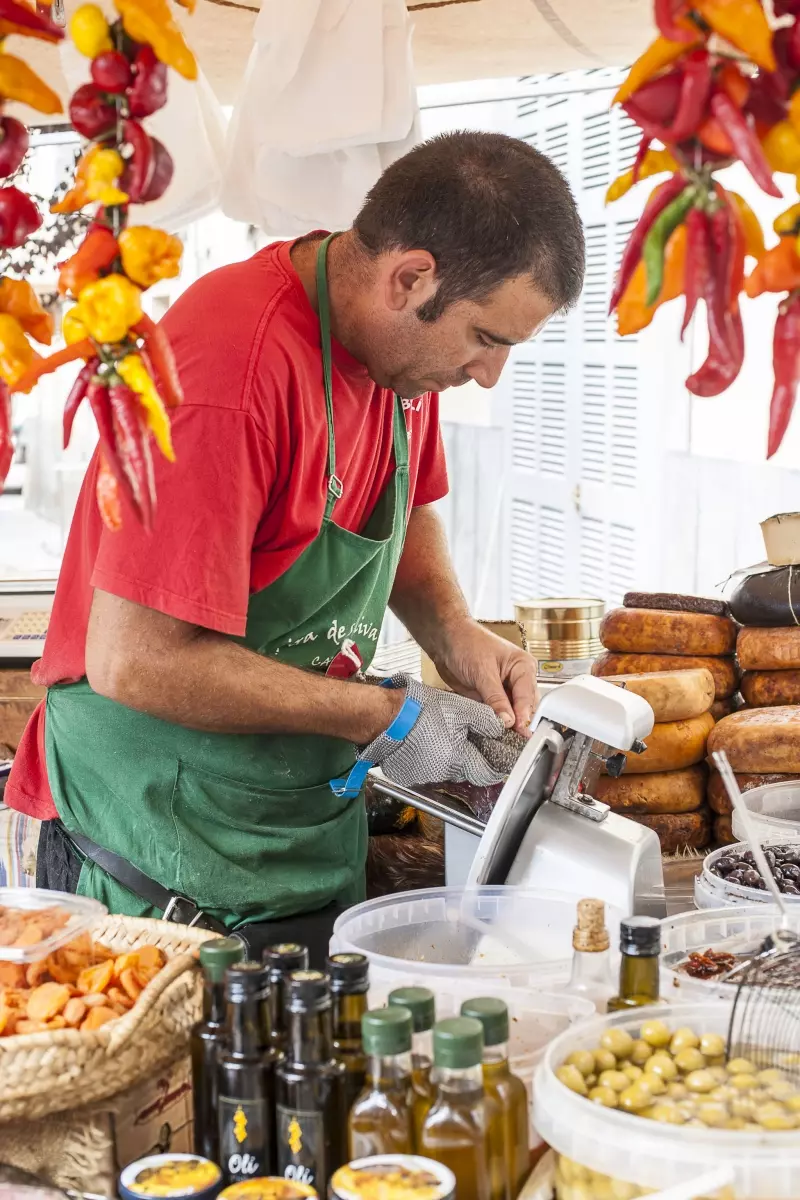 A trader cuts cheese at a market stall with olives, oil bottles and other regional products.
Photo: Alesia Belaya
A trader cuts cheese at a market stall with olives, oil bottles and other regional products.
Photo: Alesia Belaya
At a glance
- Markets, producers, specialist shops and restaurants offer different perspectives on local food.
- Season, region and current deliveries affect what is available.
- A place name in a product description does not automatically prove that every ingredient comes from the area.
- Check ingredients, origin and storage, especially for allergies or particular diets.
- A holiday home needs a usable kitchen, fridge and shopping route if you plan to cook.
Choose the kind of food experience
You might focus on cheese, ham, bread, pastries, fish, vegetables, olive oil, wine or regional sweets. France, Italy, Spain, Portugal and Germany each offer different food cultures, but the current offer still needs to be checked locally.
A market is useful for comparing small quantities. A farm shop may offer direct contact with a producer but can be outside the town. A restaurant shows how products are prepared, but may require a reservation and a fixed time. Choose one or two main activities for the day and leave room for travel and breaks.
Plan self-catering
If you want to prepare regional products yourself, check the holiday home's fridge, hob, worktop, cookware, tableware and dining area. In a rural property, include the distance to shops and the frequency of planned purchases. In a town, a central location may make spontaneous shopping easier.
Buy quantities that fit the available storage and the meals you expect to prepare. For chilled or delicate goods, ask the seller about packaging, transport and storage. The seller's current product information is more useful than a general tourist description.
Check origin and ingredients
Ask where a product was made, when it is available and how it should be stored. For processed foods, read the ingredient list and origin information. If you have an allergy or follow a particular diet, confirm the details directly with the producer, shop or restaurant rather than relying on a market sign.
Travelling with children or several generations is easier when the food activity is short and an alternative is nearby. A beach, museum, playground or walk can give everyone another option if the queue is long or the weather changes.
Build a flexible food itinerary
Leave some meals open so that you can respond to opening times, weather and the actual selection. Compare olive oil holidays, cheese and ham journeys, cooking courses on holiday and truffle holidays when they genuinely fit your route.
For general accommodation planning, compare the kitchen and location before booking. A suitable base should support the activities you have actually chosen rather than promising every possible food experience.
Frequently asked questions
Where can I find regional products?
Markets, farm shops, specialist shops and restaurants provide different information. Check the current offer and origin on site.
Do I need a holiday home with a kitchen?
No, but it is helpful if you want to buy products and prepare simple meals yourself.
How should I plan perishable purchases?
Buy them close to the intended meal, ask about cooling and storage, and keep the return route short.
How reliable are regional product names?
Check the ingredient list, origin and labelling. A place name alone does not prove that all components come from that region.
How many activities fit into one day?
One or two fixed food activities usually leave more room for travel, queues, breaks and unexpected discoveries.
