
Callosa de Segura: Sierra, History and Festival Culture
Accommodation in Callosa De Segura
The ruins of Castillo de Callosa lie on a rocky summit approximately 200 metres high in the Sierra de Callosa. They date from the caliphate period; originating in the year 961, the Castillo is considered the oldest castle in the province of Alicante.
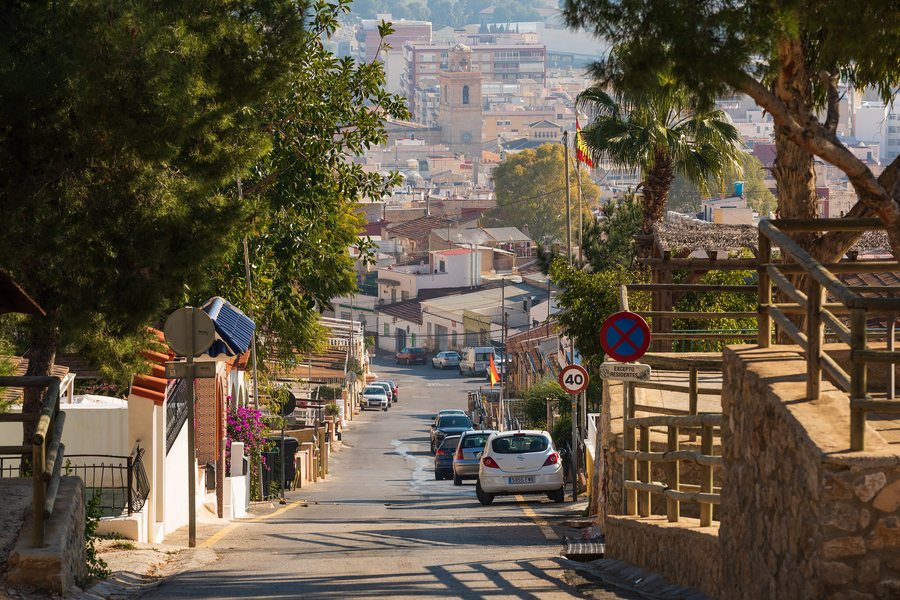 File:Calle Nuestra Señora Del Pilar street in Callosa de Segura, Alicante, Spain, 2022 January - 2.jpg
Photo: Ximonic (Simo Räsänen) via Source, CC BY-SA 4.0
File:Calle Nuestra Señora Del Pilar street in Callosa de Segura, Alicante, Spain, 2022 January - 2.jpg
Photo: Ximonic (Simo Räsänen) via Source, CC BY-SA 4.0
Nature
The Sierra de Callosa is protected as a municipal nature park and covers just under 150 hectares. As a rugged limestone massif, it rises from an alluvial plain. The protected Sierra includes the recreational areas of La Pilarica and La Cueva Ahumada, with car parks, toilets, picnic areas, springs, tables, children's play areas, educational trails and areas adapted for accessibility.
On the southeast side of the Sierra de Callosa, within the municipality of Callosa de Segura, lies the Vía Ferrata de Callosa de Segura. It is freely accessible and opened to the public in February 2020. From the car park at La Cueva Ahumada nature park, a marked access path leads to the first section in approximately 15 minutes; this has a K3 difficulty rating and is designed as an introductory or family section. The stated trail sections are signposted.
Culture
The Iglesia Arciprestal de San Martín was declared a National Historic-Artistic Monument by Royal Decree 2865/1980 of 14 November. The main construction work was completed in 1553; the building combines Gothic, Renaissance, Baroque and Neoclassical styles. Inside there are 18 Corinthian columns, while the three naves are of equal height.
A special local tradition is presented at the Museo del Cáñamo Roque Fco Albert Lucas. Demonstrations of the traditional processing of hemp are held there, and the complete cycle from sowing and cultivation through processing into yarn, ropes, nets and espadrilles is also shown. Hemp cultivation and the use of its fibres in Callosa de Segura are a tradition dating back more than eight centuries and recognised as intangible cultural heritage of cultural interest. The Museo del Cáñamo Roque Fco Albert Lucas was open all year round.
The Museo Arqueológico Antonio Ballester y Ruiz was founded in 1980 and presents the history of Callosa de Segura from prehistory to the present day. Its particularly significant prehistoric heritage includes the El Argar culture from the Bronze Age, dating from 1,800 to 1,200 BC, as well as the “Laderas del Castillo” archaeological site.
The Museo de Semana Santa José Noguera Valverde displays 25 processional floats belonging to 17 local brotherhoods. An upper gallery offers the opportunity to view the processional floats from above. The Ermita de Ntra. Sra. de los Dolores was founded at the beginning of the 17th century as the chapel of the former municipal hospital, which has since disappeared. Its Camarín preserves 18th-century Valencian floor tiles depicting the allegory of the Fountain of Wisdom.
Traditional dishes from Callosa de Segura include Arroz con costra, Bacalao meneao, Cocido con pelotas and Almojábanas.
Traditions
“La Pasión” of Callosa de Segura is a religious auto sacramental; its modern form was performed in 1969 by the local amateur theatre group Agrupación Artística. Since 1969, “La Pasión” has been performed every year during Holy Week at various locations throughout the city. In 1982, “La Pasión” received recognition as an event of tourist interest.
“Porta Celi: La Puerta del Cielo” is also among the city’s religious performances. The tradition dates back to 2011 and is associated with an annual performance in November. The work consists of seven scenes and is performed by more than 50 actors from the patronage. The processions and religious events of Holy Week are organised by 15 local brotherhoods and religious communities.
The living Stations of the Cross on Good Friday begin at the Capilla de San Francisco, continue along Calle Vía Crucis to Calvario and include a dramatised reading of the Holy Gospel. The patron saint festivities in honour of San Roque take place every year from 5 to 16 August. The Moors and Christians festivities began in 1977; they commemorate the Reconquista and include parades in which participants are divided into Moorish and Christian groups and wear medieval-inspired clothing.
The Santuario de San Roque stands on a 50-metre-high hill. From there, the “Balcón de la Vega Baja” panorama can be viewed.
Other destinations
Other destinations at this level include Lorcha, L'Atzúbia, El Bacarot, La Vila Joiosa, Onil, Banyeres De Mariola, Rojales and Puerto Marino.
Getting there
Callosa de Segura railway station offers daily Cercanías services to Alicante and Murcia. By car, Callosa de Segura can be reached via the A-7, exit 79, and then the CV-900. From the town, signposted routes continue to the recreational areas of La Pilarica and La Cueva Ahumada.
For the higher-level travel overview: Alicante.

