
Beniardá at the Guadalest Reservoir: Trails, History and Craftsmanship
Accommodation in Beniardá
Beniardá lies at the beginning of the reservoir formed by the Guadalest River of the same name. The mountainous terrain invites visitors to go hiking. The waterscape, local history, sacred architecture and regional craftsmanship provide contrasting thematic highlights. This makes it possible to explore the town through both its landscape and the visible traces of different eras and traditional forms of craftsmanship.
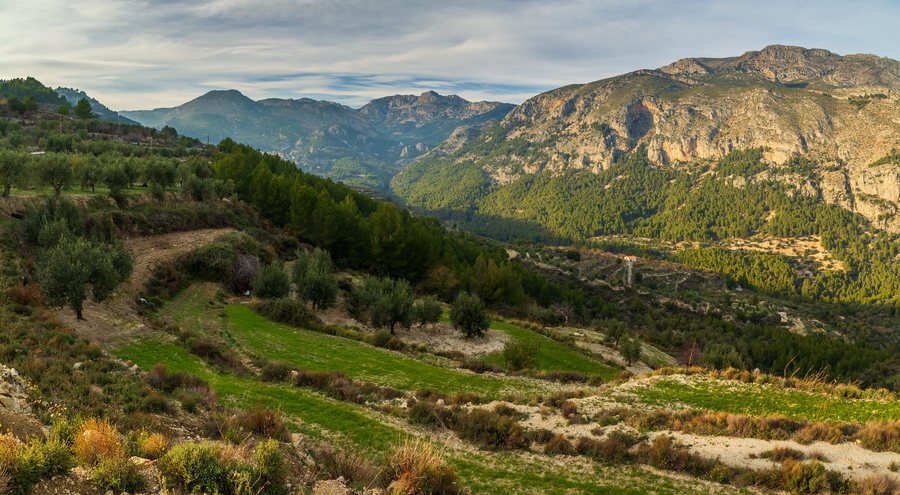 File:Valley around Riu Beniardá in Beniardá, Alicante, Valencia, Spain, 2020 January.jpg
Photo: Ximonic (Simo Räsänen) via Source, CC BY-SA 4.0
File:Valley around Riu Beniardá in Beniardá, Alicante, Valencia, Spain, 2020 January.jpg
Photo: Ximonic (Simo Räsänen) via Source, CC BY-SA 4.0
Nature and trails
The circular hike Ruta circular del embalse de Guadalest begins in Beniardá and runs parallel to the Guadalest Reservoir through pine forests and cultivated landscapes. When planning your day, the water, pine forest and cultivated landscape can be considered as separate focal points. The route, viewpoint and stops in the town represent different ways of exploring the area. The starting point in the town and the route along the water connect the built-up area with the natural sections of the hike.
Water and recreation
The Mirador del embalse is located on Calle San Francisco on the outskirts of Beniardá and offers views of the Guadalest Reservoir. The Font Vella recreation area has a children’s playground. Font Vella, with its traditional covered washhouse, has four outlets that supply the washhouse with water. The places mentioned differ in their functions: views, recreation and a traditional everyday structure come together here. Along the water, there is therefore both a viewpoint and a place with tangible everyday history.
Townscape and history
The streets of Beniardá preserve a layout dating from the Arab period. Some buildings retain remains from the same period. A small aqueduct marks the entrance to the town centre. On Carrer de la Torre, the remains of a medieval tower base have been preserved. Beniardá is also a listed stop on the De Alcoy a La Vila Joiosa route. The townscape thus brings together the preserved street layout, individual architectural traces and named historical sites.
Sacred architecture
The 16th-century church of Sant Joan Baptista can be visited. The Capella de Sant Francesc is a chapel built in an arch-like form over a street. The Capella de Sant Joan features polychrome tiles from the late 19th and early 20th centuries; they were made by the ceramicist Francisco Tos in Manises (València). An arch near the Capella de Sant Joan may have been part of the original Muslim alquería. The sacred buildings thus reflect different layers of time: a 16th-century place of worship, a chapel built over a street, ceramics created later and a merely possible connection with the original Muslim alquería.
Craftsmanship and regional traditions
Beniardá’s Feria de Artesanía y productos típicos takes place on the second weekend of May and includes stalls offering typical regional foods and handicrafts. In Beniardá, visitors can also visit stalls featuring esparto craftsmanship. Basseta Gadea is a former village washhouse that was recently uncovered and restored. The fixed date of the fair, the regional foods and the handicrafts complement the distinct tradition of esparto craftsmanship and the historic character of Basseta Gadea.
Other places
Daya Nueva, Agres, Tàrbena, L'Atzúbia, El Verger, Callosa D'en Sarrià, Los Montesinos, Xaló
For the higher-level travel overview: Alicante.

