
Casas De Fernando Alonso: Dry-Stone Structures and Festivals
Accommodation in Casas De Fernando Alonso
Casas De Fernando Alonso offers several specific ways to explore its history and culture: a route to round dry-stone structures, traditional festivals throughout the year, the hermitages with their distinctive details, and the Paseo de las Tinajas. It is also part of the D.O. Ribera del Júcar. Here, historic architectural forms, religious traditions, local details and winegrowing come together.
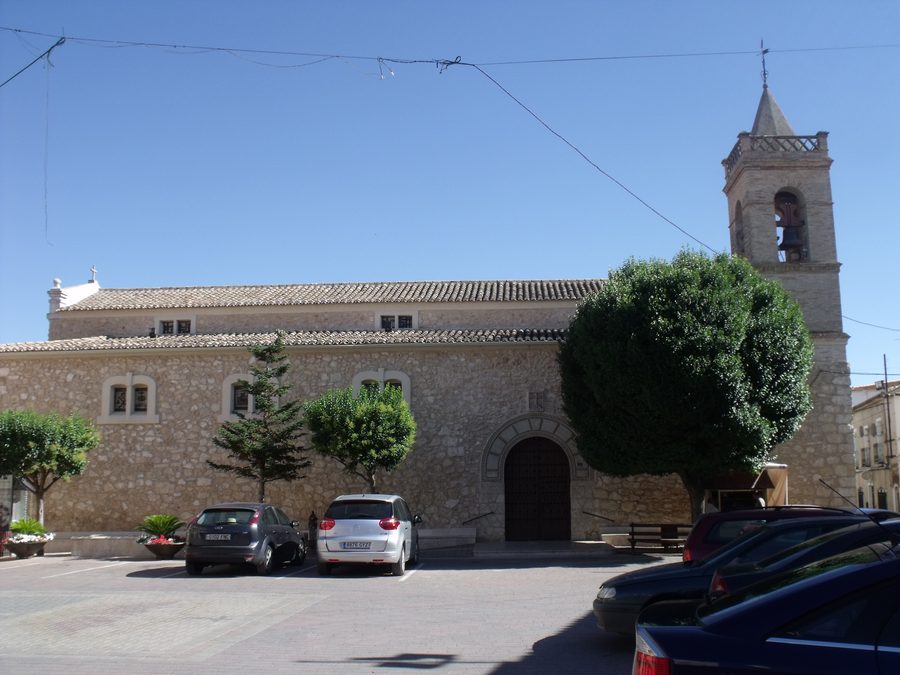 Iglesia de la Purísima Concepción de Casas de Fernando Alonso.
Photo: 19Tarrestnom65 via Wikimedia Commons, CC BY-SA 4.0
Iglesia de la Purísima Concepción de Casas de Fernando Alonso.
Photo: 19Tarrestnom65 via Wikimedia Commons, CC BY-SA 4.0
Dry-stone structures and their former purpose
On the Ruta de los Cubos o Chozos, visitors can discover ancient, round dry-stone structures. Shepherds and farmers used them as shelters. Their form and former function go hand in hand: these structures represent a practical use associated with the work of these two groups. The term “dry stone” can also be clearly understood from the structures themselves: this building technique involves laying stones without binding mortar. Those interested in historic architectural forms will find a concrete point of reference along the route, where material, shape and former use come together.
Festival dates and hermitages
The San Antón festivals are celebrated in January, and the festivals in honour of the Virgen del Carmen take place in July. Both are recurring traditional celebrations in Casas De Fernando Alonso. The months provide a clear guide if you would like to include a festival in your travel plans; check the exact dates before your trip.
The Ermita de San Antón houses a stone image of San Antón. It is 1.90 metres tall and weighs 625 kilograms—dimensions that make the image a tangible detail of local culture. The Ermita de San Cristóbal, north of the town in an area of holm oaks, offers a different architectural feature. Its building has a single nave and a small bell gable. “Single nave” means that the building has one nave; the bell gable adds a clearly identifiable architectural detail to this brief description.
Local details and winegrowing
The Paseo de las Tinajas is at the entrance to the town. Large storage jars donated by Fernando Molina stand there. As storage vessels, they differ in theme from the hermitages and the stone image: here, the focus is on an object used for storage. The Paseo thus adds a tangible local detail to the religious and festival themes.
Casas De Fernando Alonso is one of the municipalities in the D.O. Ribera del Júcar. The vineyards of the municipalities in Cuenca province that belong to the D.O. Ribera del Júcar cover around 6,700 hectares in total. This adds another perspective to the individual structures and festivals: membership in a designation of origin with vineyards spread across several municipalities.
Choose a reason for your trip when booking a holiday rental
When looking for a holiday rental, it is worth considering your travel dates alongside your interests. If a festival is the reason for your trip, use the months mentioned as a guide and check the exact date. For a trip without a specific theme, you can first decide whether you are especially interested in historic architectural forms, religious architecture, local details or the region’s winegrowing.
Discover more destinations
Pineda De Gigüela, Puente De Vadillos, Cuenca, Poyatos, Salvacañete, Villar de Cañas, Las Zomas, Víllora
For the overview of the wider area: Cuenca.

