
Mortera between El Tolío and Monte Picota
Accommodation in Mortera
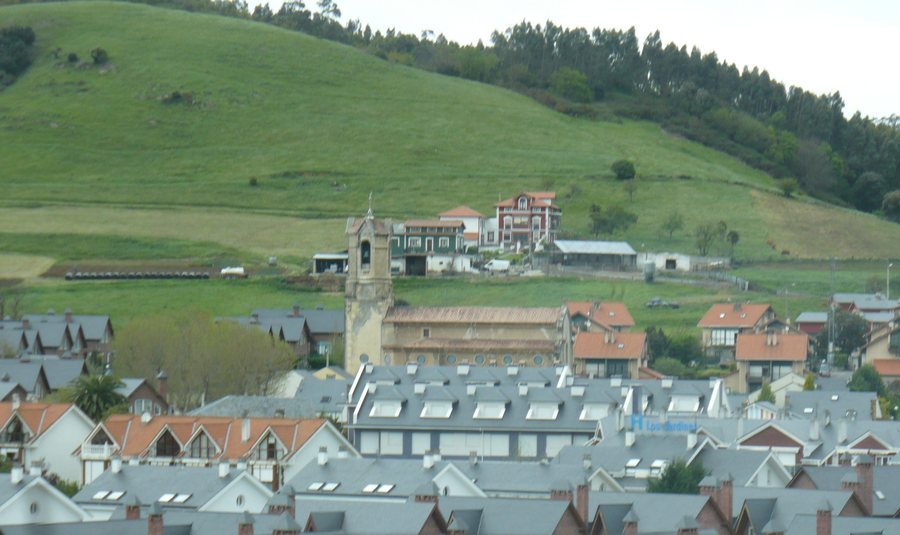
Mortera lies on a Quaternary dissolution basin that collects the surface water of the small coastal massif of El Tolío. The horseshoe-shaped massif, open to the east, protects the village. Mortera can be reached via exit 7 of the A-67 and then along the CA-303 road.
Landscape
Alto del Cuco is 146 metres high and offers an exceptional view of Mortera from the edge of the CA-303. The El Tolío complex consists of nine peaks in two superimposed rock formations: calcarenite and sandy limestones with orbitoids lie alongside marls and argillaceous limestones from the Upper Cretaceous. Despite the eucalyptus woodland and scrub, some holm oaks and oaks from the original forest have survived.
Culture and history
The parish church of Mortera is called Iglesia de San Ramón and was originally named San Julián. Irregular flint nodules were found among the limestones on the slopes of Monte Picota. They show signs of having been used to make tools and suggest prehistoric settlement. There is also evidence on the slope of an Early Medieval monastery called “San Julián”.
Cueva de las Penas is approximately 210 metres long, was used as a burial site and contained Hispano-Visigothic objects from the 7th and 8th centuries. Buckles and other finds from the cave are currently on display at the Museo de Prehistoria y Arqueología de Cantabria, or MUPAC for short.
The Palacio de los Condes de Mortera was built in the 19th century on behalf of D. Ramón de Herrera, Count of Mortera; the counts’ coat of arms is displayed on its main portal. Following a decision dated 24 April 2001, the Palacio was classified as a Bien de Interés Local in the “Inmueble” category. The complex comprises a palace house, stables, a library and a service pavilion, surrounded by gardens. The Palacio has been abandoned, requires renovation and includes a garden plot.
Casa Salomón in Mortera de Piélagos was designed by Juan Carlos Calle Tormo. It consists of two detached building units connected by a partially covered terrace. The Estructuras Militares del Monte Picota are designated in the municipality of Piélagos as a Bien de Interés Cultural in the “zona arqueológica” category.
Other places: Liencres, Renedo De Piélagos, Boó De Piélagos, Barcenilla.
When searching for a holiday apartment in Mortera, you can compare travel dates, room category and cancellation conditions on the respective offer page.
Routes and dates
The municipal route “Desde Mortera a la Atalaya del mar” starts at the Casa de los Condes de Mortera, is 6 kilometres long, takes an estimated four hours and has a medium difficulty level. Route 11 in Mortera is listed as 5.52 kilometres long, with a duration of two hours and a difficulty rating of 2. Its points of interest are the summit of Monte Picota and a machine-gun emplacement. It also passes the Iglesia de San Julián y María Inmaculada, which is designated as a cultural site of interest. The differing information on length, duration and difficulty makes the two routes directly comparable.
Parque del Pradón de los Condes in Mortera has a multi-purpose sports court, two children’s play areas, a calisthenics area, a green space and benches. From 29 to 31 August 2026, Mortera will host the Fiestas de San Ramón Nonato, organised by the local Junta Vecinal in cooperation with the Ayuntamiento de Piélagos.
For the higher-level travel overview: Piélagos.

