
You can rent a holiday apartment in Tulcea.
Nature
The Centrul Muzeal Eco-Turistic Delta Dunării in Tulcea combines a museum and a public aquarium in an integrated cultural institution. It presents habitats from the Danube Delta and the Razim-Sinoie lagoon complex, as well as the natural heritage of the Danube Delta Biosphere Reserve. The aquarium displays 24 species of native fish from the Danube Delta and the Black Sea, as well as 23 species of reef fish, eight species of marine invertebrates and six coral species.
The island of Insula Popina is part of the area around Tulcea. The nearby surroundings of Tulcea also include the hill Movila lui Uţu, the hill Dealul cu Piatră and the hill Movila Taximin.
Water
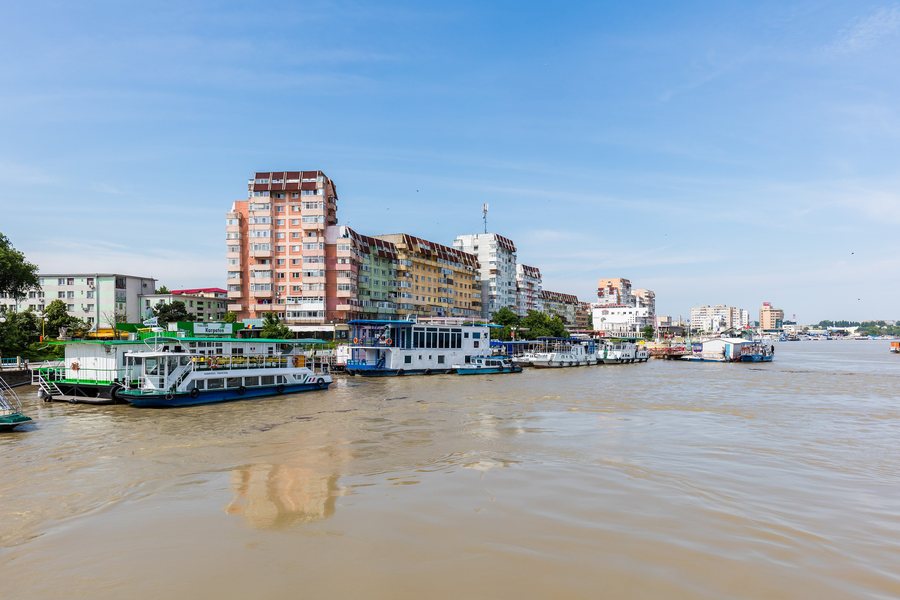
The Ansamblul Memorial Ivan Patzaichin on Tulcea's waterfront is a remarkable architectural memorial ensemble. At the same time, it marks a starting point for exploring the Danube Delta; from here, lightweight boats set off into the delta.
Navrom Delta operates passenger services on routes from Tulcea to Sulina, Sfântu Gheorghe and Periprava. Navrom Delta also offers connections to Mila 23 and Caraorman.
History
From the 3rd century onward, Aegyssus became an important military base and later, in the 6th century, a bishop's seat. The Muzeul de Istorie și Arheologie is housed in a building in Parcul Monumentul Independenței, which was built on the site of the ancient city of Aegyssus. Its collection is estimated to comprise more than 90,000 items. Several archaeological complexes from the Roman era at Aegyssus can be visited on Dealul Monumentului.
The Cetatea Medievală Enisala was built for military purposes in the second half of the 14th century.
Culture
The Muzeul Satului Pescăresc din Tulcea recreates the three channels Chilia, Sulina and Sfântu Gheorghe as routes and displays houses typical of villages in the Danube Delta. The Muzeul de Etnografie și Artă Populară is housed in a public building constructed between 1924 and 1927, illustrating forms of Romanian national architecture. Its collection includes approximately 8,000 objects from the fields of folk art, traditional costumes, ethnography and photographic documentation.
The Muzeul de Artă is housed in the historic Conacul Pașei, which was built between 1862 and 1865. It presents collections of paintings, sculptures, icons, Oriental art, graphic art and decorative art.
The nearby surroundings of Tulcea include the church Biserica Sfinţii Voievozi, the church Biserica Sfântul Vasile, the Orthodox church Biserica Ortodoxă Sarichioi and the church Biserica Naşterea Maicii Domnului.
Events
The International Folklore Festival “Peștișorul de Aur” is an annual tradition in Tulcea and brings together traditional ensembles from various countries and cultures. The Scrumbii de Rusalii Festival 2026 at the Muzeul Satului Pescăresc din Tulcea featured concerts, activities for children, local cuisine, creative workshops and outdoor experiences.
Cuisine
Recommended regional dishes and products in Tulcea include fish roe on toast, fish soup, Storceag, fresh grilled fish, fish saramură with polenta and hot peppers, local wine and Dobrujan Plăcintă.
More local pages for the regional selection: Tulcea, Sulina, Mahmudia, Maliuc, Beştepe, Crișan, Murighiol, Malleco, Uzlina, Letea, Partizani, Băltenii De Sus, Somova, Nufăru, Chilia Veche, Murighiol, Cerna, Jurilovca, Periprava, Plopul, Sarichioi, Babadag, Comuna Sarichioi, Comuna Maliuc, Comuna Murighiol, Topolog, Caraorman, Luncavița.

