
Discover Maia: Mária Way, Chapels and Village Architecture
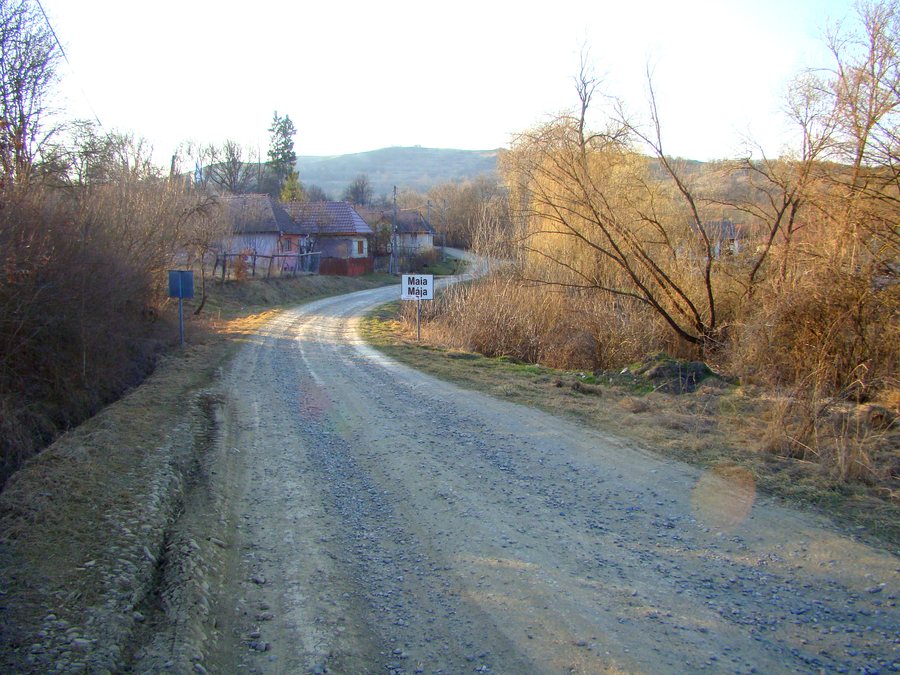
Maia is located in the municipality of Bereni in Mureş County. Archaeological finds from the Eneolithic and Neolithic periods have been recorded in Maia. Isolated artefacts discovered in Maia, in the municipality of Bereni, have also been recorded as dating from the Eneolithic period.
Find more places at Burgfeld, Gorneşti, Feleag, Sighişoara, Eremitu, Targu Mures, Lunca Bradului and Saschiz.
Culture
The Lovász Chapel was brought to the village of Maia in 1763. Twenty-eight teams of oxen were involved in transporting it. Eighty-four strong men helped with the task. The Reformed Church in Maia was built around 1863. On the Mária Way, it can be seen behind the houses on the main road. A wooden chapel near Maia was built by Lovász Márton.
House No. 17 in Maia has a decorated gable. The gable is designed with sawn boards and radially arranged wooden elements.
Maia therefore brings together several different forms of rural architectural culture: the Lovász Chapel brought there in 1763, the Reformed Church built around 1863, the wooden chapel built by Lovász Márton and the particularly distinctive gable on House No. 17. The two chapels are distinguished from one another by their construction history and location.
Landscape
The Firtos-tető summit lies in the wider regional surroundings of Maia. The Dealul Călugărului hill lies in the vicinity of Maia. The Dealul Sântana hill is likewise located in the wider regional surroundings of Maia.
In Maia, clustered farmsteads are common among the hilly villages along the upper Nyárád.
The landscape references therefore extend from the immediate vicinity to the wider regional surroundings. Dealul Călugărului lies in the vicinity of Maia, while Firtos-tető and Dealul Sântana are assigned to the wider regional surroundings. At the same time, the clustered farmsteads form part of the built character of the hilly villages along the upper Nyárád.
Trails
If you plan the M01-Ms section of the Mária Way as a day hike, it passes through Maia. The section is approximately 25.5 kilometres long. It takes about eight hours.
The alternative M01-MsC route branches off at the watershed. At this point, the main route descends in the direction of Maia. M01-MsC runs via Mikháza and the Bekecs. At Farkas-tető, the alternative route rejoins the main route.
The route through Maia crosses a bridge. It leads to a triangular square with the so-called village well.
On the M01-Ms section, Maia is therefore mentioned not merely as a place the route passes through, but is also connected with several fixed landmarks. The Reformed Church lies behind the houses on the main road and remains visible on the Mária Way. Further on, the route crosses a bridge and continues to the triangular square where the so-called village well is located. The alternative M01-MsC route begins at the watershed, passes through Mikháza and the Bekecs, and rejoins the main route at Farkas-tető. The main section is specified as approximately 25.5 kilometres and about eight hours.
For the overarching travel overview: Mures.
Check prices, availability and amenities for your travel dates directly on Booking.com.
View accommodation and offersAdvertisement · Affiliate link to Booking.com
.jpg)