
Galda de Jos: Castle, Church, Customs and Landscape
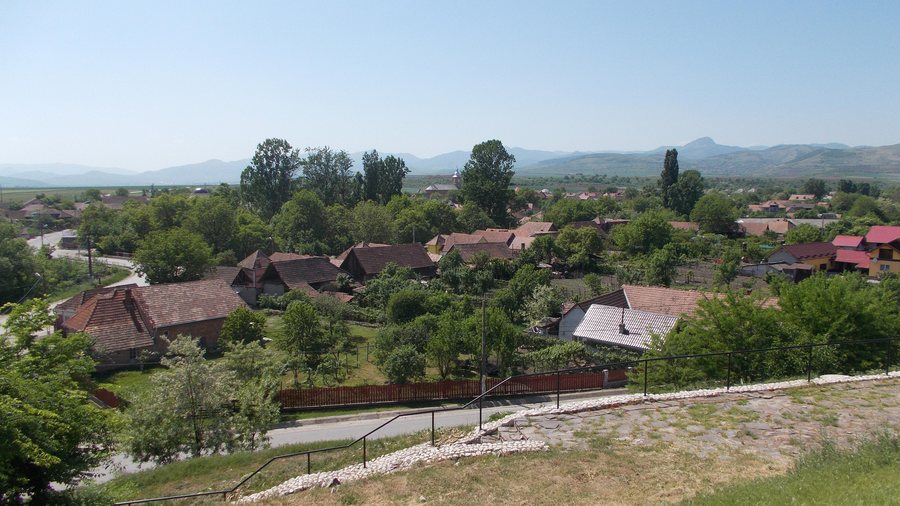
Kemény-Albini Castle is located in Galda de Jos. At the end of the 19th century, it was built over a medieval castle dating from the 17th century. During the uprisings led by Horea, Cloșca and Crișan from 1784 to 1785, the castle served as a detention site for arrested peasants. A labour colony for political prisoners existed on the Kemény estate. The estate was later taken over by the Albini family. The castle therefore preserves evidence of several historical periods and the changing use of the estate.
Culture and History
The “Nașterea Maicii Domnului” Church is one of the historic monuments included in Romania’s National Cultural Heritage. It was built in 1715 on the site of an older church. It has been documented in records since 1723. The three dates mark different stages in its history: the earlier predecessor building, the construction of the present church and the later written record. The Monumentul Eroilor and the Troița commemorate the sacrifice of those who fought in the First and Second World Wars. Both memorial sites thus complement the older architectural and local history with a commemoration of the war participants.
Nature and Trails
Piatra Bulzului is also known as Bulzul Gălzii. The geological reserve lies within the administrative territory of the municipality of Galda de Jos. It includes a pointed limestone ridge that reaches an elevation of 971 m. The approach from Galda de Jos follows the DJ 107K to the village of Poiana Gălzii. From there, an approximately 2 km-long footpath continues along the Bulzulului stream. The route therefore first includes the approach via the aforementioned road and then the described walking section along the stream.
Piatra Craivii lies in the vicinity of Galda de Jos. It is located about 15 km from Galda de Jos and lies at an elevation of 1,083 m. The final approach follows a forest road. This begins after the asphalt road ends at the exit of Craiva and is covered on foot. For this section, the transition from the paved road to the footpath is therefore explicitly part of the route described.
Routes Through the Surrounding Area
One route is called “Galda de Jos – Benic – Cetea – Cheile Cetii – Poiana Narciselor”. It begins in Galda de Jos. Along the Valea Galzii, it heads towards the village of Benic. The named stops extend from Galda de Jos via Benic and Cetea to Cheile Cetii and Poiana Narciselor.
Customs
Sânvăsaiul de la Galda de Jos is a preserved New Year’s custom. It is part of Transylvania’s living rural winter traditions. During Sânvăsaiul, seven plates are placed on the table of the Ursitoare. A comb, a mirror and a piece of coal are hidden among them. The other hidden objects include a grain of wheat, tow, a carrot and a pencil. The seven plates form the established framework of the custom, while the hidden objects constitute its traditional details.
To the overarching travel overview: Galda de Jos.
Check prices, availability and amenities for your travel dates directly on Booking.com.
View accommodation and offersAdvertisement · Affiliate link to Booking.com
