
Albac – Gorges, Caves and Holiday Apartments
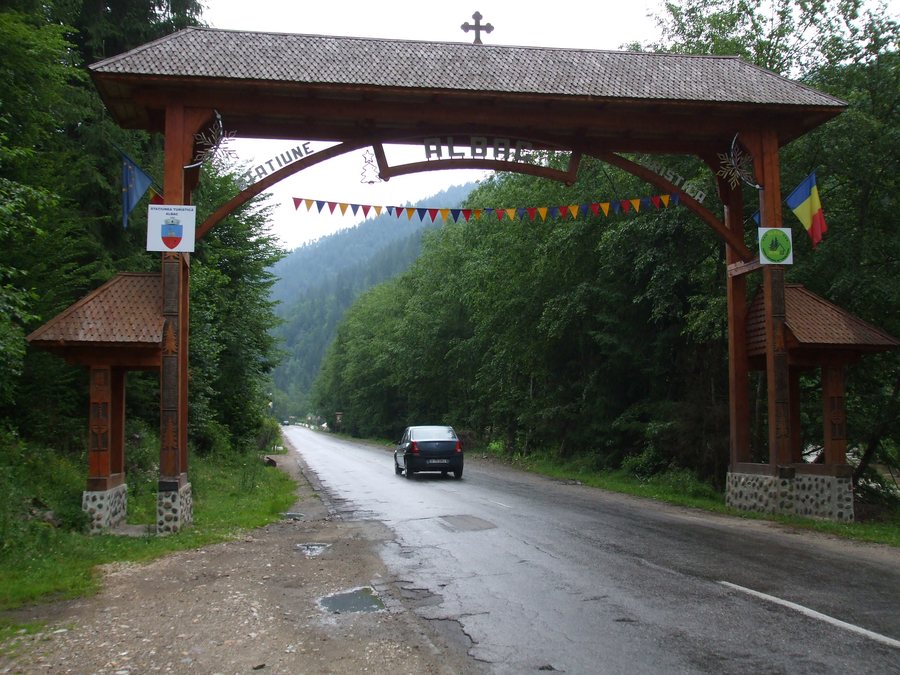 File:Albac,Alba-DSCF1749.JPG
Photo: TARE GHEORGHE at Romanian Wikipedia via Wikimedia Commons, Public domain
File:Albac,Alba-DSCF1749.JPG
Photo: TARE GHEORGHE at Romanian Wikipedia via Wikimedia Commons, Public domain
For travel planning purposes, Albac can be regarded as one of the gateways to Țara Moților. Albac offers opportunities for hiking; paths around the town lead to gorges, caves and alpine plateaus. The landscape includes wide-open scenery, forests, cold waters and traditional farmsteads.
This designation as a gateway describes not only the regional location, but also points to the connection between the town and the landscapes of Țara Moților. The paths mentioned lead to different types of destinations: rock formations, underground spaces and alpine elevations. Forests, cold waters and traditional farmsteads are also part of this landscape and complement the open areas with more distinctly shaped natural and rural elements.
Other places within the same overarching region are Mătișești, Pleșcuța, Pianu De Jos, Gârbova, Straja, Șugag, Laz and Răchita.
Nature and Trails
Cheile Albacului is a limestone gorge with steep walls and rock towers where firs and beech trees grow. The PA trail connects the Cheile Albacului area with Peştera Huda de Lapte, descends steeply to its entrance and offers views of the Arieș Valley along the way. At Peştera Huda de Lapte, there is a bench from which the panorama can be viewed.
The trail described therefore connects the gorge area, the cave entrance and the view into the Arieș Valley in one continuous route. The steep descent is explicitly part of the access to Peştera Huda de Lapte. The bench at the cave is also a specific point from which the panorama can be viewed. In addition, the trails around Albac lead not only to a single type of landscape, but also to gorges and alpine plateaus.
Culture and Crafts
Albac has an ethnographic museum collection. For almost two decades, the Târgul de Turism Rural de la Albac has been held annually in Albac. Knowledge of how to make stone slabs has been passed down in Albac from generation to generation, from father to son. In Albac, you can travel on foot or by bicycle through the villages on the ridgelines.
The museum collection establishes a connection with the ethnographic aspect of the town, while the annual Târgul de Turism Rural de la Albac has accompanied this regional focus for almost two decades. Local crafts include the production of stone slabs. The knowledge passed down for this purpose is handed down from father to son. The villages on the ridgelines can be explored on foot or by bicycle, bringing culture, crafts and the rural landscape together in the forms described.
Regional Cuisine
Plăcintele pe lespede are baked on heated stone slabs and served warm with milk or wild berry syrup. In the Albac–Arieșeni area, blueberry jam has long been produced both for personal consumption and for sale at local fairs. Cămara Moțului’s blueberry jam is made using blueberries gathered by individual wild-fruit gatherers in the villages of the communes of Arieșeni, Gârda, Scărișoara, Albac and Horea.
For Plăcintele pe lespede, the heated stone slab is an integral part of the preparation; they are served warm with milk or wild berry syrup. The blueberry jam connects the Albac–Arieșeni area with two uses: it has long been produced for personal consumption and for sale at local fairs. At Cămara Moțului, the blueberries used for it come from individual wild-fruit gatherers in the villages of the communes of Arieșeni, Gârda, Scărișoara, Albac and Horea.
For the overarching travel overview: Alba.
Check prices, availability and amenities for your travel dates directly on Booking.com.
View accommodations and offersAdvertisement · Affiliate link to Booking.com
