
Nawodna on the Rurzyca: Village History and Landscape
Accommodation in Nawodna
Nawodna combines a distinctive river landscape with a layered village history. Along the Rurzyca River, slopes cut through with dry valleys meet a historic village layout whose centrepiece is the Church of the Holy Cross. When planning your trip, you can therefore consider whether you are most interested in the landscape, historic architectural styles, or both sides of the village.
Rurzyca Slopes and Dry Grasslands
Nawodna encompasses a section of the slope above the Rurzyca. Numerous dry valleys cut across the slope, giving the landscape a varied form. Xerothermic dry grasslands grow on the warm, south-facing slopes of the ravines. This distinctive vegetation differs from an area with uniform plant cover: it is adapted to dry, warm locations. For anyone interested in nature and varied landscapes, this offers a specific reason to look closely at the slopes and their valleys.
The landscape can be considered as a focus in its own right, alongside the village’s history. You do not have to understand Nawodna solely through individual historic buildings: the course of the Rurzyca slope and the dry valleys also shape the features that make the place distinctive. For a trip with children, this could be a way to include nature observation and an interest in village history in your holiday days, without having to combine them into a fixed programme.
Church and Historic Village Layout
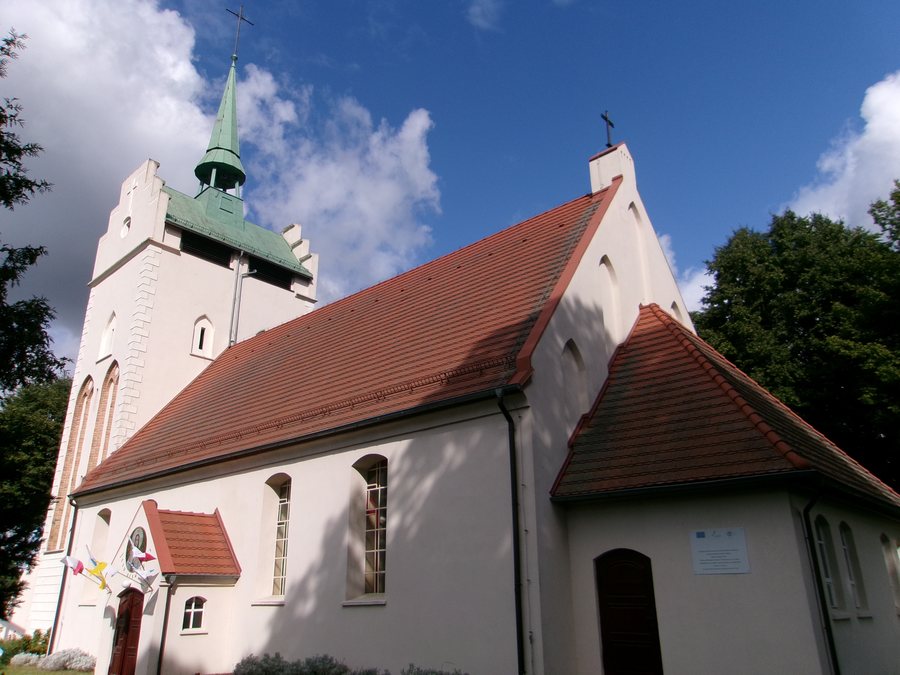
The parish Church of the Holy Cross is a Gothic building from the late Middle Ages. Its tower dates from the turn of the 15th and 16th centuries. After a fire in 1964, the church was rebuilt in 1966. These dates describe different chapters in the church’s history: its late medieval construction, the period when the tower was built, and the rebuilding after the fire. The church thus offers a tangible connection to several historical periods, which cannot be reduced to a single building phase.
The churchyard also preserves old architectural elements: its oldest surviving features include a gate and a stone enclosure dating from the 14th or 15th century. The gate and enclosure add the history of the churchyard itself to the story of the church. If you are interested in architectural history, you can consider these features alongside the Gothic church building and the tower, which dates from a later period, as distinct aspects of the historic ensemble.
Beyond its individual buildings, the layout of the historic village is remarkable. Nawodna is laid out as an oval village, with the church at the centre of a central, spindle-shaped square. Both the shape of the village and the position of the church are therefore among its defining historic features. The village layout offers a different perspective on Nawodna than looking at a single building: it shows how the village form and church belong together in the historic plan.
Further Historical Details and Getting Around
Another historic site is the Old Lutheran chapel in Nawodna. It was built between 1816 and 1825 and serves as a funeral chapel. Its date and function clearly distinguish it from the late medieval parish church. Exploring the village’s architectural history can therefore introduce you to different religious buildings and their respective historical contexts.
Nawodna’s location on district road 1387Z between Chojna and Lisie Pole provides a specific reference point for getting there. During the 2016–2022 planning period, a PKS bus stop was also designated in Nawodna. This information refers to the stated period and describes the designation of the stop. When planning your trip, you can take the road location and the village’s historic and natural attractions into account.
When choosing a holiday apartment, you can base your decision on what interests you most about Nawodna: the river landscape with its dry valleys, the dry grasslands on the south-facing slopes, or the history of the church, churchyard, and village layout. The information offers different perspectives on the village, without prescribing a particular order or a shared sightseeing programme.
If you would like to explore other places in this selection, you can also find Kolbatz, Chojna, Nowe Czarnowo, Gryfino, Steklno, Cedynia, Moryń and Stare Czarnowo.
For the broader travel overview: Greifenhagen.

