
Kuty: Lakes, Church Art and History
Accommodation in Kuty
Kuty lies on Lake Czarna Kuta, on the boundary between the East Masurian Lake District and the Great Masurian Lakes region. This means you can discover the village from two perspectives: its direct connection to the lake, and its history of churches and storytelling. When choosing a holiday apartment, this combination is a useful starting point if you want to balance landscape and local history during your holiday.
Lakes and landscape
The smaller lakes near Kuty include Głęboka Kuta, Wilkus, Brząs, Biała Kuta, Mszar (Kacze), Krzywa Kuta, Piłackie, Smolak, Piecek, Pozezdrze and Rominty. Czarna Kuta is the lake on which the village is situated; the other lakes provide a broader landscape context. Kuty is also within the Kraina Wielkich Jezior Landscape Protection Area and a Natura 2000 area. If you are looking for a holiday destination connected to a lake and set within a regional landscape, these are concrete points to consider when making your decision.
Legends and stories
At the legend points in Kuty, you can learn about, among other things, the legend of Mateusz and Celestyn Myślęta, the story of a sunken bell, and tales about the Queen and the Prince of Kut. These themes offer a different perspective from the geographical orientation provided by the lakes: here, local traditions and characters take centre stage. As you plan your holiday, you can decide whether to explore stories and local folklore as well as the landscape.
Church history and art
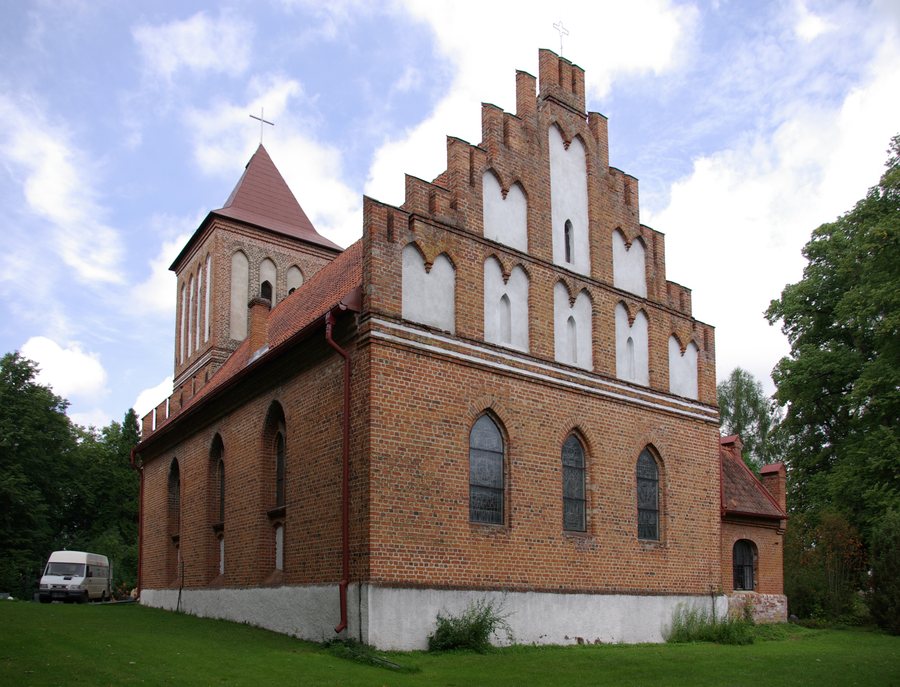
The church in Kuty was first mentioned in 1567 and was Lutheran at the time. It was destroyed in the second half of the 17th century and rebuilt in 1887. The Church of St. Maximilian Kolbe was burned down in 1945 and rebuilt in 1973–1974. These dates offer insight into different periods in the village’s church history.
Artworks and places of remembrance
The Church of St. Maximilian Kolbe houses a Baroque sculpture of the Madonna and Child. The church in Kuty also contains a 15th-century Gothic crucifix. It also has lamps decorated with the horns of hunted animals, donated by local hunters. A former Protestant cemetery is also located in Kuty. For those interested in cultural history, the sights range from artworks and a local donation to a historic place of remembrance.
Historic routes and planning a trip today
Before the First World War, Mieczysław Orłowicz described a walk from the church in Kuty to Lake Wilkus and on to a mill in a picturesque setting. The route went through Przerwanki and past Lake Gołdopiwo, through the forest to Jakunówko, and back to Kuty along the main road. The description of the walk also mentioned a beautiful view of Lake Krzywa Kuta, surrounded by forests. This historical context makes the walk a glimpse into the surrounding area as it was in the past.
A different option is the 102-kilometre “Szlakiem mazurskich legend i opowieści” cycling route, which passes through Kuty. If you would like to include it in your current trip plans, please check the latest route details in advance. This allows you to view the historic walk and the cycling route as two different kinds of guide: one a travel account from before the First World War, the other a named cycling route with a stated total length.
Whether Kuty is the right holiday destination for you depends on which of these aspects interests you most: the lakes and landscape, church history and art, or the stories and routes. You can look for a holiday apartment in Kuty based on the focus you want for your stay, without limiting your choice of destination to just one theme.
Discover more destinations
Discover more destinations: Przystan, Jakunówko, Ogonki, Łabapa, Trygort, Pawłowo, Budry, Wesołowo.
For the broader travel overview: Węgorzewski.

