
Księży Las – Wooden Church and Village History
Accommodation in Księży Las
Księży Las can be explored through two specific themes: the history of the old village and the wooden Church of St. Michael the Archangel. The village’s history dates back to 1302; the church dates from 1494. There is also a connection between the Pętla Zbrosławicka and the Północ-Południe cycle route. Cultural history and route planning therefore stand side by side as distinct topics. If you are interested in historic religious buildings, the church offers a clearly defined focus; if you are planning to cycle, you can consider the route connection separately.
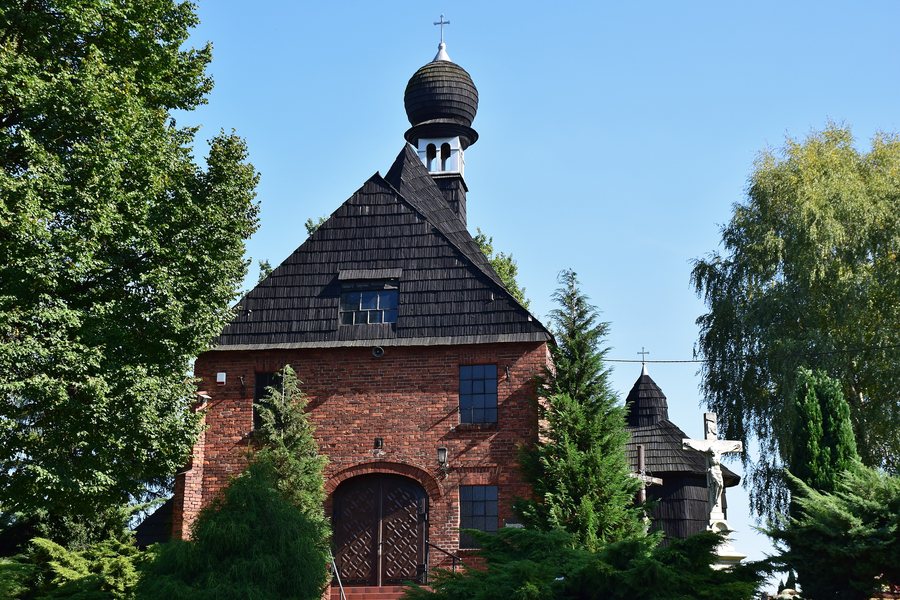
Wooden Church: Construction and History
The wooden Church of St. Michael the Archangel dates from 1494 and is oriented eastward and built using the log construction method. “Oriented eastward” describes the building’s alignment; “log construction” describes a structure made of layers of timber stacked on top of one another. These are two distinct features: the building’s orientation and its method of construction. For anyone interested in architecture, this offers a concrete way to explore the historic religious building’s design and materials.
During the Reformation, the church was taken over by Protestants and used from 1570 to 1629. The year it was built and the period it was used refer to different stages: 1494 marks its construction, while 1570 to 1629 marks its use by Protestants. This distinction in time adds a specific historical perspective to the architecture. It shifts the focus not only to how the building was constructed, but also to how it was used for religious purposes in a later period. The church’s construction and use thus provide two distinct points of reference for local history, brought together in the same building.
The furnishings also have a distinctive character: they are predominantly Baroque, and the high altar depicts the church’s patron, the Archangel Michael. The patron is therefore present not only in the name of the church; the altarpiece also reflects this theme. The predominantly Baroque furnishings provide the broader context, while the high altar offers a specific focal point. For culturally minded travelers, this provides another perspective on the church alongside its construction and history of use: the interplay between the furnishings and the patron.
Cycling Plans as a Separate Focus
A route description from 2024 mentions a connection in Księży Las between the Pętla Zbrosławicka and the Północ-Południe cycle route. This is a separate point of reference for your route planning. Check current route conditions before setting off. This lets you take the connection into account when preparing and weigh it as a separate focus alongside the church and village history.
Choose a Holiday Apartment That Suits Your Travel Interests
These interests can serve as a practical guide when choosing a holiday apartment. Consider whether you are interested in Księży Las primarily for its village history and church architecture, or whether cycling plans are also important for your stay. If you are traveling with family or friends, these topics do not have to shape the same day’s itinerary; you can weigh cultural interests and cycling plans separately. This helps you match the activities to your expectations and focus your accommodation search on what brings you to Księży Las.
Discover More Destinations
Discover more destinations: Ziętek, Nowa Wieś Tworoska, Radzionków, Pyrzowice, Nowe Chechło, Miasteczko Śląskie, Tarnowskie Góry, Wieszowa.
For the broader travel overview: Tarnowskie Góry.

