
Jankowice Rybnickie: Studzienka, Wooden Church and Trails
Accommodation in Jankowice Rybnickie
Jankowice Rybnickie brings together the traditions of Studzienka, distinctive sacred architecture and a network of trails. In the Studzienka forest area, there is a Marian chapel and two smaller grottoes; routes pass the chapel, lead to a wooden church or take you cycling through the village. This gives you the option to focus on different things: history and religious culture, a pilgrimage route or a cycling connection.
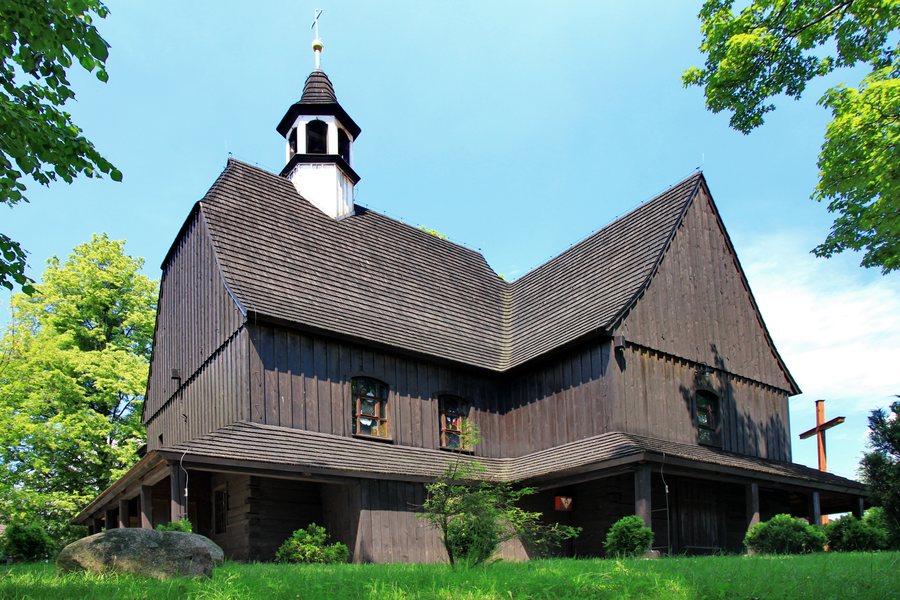 File:Kościół Bożego Ciała w Jankowicach Rybnickich 5.JPG
Photo: Hons084 via Wikimedia Commons, CC BY-SA 3.0 PL
File:Kościół Bożego Ciała w Jankowicach Rybnickich 5.JPG
Photo: Hons084 via Wikimedia Commons, CC BY-SA 3.0 PL
Studzienka between legend and building history
The spring at Studzienka is associated with the tradition surrounding Father Walenty. According to legend, it sprang up exactly where the clergyman was murdered by the Hussites around 1430 and later buried. The spring water was also believed to have miraculous properties in the area; local belief held that it could cure illnesses. Studzienka is therefore associated both with a legend about the spring’s origins and with a local belief in its healing power.
In gratitude for regaining his health, Father Edward Bolik had a chapel dedicated to the Virgin Mary built at Studzienka in the late 19th century. It was modelled on the chapel above the grotto in Lourdes, France, and was solemnly consecrated on 15 August 1895. Inside are sculptures of Our Lady of Lourdes and Bernadette Soubirous kneeling before her. Studzienka also has two smaller grottoes: one is dedicated to Saint Barbara, the patron saint of miners; the other is called the Grotto of the Unemployed. Each grotto’s distinct dedication gives it its own association.
Routes to the chapel, pilgrimage sites and cycling trail
The Jankowice Trail passes the chapel in the Studzienka forest area and ends at the wooden Church of Boże Ciało in Jankowice. This route connects the chapel with another notable cultural site. The church was built in 1675 and is one of the few churches in Silesia with a Greek-cross floor plan. In a Greek cross, all four arms are the same length—a clearly defined layout that differs from other architectural forms.
Pilgrimage Route No. 323 starts at the Church of Boże Ciało in Jankowice and runs from Świerklany to Pszów, passing religious places of worship and sacred cultural monuments. The entire route is 17.4 kilometres long; changes to the route may also affect its length. This makes the pilgrimage route a distinct planning option, separate from the cycling connections described in the area.
The marked blue cycling route No. 292 connects Boguszowice and Jankowice. It crosses Jankowice from northwest to east and joins the Rybnik cycling route, which loops around Boguszowice. There are relatively few trail markers on the Jankowice section; the final stretch near Jankowice runs partly on gravel and, in places, on muddy, unpaved ground. As markings and surface conditions may change, check this information again before setting out.
A natural attraction on Akacjowa Street
Another named feature of the area is the Michał Oak. It stands on Akacjowa, on the right-hand side of the road, and is described as a monumental tree. Alongside the religious sites and routes described here, this individual tree offers another aspect to consider when planning your trip.
When choosing a holiday apartment, you can first consider whether Studzienka and its traditions, the wooden church and pilgrimage route, or cycling will shape your stay. These options offer practical guidance for planning your trip without requiring you to treat the various routes as one single itinerary.
Discover more destinations
Discover more destinations: Zwonowice, Czernica, Piece, Gaszowice, Jejkowice, Bełk, Sumina, Czerwionka-Leszczyny.
For the broader travel overview: Rybnik.

