
Rogów Opolski – Castle, Oder and Parish Church
Accommodation in Rogów Opolski
Rogów Opolski Castle between the slope and the Oder
Rogów Opolski Castle was built on a slope beside the Oder, at one of its bends. From the north, a stone bridge resting on arcades leads to the castle. The park has paths and terraces, some of which were laid out on the site of the former moat. Oak trees grow there that are believed to be more than 250 years old. The slope, river bend, bridge and park describe different aspects of the place: its location by the water, the northern approach to the castle and the design of the grounds. If you are interested in destinations where architecture and landscape can be considered together, Rogów Opolski offers a clear focus for this.
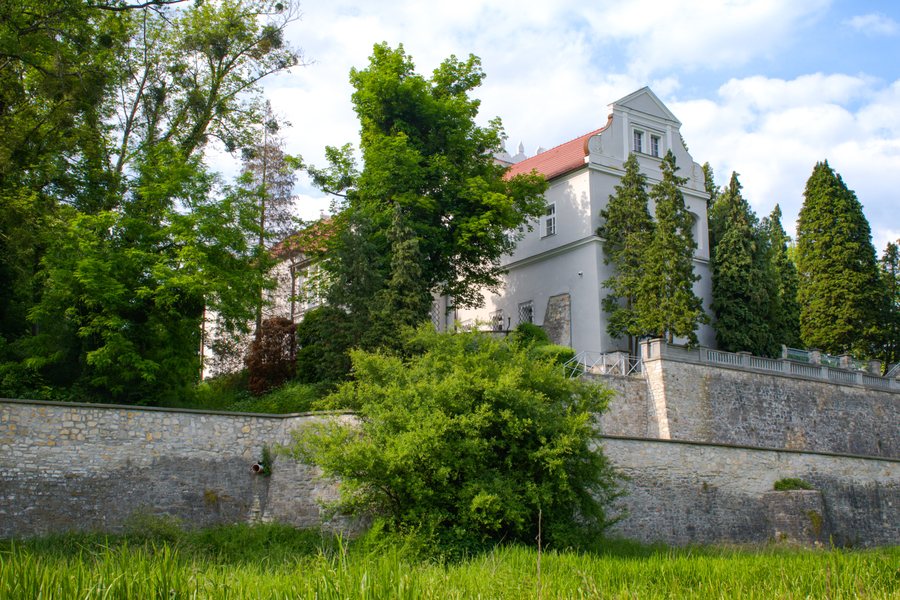 File:Zamek w Rogowie Opolskim.jpg
Photo: Christinagrabelusshaikh via Wikimedia Commons, CC BY-SA 4.0
File:Zamek w Rogowie Opolskim.jpg
Photo: Christinagrabelusshaikh via Wikimedia Commons, CC BY-SA 4.0
Building history in several stages
The oldest part of the castle is the east wing, dating from the 14th and 15th centuries. Around 1600, the south wing, a staircase in the southeast corner of the east wing and the cloisters were added. The north wing was built in the final construction phase, towards the end of the 18th century. The sequence of dates thus extends from the medieval building fabric, through the additions around 1600, to a late 18th-century construction phase. Rather than a single period of origin, the castle’s history comprises several clearly distinct stages.
Parish church and historic collections
The parish church also brings together traces from different periods: its oldest part dates from around 1300, while the tower is from the late 16th century. The church also contains a Romanesque stone baptismal font from the mid-12th century. Its inscription reads “Vas devodti baptismi”. This means that one of the listed furnishings predates the church’s oldest structural elements.
Rogów Opolski Castle houses a branch of the Wojewódzka Biblioteka Publiczna im. Emanuela Smołki w Opolu. It holds special collections, including a collection of old prints dating back to 1488. Culture enthusiasts can therefore explore several historical subjects side by side: castle architecture, church architecture, a Romanesque baptismal font and a collection of prints whose history reaches back to the 15th century.
Krapkowice as a wider destination
The wider destination of Krapkowice offers additional, distinct urban and historical themes. Krapkowicka Baszta, the tower of the Upper Gate, was built in the second half of the 14th century and remodelled around 1580. The tower houses a tourist information office, exhibition rooms on several floors and a viewing terrace with a telescope. Krapkowicki Rynek has a typically medieval layout: a fountain stands in the centre, old townhouses line the rectangular square, and narrow streets lead to it.
Krapkowice Castle is also part of the town’s distinctive character. It lies within Krapkowice’s administrative boundaries, near the old town, and is a massive, square-shaped late Renaissance building. The castle is believed to have already existed in the 13th century, before Krapkowice was granted town rights by Duke Władysław of Opole in 1275. The castle ruins in Otmęt preserve the remains of living quarters, the ruin of the southeastern tower, the perimeter wall and a semicircular bastion at the southwestern corner; the oldest surviving masonry dates from the 16th century.
If you would like to explore a route or activities on the water as well as architecture, Krapkowice offers further options. The Obuwniczy Szlak shares stories and legends from Krapkowice’s past centuries, featuring mysterious bronze shoes called Laciek, Mieszczuch, Kopytko, Pepoż, Rogatek, Rolszpila, Tempel and Wyczynówka, as well as QR codes. The route is approximately 6 km long. At Port Jachtowy Krapkowice, where the Osobłoga meets the Oder, you can rent kayaks, pedal boats and boats; trips on the Oder are also offered, with views of Krapkowice’s medieval castle.
When choosing your holiday apartment, you can start by considering which kind of trip appeals to you: Rogów Opolski stands out for the castle’s architectural history, its location on the Oder and the parish church. Krapkowice, as a wider destination, adds its own urban history, a themed route and activities on the water.
Discover more destinations: Kamień Śląski, Mallnie, Krapkowice, Moschen, Zabierzów, Zellin, Gogolin, Oleszka.
Go to the wider travel overview: Krapkowice.

