
Sławnikowice: Pilgrimage Route and Local History
Accommodation in Sławnikowice
Church history, palace architecture and a pilgrimage route through the village offer several possible focuses for a trip to Sławnikowice. Historical traces include the church, its cemetery, a mausoleum and a penance cross; the palace and its surroundings add architectural and landscape history to these themes. If you are looking for a holiday apartment in Sławnikowice, you can consider whether you would like your trip to focus on the Camino de Santiago or the local cultural heritage.
Pilgrimage Route and Landscaped Grounds
The Dolnośląska Droga św. Jakuba pilgrimage route passes through Sławnikowice and continues to Santiago de Compostela. For travellers following the Camino de Santiago, this route is a specific point of reference: it connects the village with a route that leads all the way to Santiago. As the route status may change, check the route before setting out.
The grounds around the palace also tell of an earlier use. In the second half of the 19th century, the area, criss-crossed by drainage ditches, was landscaped for recreation. This adds the development of the palace’s surroundings to the history of the building. This refers to the grounds’ design at the time; together with the architectural details of the palace, it offers a distinct perspective on local history.
Church, Cemetery and Mausoleum
The Church of the Most Sacred Heart of Jesus (Najświętszego Serca Pana Jezusa) was first mentioned in a document in 1346. Extensive structural alterations took place in 1776 and 1838; the interior furnishings were also modernised. The dates mark different chapters: 1346 is the first documentary mention, while the two later dates refer to major alterations to the building.
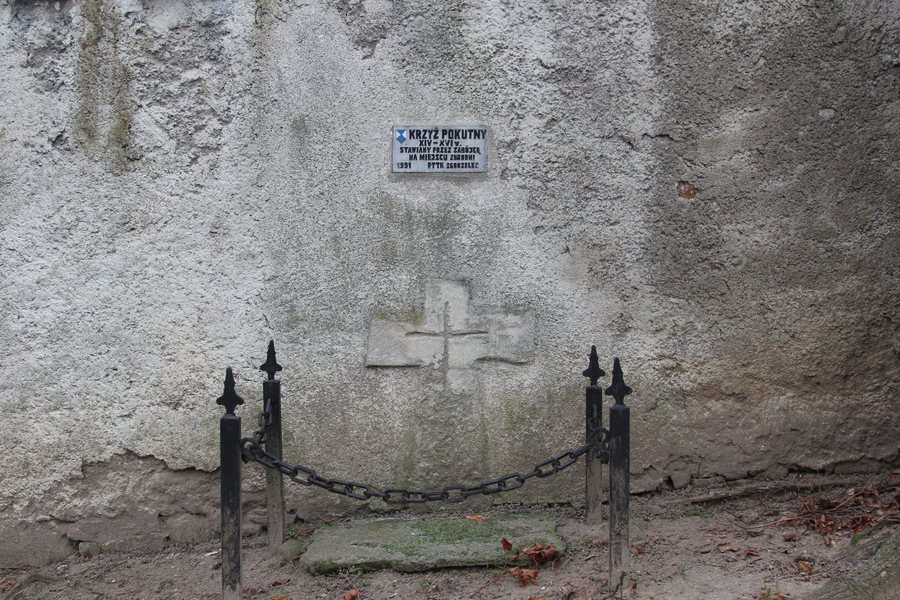
The cemetery by the church dates from the turn of the 18th and 19th centuries. It was Protestant and is now Roman Catholic. A mausoleum with groin vaults dating from 1733 stands north of the church. It served as the burial place of the church’s patrons at the time, the von Fromberg family. A penance cross also stands next to the church. These landmarks have different associations: the cemetery and mausoleum relate to burial history, while the cross is another monument in the church’s surroundings.
Palace Architecture and a Local Biography
The two-storey palace has a rectangular floor plan and a columned portico on its front façade. A portico is a projecting structure supported by columns; the term describes a specific feature of the façade. The details of the floor plan and portico provide an architectural point of reference distinct from the church’s building history. Ehrenfried Walther von Tschirnhaus (1651–1708) is also part of local history: the scholar and philosopher was born in Sławnikowice. The village’s history thus encompasses both buildings and the biography of a person born there.
As you plan your trip, you can weigh these themes against each other: should the pilgrimage route to Santiago set the tone, or are you particularly interested in the local ecclesiastical and architectural landmarks? The historical dates provide specific chronological reference points; the route, in turn, offers a focus that extends beyond Sławnikowice. Looking for a holiday apartment in Sławnikowice can therefore go hand in hand with considering which of these themes you would like to shape your trip.
Discover more destinations: Bierna, Jędrzychowice, Zgorzelec, Dłużyna Dolna, Bogatynia, Pieńsk, Ruszów, Trójca.
For the wider travel overview: Zgorzelecki.

