
Legnickie Pole: History and Marked Routes
Accommodation in Legnickie Pole
Legnickie Pole combines a tangible connection to medieval history with two marked routes that place the area within longer trails. The Muzeum Bitwy Legnickiej commemorates a significant event in the history of Silesia and Poland. This gives you a choice of different focuses when planning your trip: historical context, a route with named places or a longer connection.
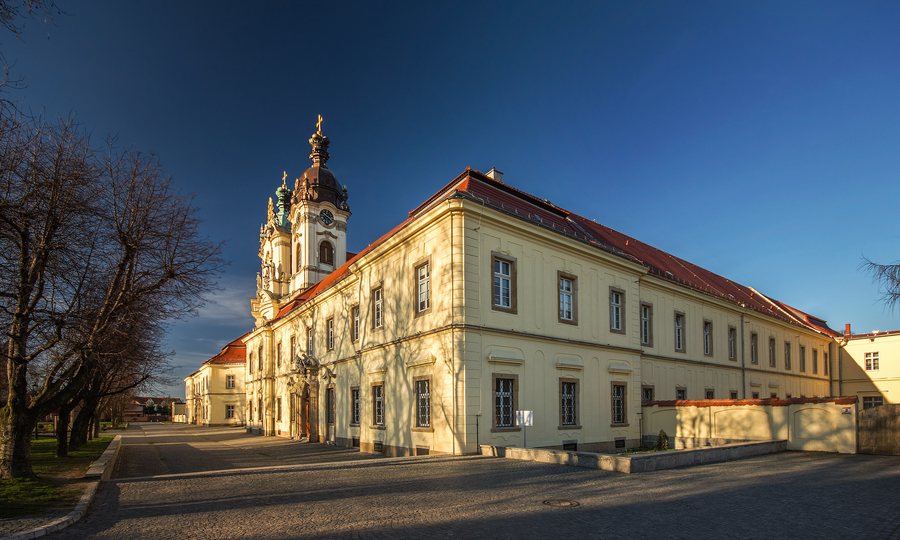 Legnickie Pole Benedictine monastery complex
Photo: Sławomir Milejski via Wikimedia Commons, CC BY 3.0
Legnickie Pole Benedictine monastery complex
Photo: Sławomir Milejski via Wikimedia Commons, CC BY 3.0
Museum and the History of the Battle
The Battle of 1241 took place near Legnica. It ended with the defeat of the ducal forces and the death of Henry II. The Muzeum Bitwy Legnickiej in Legnickie Pole commemorates this event. The museum’s development offers a second historical reference point: in 1972, the museum became a branch of the Muzeum Miedzi in Legnica. Thus, a medieval event and a later stage in the institution’s history sit alongside one another, while belonging to different periods.
If you are travelling with children, the two years can provide a simple timeline: 1241 marks the battle, and 1972 the museum’s move to branch status. The outcome of the battle can also be stated concisely: the defeat of the ducal forces and the death of Henry II. This gives the historical topic clear points of reference, rather than treating it only as medieval history in general.
Comparing the Two Marked Routes
The green-marked Szlak Tatarów is 27.1 kilometres long and passes through Prochowice, Szczedrzykowice, Grzybiany, Legnickie Pole and Raczkowa. The yellow-marked Szlak Wygasłych Wulkanów covers 96.8 kilometres and connects Legnickie Pole with Złotoryja. The two descriptions therefore differ both in stated total length and in their place references: one names a sequence of five places, while the other gives two endpoints.
Route length is a clear point of comparison when making your choice: the Szlak Tatarów is the shorter of the two stated routes, while the Szlak Wygasłych Wulkanów is considerably longer. The markings also help distinguish the routes. The named places and endpoints offer different starting points for further planning, without implying a particular daily itinerary.
Guided Tours in the Basilica
Organised pilgrim and tourist groups can arrange a guided tour of the basilica in Polish or German in advance. Confirm availability before travelling. This offer is for the groups named above and requires prior arrangement.
Choosing the Right Focus for Your Stay
When looking for a holiday apartment, you can first consider which aspect of Legnickie Pole you want to shape your stay: the history surrounding the Muzeum Bitwy Legnickiej, a comparison of the two marked routes or—if your group is eligible—a guided tour of the basilica arranged in advance. These focuses raise different questions when planning a holiday. The stated route lengths help you compare their scope, while the named places and endpoints each offer a different point of reference. When choosing accommodation, consider the interests of your fellow travellers and compare options based on your planned trip.
Discover more destinations: Jerzmanowice, Krotoszyce, Rokitki, Pątnówek, Legnica, Chojnów, Warmątowice Sienkiewiczowskie, Kawice.
For the overview of the wider area: Legnicki.

_ID_593490.jpg)