
Discover Haynau’s Natural and Cultural Heritage
Accommodation in Haynau
Haynau can be explored through natural and cultural highlights that appeal to different interests: a hornbeam with seven branches, a water tower built in 1915, and a museum history that dates back to 1906. There is also an educational outdoor trail game with a walking time of 30 minutes. This selection offers a concrete starting point when looking for a holiday apartment: consider whether parks, architectural history or museum history will be the focus of your stay.
Parks combining nature and architectural history
In “Mały” Park, part of Park Śródmiejski in Chojnów, the hornbeam “Siedmiu Wspaniałych” grows with seven branches. It came second in the vote for Lower Silesia’s natural monument. This highlight brings together two distinct aspects: its unusual form, defined by the number of branches, and its result in a Lower Silesian competition. If you are interested in distinctive individual trees or regional votes, you can consider both aspects together in this example.
Another architectural highlight is the water tower in Park Piastowski in Chojnów. It was built in 1915 using the then-modern reinforced concrete construction method. The year of construction and the method can be considered together: the date provides the historical context, while the material offers an insight into the construction methods that were modern at the time. Unlike the hornbeam, the tower offers a different point of interest for anyone more interested in architectural history than in a distinctive tree form.
The museum’s history in several stages
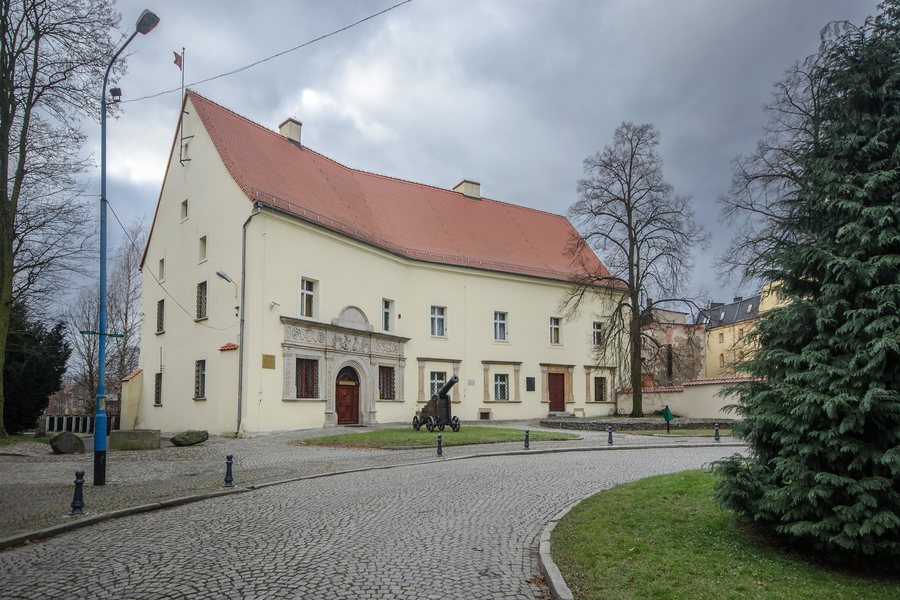
The history of museums in Chojnów dates back to 1906. The museum opened in 1908 in the renovated Baszta Tkaczy; in 1933, the collections were moved to the castle of the Piasts of Legnica and Brzeg. The later relocation of the collections is a chapter in its own right: the story did not end with the opening but continued at a new location. If you enjoy exploring cultural history through specific milestones, you can follow a timeline here from 1906 to 1908 and then 1933.
Visits and planning your time
The Muzeum Regionalne w Chojnowie invites visitors to take part in the educational outdoor trail game “Najazd Husytów na Chojnów.” The walking time is 30 minutes. This gives you a specific time slot to work into your day’s plans; note that the walking time is separate from the duration of the entire visit.
The museum building is not fully accessible. Wheelchair users can visit the exhibitions on the ground floor and the garden. This information provides practical guidance for planning a museum visit. Visits to Baszta Tkaczy in Chojnów are possible by prior arrangement. If you plan to visit, arrange it in advance and confirm the details before your trip.
Choose a holiday apartment to match your interests
When looking for a holiday apartment in Haynau, you can use your interests as a guide. If you are especially interested in the museum’s past, its milestones from 1906 to 1933 provide a historical thread; the outdoor trail game adds a distinct educational element. If you would rather explore individual park highlights, you can include the hornbeam and water tower in your travel plans as different topics in natural and architectural history. This way, your choice of accommodation begins with the question of which discoveries you would like to include in your stay.
Discover more destinations
Discover more destinations: Strachowice, Kawice, Legnickie Pole, Jerzmanowice, Liegnitz, Rokitki, Pątnówek, Krotoszyce.
Go to the main travel overview: Legnicki.

_ID_593385.jpg)