
Tauragė: Bunkers, Remembrance and Architecture
Accommodation in Tauragė
Tauragė appeals to travelers who want to combine cultural and historical discoveries with a closer look at the region. The DOT bunker is part of a defensive line whose construction began in 1940; a memorial commemorates the victims of the resistance, and a bank building displays neoclassical architectural features. At the same time, a regional electronic ticket connects municipalities in several districts and allows unlimited travel throughout the area. This brings urban history and regional mobility together in your travel plans, without reducing Tauragė to a single theme.
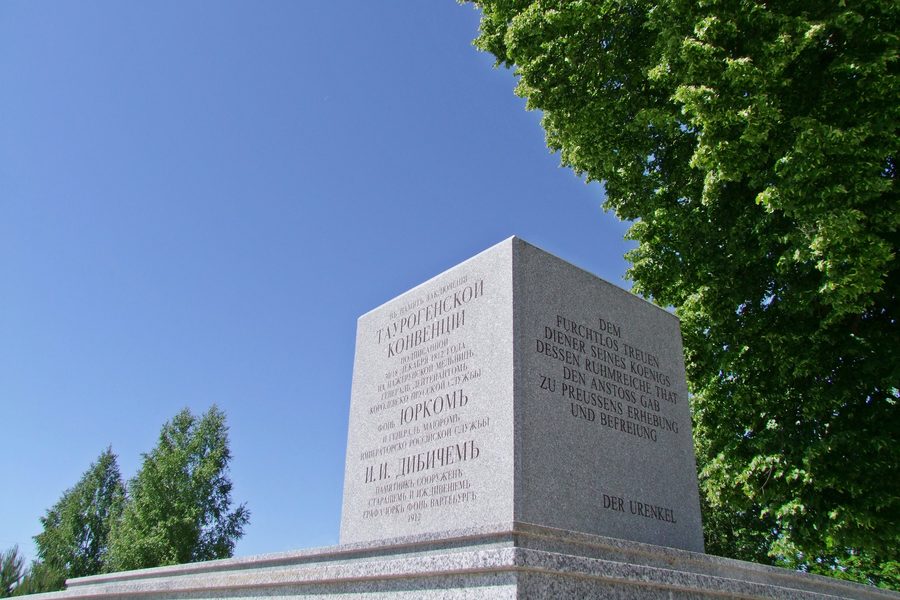 Gedenkstätte für die Konvention von Tauroggen (Tauragė).
Photo: Alta Falisa via Wikimedia Commons, CC BY-SA 4.0
Plan for regional mobility
The regional electronic ticket connects the municipalities of Tauragė, Jurbarkas and Šilalė districts, as well as Pagėgiai municipality. It allows unlimited travel throughout the region. This is particularly relevant for travelers who want to include Tauragė in broader regional plans. Before traveling, check the transport operator’s current information on coverage, as it may change. This lets you consider regional mobility early on, alongside your cultural and historical interests.
Defensive line and remembrance
The DOT bunker in Tauragė is part of a defensive line whose construction began in 1940. This places the individual structure in a broader historical context. If you are interested in historic sites, you can make the bunker a distinct focus of your trip. Its theme differs both from the remembrance at the former NKVD headquarters and from the architecture of the bank building: here, the focus is on the defensive line; there, on remembrance and architectural design.
Another somber chapter in the city’s history is connected with the former NKVD headquarters. Between 1944 and 1955, people were interrogated and tortured there. A memorial to the victims of the resistance was erected in the courtyard of the former headquarters in 1993. Together, these details connect a historical period with a later act of remembrance, giving the site significance as a place of commemoration. For travelers interested in the history of resistance and persecution, this is a distinct topic alongside the defensive structure and the bank building.
Architecture as another perspective
The bank building adds architectural history to these perspectives. A. Funk and M. Songaila designed the building in 1935; it displays neoclassical architectural features. The term describes a style based on classical models. This architectural perspective differs from the DOT bunker’s military-historical context and the remembrance at the former headquarters. If you are particularly interested in architectural design, this gives you another specific point of interest to consider when planning your trip.
Choose a holiday apartment to suit your trip
When looking for a holiday apartment in Tauragė, you can sort these themes according to your travel interests. If architecture and urban history are your main focus, make the cultural and historical sites the centerpiece of your stay; if regional mobility also interests you, include the ticket as an additional planning consideration. This way, your choice of accommodation starts with what you want to explore during your trip. Consider which visits and journeys are important to your plans.
Compare hotels and holiday rentals in Tauragė by price and availability for your travel dates.
Advertisement · We may receive a commission if you book.Discover more destinations
Discover more destinations: Smalininkai, Jurbarkas, Lumpėnai, Veliuona, Margiškiai, Pilis I, Pagėgiai.
Return to the higher-level travel overview: Tauragė District.

