
Holiday apartment in Domegge di Cadore: lake, trails and churches
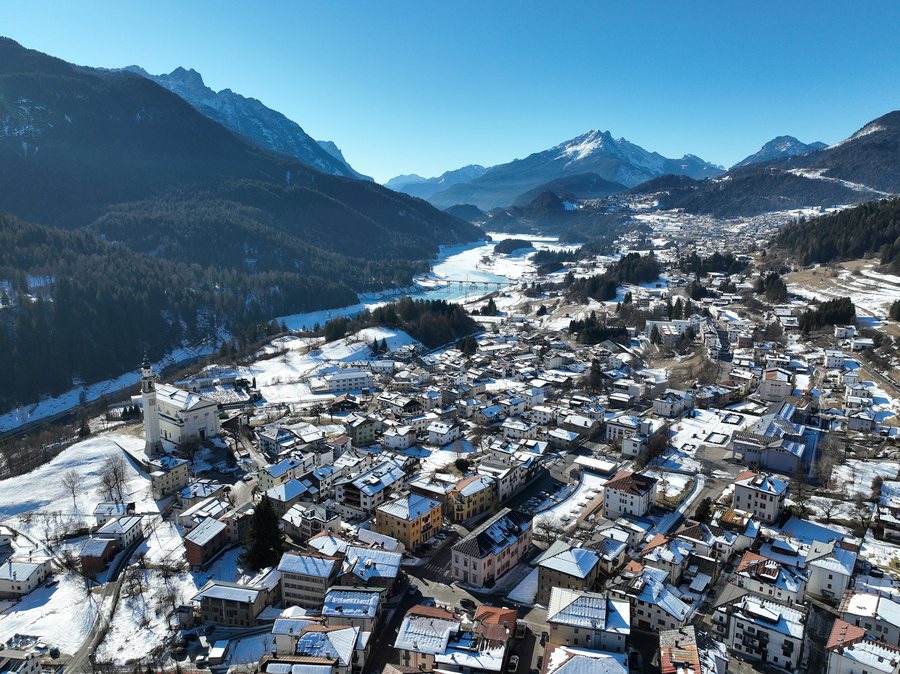
Domegge di Cadore lies on the right-hand side of the upper Piave Valley and on the shore of Lago Centro Cadore. The area is framed by the Spalti di Toro. This means that choosing a holiday apartment in Domegge di Cadore can be guided by specific days of your holiday: you can focus on lakeside trails, mountain destinations, churches, historic buildings or regional cuisine.
Between lakeside trails and mountain destinations
The Domegge di Cadore section of the CAI maintains 16 trails with a total length of 50 kilometres. The local hiking options include trails of varying difficulty levels, including Alta Via No. 6. Easier walking options in the surrounding area include a lakeside trail and the Pian dei Buoi plateau. At the Vallesella rock-climbing area along Route No. 1, there are climbing routes of varying difficulty levels as well as a short via ferrata.
There are fixed reference points for shorter and longer tours: Municipal Route No. 1 leads in 30 minutes from Piazza dei Martiri in Domegge via Vallesella to the bridge over the lake. Municipal Route No. 2 is an easy trail from Vallesella via Pignola to the Molinà chapel. Route No. 5 takes 1.5 hours as a nature-oriented circular route via Talagona and returns along the lake. Route 7 leads from the square in Domegge to Rifugio Cercenà in one hour and to Rifugio Padova in two hours. Starting points and time estimates make it easier to choose the right focus for your accommodation.
Churches, art and local history
The Eremo dei Romiti is a monastery built in the 18th century: it was constructed in 1720, and the adjoining church in 1724. The hermitage is a destination for short excursions and a starting point for trails to Col Cros, Montanel and towards the Spalti di Toro. Every year on 24 June, the feast day of Saint John the Baptist, Mass is celebrated in the small chapel at the hermitage. The parish church of San Giorgio was built between 1861 and 1865 and consecrated on 20 April 1933; the dome and chancel were frescoed by Bargellini in 1930. It contains the painting „Madonna and Child Enthroned between Saint Apollonia and Saint Lucy“, attributed to Marco Vecellio.
San Rocco houses the painting „Madonna Enthroned with Child between Saints Roch and Sebastian“, attributed to Francesco Vecellio. The church of Madonna della Neve (S. Antonio) in Val di Croce was built in 1508 along the former road to Lozzo and consecrated in 1659. The Chiesa della Madonna delle Grazie – Valesella was built between 1510 and 1515 by Nicolò Ruopèl as a votive church following the Battle of Vallesella in 1509 against the troops of Maximilian I of Habsburg. Attached to it is a cell formerly inhabited by a hermit, considered the only surviving example in Cadore. Casa Valmassoi was originally built in 1360 and repurposed and altered several times over the centuries.
A regional specialty
There is also a specific local connection in culinary terms: La Cartufola's main product is an oil-preserved vegetable conserve made from thin slices of Jerusalem artichoke, traditionally prepared by hand according to an old local recipe. The specialties are still on the menu at Antica Hostaria Serenissima and can be tasted there. Visitors can purchase and collect La Cartufola products there.
Discover more places here: Lamon, Garna, Paderno, Cencenighe Agordino, Canai, Danta, Pascoli, Falcade.
To the higher-level travel overview: Belluno.
Check prices, availability and amenities for your travel dates directly on Booking.com.
View accommodation and offersAdvertisement · Affiliate link to Booking.com
