
Holiday apartment in Gubbio – culture between the stone-built city and Monte Ingino
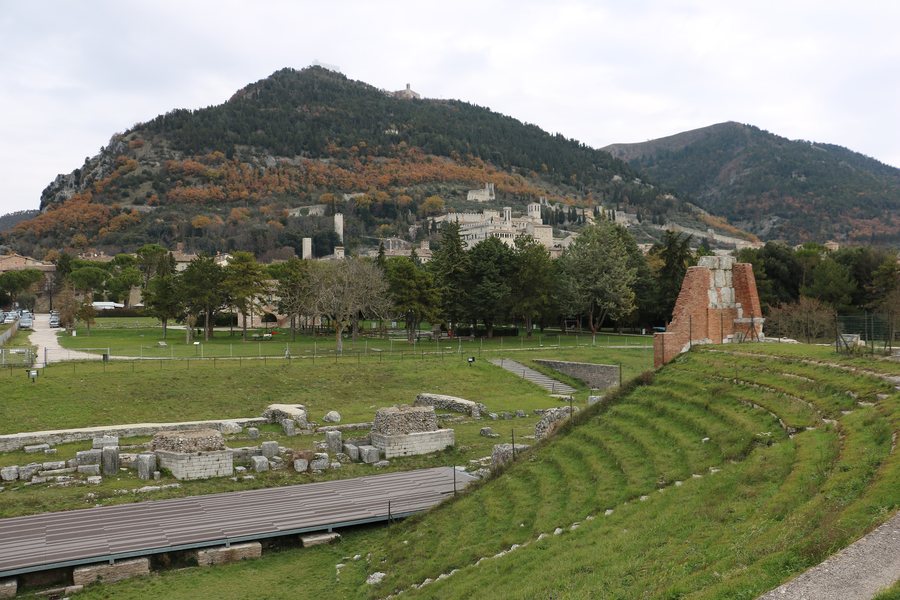
Gubbio between stone lanes and mountain landscapes
Gubbio is known as the “city of stone” and has a medieval maze of lanes and narrow streets. As you explore, narrow paths, historic buildings and views of the landscape around the city alternate. When choosing your holiday apartment in Gubbio, it is therefore helpful to consider whether your holiday days should focus mainly on culture, religious history, art or walks. The city combines these interests within a compact thematic area, without requiring you to limit yourself to just one way of experiencing it.
Ancient evidence between theatre and mosaic
The Tavole Iguvine consist of seven bronze tablets bearing an important text in the Umbrian language and a detailed description of religious rites. Construction of the Roman theatre of Gubbio began in the 1st century BC and was completed between 55 and 20 BC. In the largest room of the Antiquarium, you can see a mosaic with a geometric border and a scene of Odysseus and Scylla from Homer's Odyssey. The historical perspective thus extends from religious texts through Roman architecture to a subject from ancient literature.
Art and ecclesiastical history
The Museo Diocesano di Gubbio is located in the historic centre in the Palazzo del Capitolo dei Canonici. It displays stone materials from the Roman, Byzantine and early medieval periods, paintings from the 14th and 15th centuries, ecclesiastical furnishings and liturgical vestments. The upper floors of the Palazzo Ducale di Gubbio also contain a section featuring the winning works of the Biennale d’Arte Contemporanea di Gubbio. When planning your accommodation, you can therefore combine different areas of interest: older artefacts, sacred art and contemporary works.
Monte Ingino and the Festa dei Ceri
The “Colle Eletto” funicular connects Gubbio with Monte Ingino and runs up to the Basilica di Sant’Ubaldo. Monte Ingino is rich in extensive pine forests. The Basilica di Sant’Ubaldo houses the bronze urn containing the ashes of Gubbio’s patron saint. During the Festa dei Ceri, the Ceri are carried in a procession through the streets of Gubbio to the Basilica di Sant’Ubaldo on Monte Ingino. This combination of mountain, religious site and living tradition gives your trip a particularly distinctive cultural character.
Discover the Gola del Bottaccione on foot
The Gola del Bottaccione lies north of Gubbio between the Ingino and Foce mountains and was formed by the erosion caused by the Camignano stream over the course of the last three million years. From Gubbio, the gorge can be reached on foot via the Porta Metronio. The medieval aqueduct at the Gola del Bottaccione can also be explored on foot. If you are choosing a holiday apartment or holiday home for varied days, this site offers a clear focus on landscape and walking alongside the museums and historic buildings.
Archaeology and individual holiday days
The Guastuglia archaeological site has information points and explanatory panels that make the facilities accessible for public use. Together with Gubbio’s ancient, ecclesiastical and artistic themes, this creates a versatile basis for planning your days. You can focus on exhibitions and architectural history, include the paths to the Gola del Bottaccione, or make Monte Ingino and the Basilica di Sant’Ubaldo the centre of your visit. The right accommodation choice depends on the rhythm you want, rather than on a single type of attraction.
More local pages: Casacce, Corlo I, Savelli, Vitellino, Civitella d'Arna, Cecanibbi, Rosceto, Torraccia
To the higher-level travel overview: Perugia.
Check prices, availability and amenities for your travel dates directly on Booking.com.
View accommodation and offersAdvertisement · Affiliate link to Booking.com
