
Holiday apartment in Grutti: Discover history, Cicotto and woodland paths
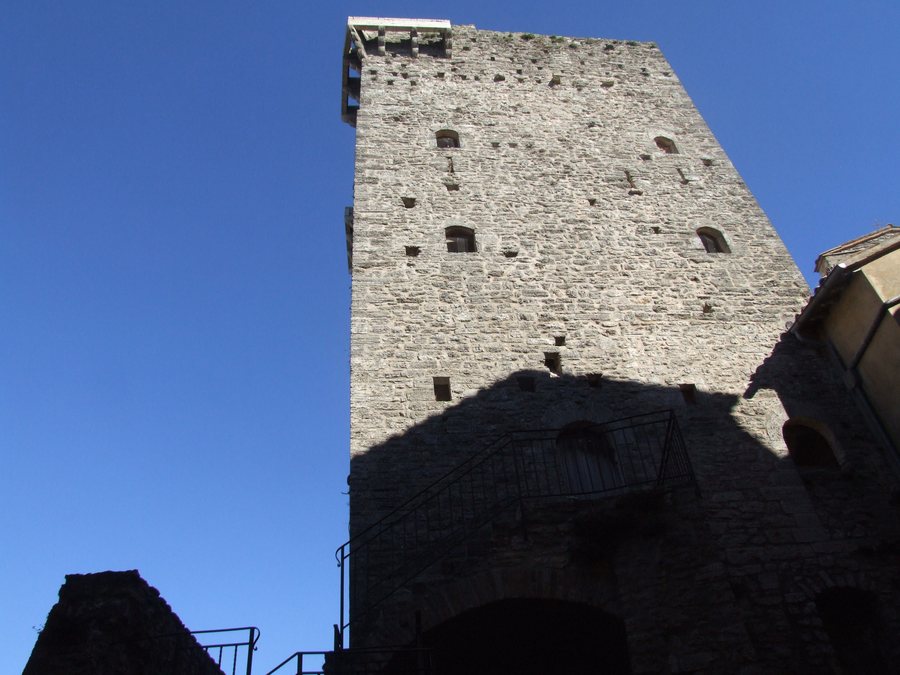
Grutti combines a local history that has developed over centuries with culinary traditions and various ways to explore the surrounding area. Grutti was established in the 11th century under the name Grottombra. Anyone looking for a holiday apartment in Grutti will discover a place where historical traces and regional everyday culture are closely intertwined.
Medieval traces in and around Grutti
A notable example is the Torre palombara in Grutti. The square dovecote complex originally served as a defensive tower and dates back to the 12th century. The Castello di Grutti also tells of the medieval past: several towers and broad sections of wall still remain of its structure. In 1126, the Castello di Grutti was enclosed by massive walls by Ghibelline lords.
In the immediate vicinity of Grutti, Santa Maria d’Agello stands on a hill as a Romanesque church. The church is built of hewn travertine stones and has a rafter roof. The Festa di Grutti is dedicated to Santa Maria d’Agello, the patron saint of Grutti. As a traditional event, it is free to attend.
Cicotto and Umbrian cuisine
The tradition of Cicotto has been passed down through generations in Grutti. In the historic centre, you can also still see the former communal wood-fired oven, where Cicotto and porchetta were roasted until 1970. For planning a culinary stay, Grutti therefore offers specific points of interest: Ristorante Le Noci serves traditional Umbrian cuisine, while Taverna del Giogo is the focal point of the Festa di Grutti and a meeting place for sampling Umbrian specialities in a convivial atmosphere.
Paths, driving tours and shared experiences
For active days, there are two differently designed options. The Tour dei Castelli Gualdesi intorno ai Monti di Grutti covers an 18.2 km route by car. In addition, the Per Grutti association has reopened paths in the woods around Grutti. When choosing a holiday apartment in Grutti, you can therefore consider whether historical discoveries, a drive through the surrounding area, woodland paths or culinary encounters should be the focus of your trip.
Getting there and choosing accommodation
From the north, take the E45 southbound to the Orvieto-Todi exit. Then, at Ponte Rio, continue towards Grutti-San Terenziano. If travelling by train, Foligno station is the arrival station for Grutti. These two details can help you consider your planned journey, alongside your interests in history, cuisine and walking routes, as a separate factor when looking for accommodation.
Other places to include in your travel plans are Terraia, Collesanto Di Magione, Sellano, San Giovanni Di Baiano, Bevagna, Corciano, Castel Rigone and Castel Del Piano.
For the overarching travel overview: Perugia.
Check prices, availability and amenities for your travel dates directly on Booking.com.
View accommodation and offersAdvertisement · Affiliate link to Booking.com
