
Holiday apartment in Ragoli: churches, Irone and walking trails
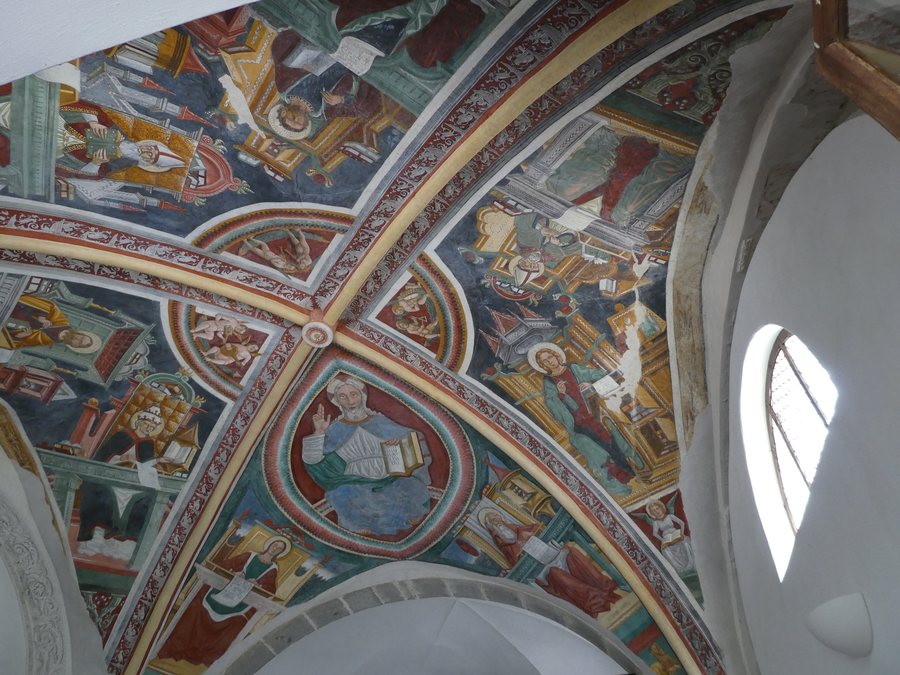 File:Ragoli, chiesa dei Santi Faustino e Giovita - Affreschi.jpg
Photo: Syrio via Wikimedia Commons, CC BY-SA 4.0
File:Ragoli, chiesa dei Santi Faustino e Giovita - Affreschi.jpg
Photo: Syrio via Wikimedia Commons, CC BY-SA 4.0
Ragoli between the Sarca, Monte Irón and Val d’Algone
Ragoli combines a distinctive landscape with historical evidence. The village lies on the orographic left bank of the Sarca River at the foot of Monte Irón, which is 1,864 metres high. At the same time, Ragoli is located at the entrance to Val d’Algone. This valley forms the most important southeastern access to Adamello-Brenta Nature Park.
Churches and frescoes as cultural discoveries
The old Church of Saints Faustino and Giovita in Ragoli is first documented in a record from 1249. The presbytery and apse contain a significant cycle of frescoes. It is dated to around the end of the first decade of the 16th century and attributed to Cristoforo II Baschenis, with the assistance of his son Simone. For visitors interested in culture, this offers a tangible insight into sacred art and regional history.
The present parish church of San Faustino was built in the second half of the 18th century. On 24 August 1837, it was consecrated by Bishop Giovanni Nepomuceno de Tschiderer. The cemetery chapel in Ragoli also contains significant paintings by the Baschenis family.
Traces of everyday life and local history
Ragoli also reveals remarkable details outside its churches. Numerous graffiti and frescoes can be found on the outer walls of the houses. In the 19th century, Ragoli was also known for its black marble quarries, from which large blocks were extracted. A black marble plaque from 1496 bears an inscription commemorating the feudal-law granting of the right to collect the tithe to the community of Preore.
The hamlet of Irone preserves old rural buildings with typical Alpine features, including the medieval Church of San Giacomo Maggiore. Irone was abandoned after plague epidemics, including the epidemic of 1630. In Vigo, historical assemblies of the public Regole of the community of Preore took place near the bell tower built there. The Church of Saints Faustino and Giovita was regarded as the church of the entire community of Preore. Those who value cultural discoveries when choosing accommodation in Ragoli can therefore explore various themes relating to art, architectural history and the community life handed down through the generations.
Walking trails with varying levels of difficulty
In Vino Veritas is an easy 3 km walk with 170 metres of elevation gain and a duration of 1 hour and 15 minutes. The trail runs along the edge of Ragoli’s upper meadows, crosses fields where vines were once cultivated and eventually reaches the artificial Ponte Pià lake.
Senter da le Regole is a moderately difficult 4 km walk with 430 metres of elevation gain and a walking time of 1 hour and 30 minutes. The Senter da l’Acqua trail begins in Vigo di Ragoli behind the historic Casa Rusca and combines experiences in nature with fragments of history that actually took place. The different distances, elevation gains and walking times help you plan your desired holiday days more effectively: an easy walk can be planned differently from a moderately difficult route with considerably more elevation gain.
Other places for planning your holiday
If you would like to compare other places in the same region with Ragoli, continue here to Pomarolo, Pera, Montesover, Fai Della Paganella, Castello Tesino, Drena, Vigolo Baselga and Grigno.
To the higher-level travel overview: Trentino.
Check prices, availability and amenities for your travel dates directly on Booking.com.
View accommodation and offersAdvertisement · Partner link to Booking.com
