
Holiday apartment in Villanders: Alpine pasture, Archaeoparc and village history
Villanders offers you a journey between alpine landscapes and a cultural history stretching far back in time. The Villanders Alpine pasture is characterised by meadows, bogs, lakes and grass-covered mountain summits; at the Villanders Archaeoparc on the Plunacker, traces of human settlement date back to the Stone Age. Those who wish to plan nature and culture separately can consider the high alpine pasture and historic sites as different themes for individual days.
Alpine pasture landscape, hiking and traditional cuisine
The Villanders Alpine pasture is an extensive high-altitude pasture above Villanders, between the Tinnebach and Zargenbach streams. Lush green meadows, bogs, lakes and grass-covered mountain summits shape its appearance. Numerous mountain huts offer hikers traditional dishes and refreshing drinks. This allows a stay on the alpine pasture to be combined with scenery and a hearty break.
One specific tour is the “Villanders–Flor–Three Churches–Villanders” hike. It follows trails 4, 10 and 11, is 10 km long and includes 638 metres of ascent and 640 metres of descent. For a day of hiking, the route and elevation profile can be considered separately: the 10 kilometres indicate the distance, while 638 metres of ascent and 640 metres of descent add to the physical planning. The two elevation figures, 638 and 640 metres, are close to each other in direct comparison. The hike leads from Villanders via Flor and Three Churches back to Villanders.
Archaeological traces and distinctive local history
At the Villanders Archaeoparc on the Plunacker, you can encounter remains from the Stone Age, Copper Age, Bronze Age and Roman period. Archaeological traces of settlements and burial sites show that people were already living there more than 7,000 years ago. Reconstructions of buildings can also be seen: a Mesolithic dwelling, a Neolithic hut and a Rhaetian house. Several eras can thus be experienced at one specific location.
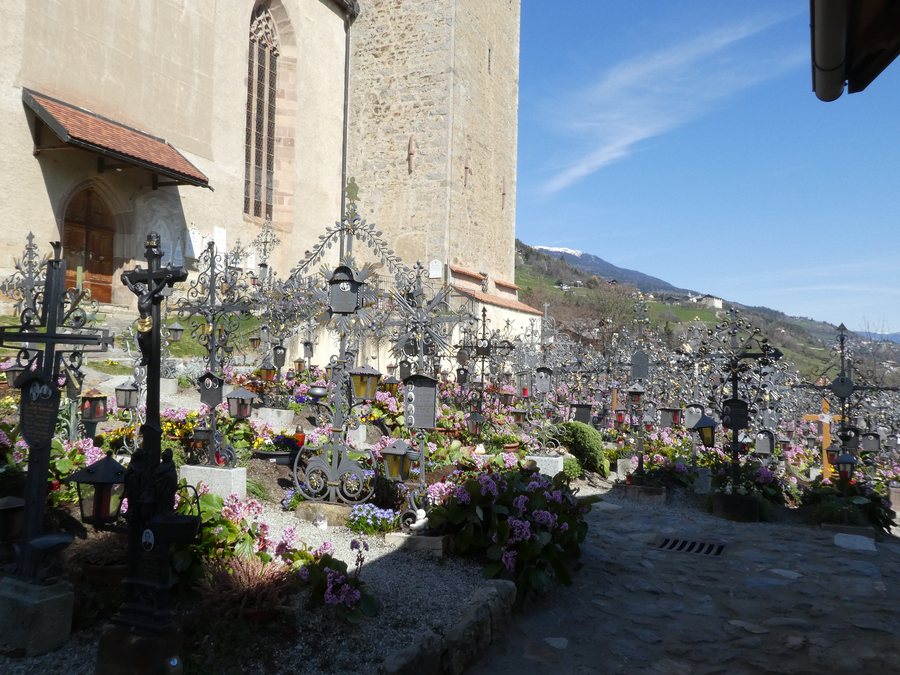
St Michael’s Church at the cemetery in Villanders was consecrated in 1344. In the cemetery by St Michael’s Church, the fronts of the exclusively forged grave crosses are positioned facing away from the burial mound.
The old village centre of Villanders comprises narrow alleyways and two towering Gothic towers. This very village centre, with its alleyways and towers, served Franz von Defregger as the backdrop for his painting “The Last Levy”. The townscape, sacred architecture and art history thus create different reasons to explore Villanders at a leisurely pace.
Mining history and the connection to the Villanders Alpine pasture
Mining is also one of the area’s historical themes. In the mining complex in the Tinne Valley, 16 tunnels with a total length of 25 km were excavated. Those interested in mining history can consciously include the complex in the Tinne Valley as a separate focus when planning their trip. Bus route 345 connects Chiusa, Villanders and the Villanders Alpine pasture and can play a role in planning your days.
If you would like to expand your travel ideas beyond Villanders, you can find more places here: Chiusa, Barbiano, Rio di Pusteria, Funes, Rodengo, Laion, Velturno and Naz-Sciaves.
For the overarching travel overview: Eisack Valley.
Check prices, availability and amenities for your travel dates directly on Booking.com.
View accommodation and offersAdvertisement · Affiliate link to Booking.com
