
Verrua Savoia: Fortress and Hilly Landscape
Accommodation in Verrua Savoia
Verrua Savoia combines historic buildings with distinctive natural features. The first known documentary mention of the place dates back to 999. When choosing a holiday apartment in Verrua Savoia, you can prioritize cultural highlights and landscape experiences according to your personal interests.
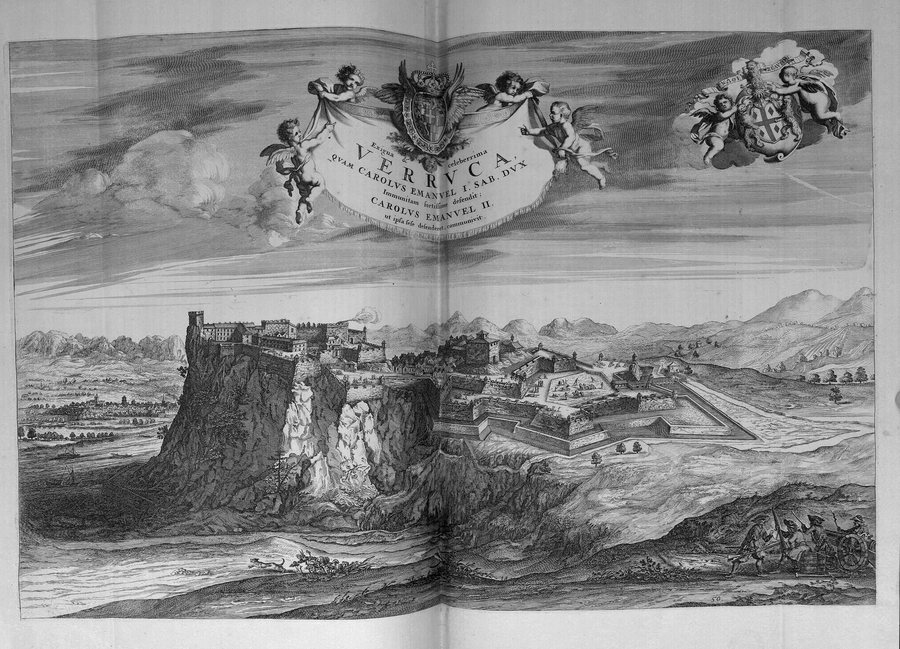 File:Verrua Savoia (1726).jpg
Photo: Fondo Antiguo de la Biblioteca de la Universidad de Sevilla via Wikimedia Commons, Public domain
File:Verrua Savoia (1726).jpg
Photo: Fondo Antiguo de la Biblioteca de la Universidad de Sevilla via Wikimedia Commons, Public domain
Fortezza di Verrua Savoia and the Remains of the Fortress
The Fortezza di Verrua Savoia stands on a hill spur projecting over the Po. Today, only the Dongione with its associated structures and the Ponte del Soccorso are visible of the complex. Renovation work, as well as work on some rooms and access roads, is currently underway at the Fortezza.
Churches Between Baroque and Local History
Construction of the present-day Chiesa Parrocchiale di San Giovanni Battista began in 1749. It was consecrated and opened for worship on 2 September 1759. Its façade displays a late Baroque character typical of Piedmont. The organ was built by the Bergamasque Serassi family for the church of the Franciscan monastery in Crescentino.
The Chiesa di Santa Lucia di Siracusa in Sivrasco was built in 1695 on the site of an earlier chapel dedicated to the Madonna del Carmine. It is considered to still be in good condition. In Collegna stands the Chiesa di San Pietro, a church from the late 17th century with a single nave, a presbytery and a small choir.
Construction of the Chiesa Parrocchiale di San Sebastiano was planned between 1760 and 1763. In Cervotto, the Chiesa di San Giacomo Apostolo was elevated to the status of an independent parish. Together, these churches offer travelers different historical perspectives for connecting architecture with local religious history.
Hilly Landscape, Protected Area and Geological Nature
Almost the entire area of Verrua Savoia is hilly. The landscape extends from Monviso to the hills of the Po and Monferrato. The Isola di Santa Maria special protected area also includes the territory of Verrua Savoia. The Fossil Mud Volcano of Verrua Savoia is a geological natural feature and creates an unusual accent alongside the historic buildings.
Castles, Museum and Parks in the Regional Area
The surroundings of Verrua Savoia include Castello di Gabiano and Castello di Piea, both castles. In the wider regional area lies the Foresteria del Castello di Camino, a fortress. The Museo Clizia - Palazzo Luigi Einaudi, a museum, is also located there.
The wider regional area also includes the Parco di Via Togliatti, the Parco Fluviale del Bricel and the Parco del Mauriziano, each a park. The Arco Charles Emmanuel I - Emmanuel Philibert of Savoy is known there as a natural arch. These regional features expand the thematic scope beyond Verrua Savoia.
Choose a Holiday Apartment in Verrua Savoia According to Your Travel Interests
When choosing your holiday apartment, you can use your preferred daily itinerary as a starting point: historical interests lead to the churches and fortress, while interests in nature lead to the hilly landscape, the protected area and the mud volcano. For families with different preferences, this division provides a practical basis for combining cultural and nature-focused days.
Further places for trip planning: Coassolo, Bardonecchia, Usseaux, Garibaldi, Collegno, Bobbio Pellice, Torrazza Piemonte, San Sicario Alto
To the higher-level travel overview: Turin.

.jpg)