
Holiday apartment in Civitanova Alta: city walls, art and views
 File:Centro storico di Civitanova Alta - Civitanova Marche 1.jpg
Photo: Diego Baglieri via Wikimedia Commons, CC BY-SA 4.0
File:Centro storico di Civitanova Alta - Civitanova Marche 1.jpg
Photo: Diego Baglieri via Wikimedia Commons, CC BY-SA 4.0
Civitanova Alta combines striking fortification structures with theatres, collections, religious buildings and exceptional viewpoints. If you are looking for a holiday apartment in Civitanova Alta, you can explore art, architectural history and the regional landscape here in a variety of ways.
Holiday apartment in Civitanova Alta between city walls and culture
One impressive entrance is Porta Zoppa (Porta San Paolo). It is a striking example of Renaissance defensive architecture on the southern side of the city walls. A double flight of stairs and a barrel-vaulted gallery lead through the gate towards Piazza della Libertà. Porta Marina (Porta Sant’Angelo) stands on the eastern side of the city walls. It was built in the mid-15th century at the request of Francesco Sforza, using brick in the Ghibelline style, and features a double pointed arch and a tower. From here, there is a view of the sea.
The Torrione is also part of the historic urban fabric and is a preserved example of military Renaissance architecture in Civitanova Alta. During a walk through the town, you can view the tower up close. Another striking structure is the Torre dell’Acquedotto. It was built in 1935 as a neo-Renaissance-style structure with an octagonal ground plan and Ghibelline crenellations.
Art, theatre and historic spaces
The Teatro Storico Annibal Caro has a horseshoe-shaped auditorium and was built between 1869 and 1872. After years of closure, it reopened in 1997 following restoration and once again became available for dance, theatre, concerts and cultural events. The Pinacoteca Civica “Marco Moretti” is housed in the historic home of Annibal Caro’s family. It displays paintings, drawings and graphics by important 20th-century artists, as well as numerous Italian prints associated with the Urbino school. The Giardino della Pinacoteca Civica is a terrace of around 250 m² overlooking the Monti Sibillini and the Marche landscape.
Former religious buildings also shape the cultural character of the town. The first records of the church now housing the Spazio Multimediale San Francesco, formerly the Chiesa di San Francesco, date back to the 13th century. The restored former church is now a cultural space within the museum network of the upper town of Civitanova Alta. The Ex Chiesa di Sant’Agostino has Romanesque-Gothic origins and an interior designed in the Rococo style, with stucco work attributed to Agostino Varlè. It has been converted into an auditorium for cultural events, performances, exhibitions and performances.
The Chiesa di San Paolo dates back to origins as early as 1212. The present building was constructed between 1736 and 1753 and has an 18th-century organ attributed to Antonio Callido. The Chiesa del Santissimo Sacramento has an interior designed according to the principles of Marche Baroque, with six side chapels housing paintings from the 17th and 18th centuries. The adjacent Antiquarium preserves ecclesiastical vestments, liturgical objects, paintings and religious artefacts from the 16th to the 19th century.
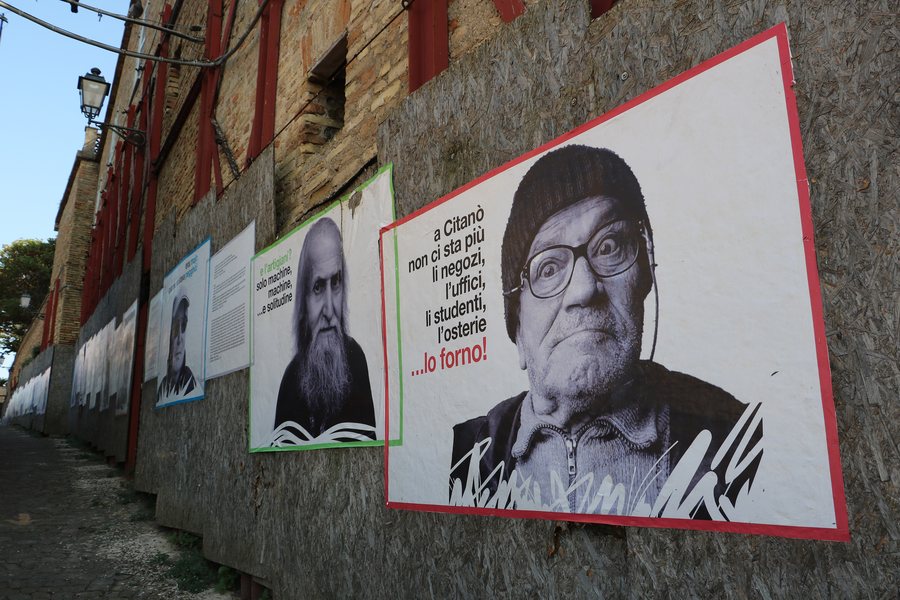
Graphic art is the focus of the MAGMA – Museo Archivio Grafica Manifesto. It was established from a donation of more than 20,000 posters, volumes and graphic artefacts; its specialist library contains around 3,000 volumes. Exhibitions, meetings with international graphic designers, educational programmes and guided tours are among the formats offered there. Via dei Sediari commemorates the historic craft of chairmaking in Civitanova Alta and the women who hand-wove the seats of wooden chairs. The Archivio storico comunale preserves historically significant documents from the institutional activities of the municipal administration. The restored Lavatoio Comunale retains its stone washbasins and a wooden roof. The Stazione del Tram dates from 1900 and is a Liberty-style building with polychrome ceramics.
When planning your trip, you can combine different highlights in Civitanova Alta: the structures of the city walls, the Teatro Storico Annibal Caro, churches and museums reveal various historical and cultural facets of the town. The Giardino della Pinacoteca Civica opens up views of the Monti Sibillini and the Marche landscape, while Porta Marina directs your gaze towards the sea.
For further travel ideas, you can also include Urbisaglia, Macerata, Contrada di Forano, Penna San Giovanni, Alfi, Croce, Monte Cavallo and San Ginesio in your plans.
Check prices, availability and amenities for your travel dates directly on Booking.com.
View accommodation and offersAdvertisement · Affiliate link to Booking.comTo the higher-level travel overview: Macerata.

