
Borgagne: Castello Petraroli and Olive Landscapes
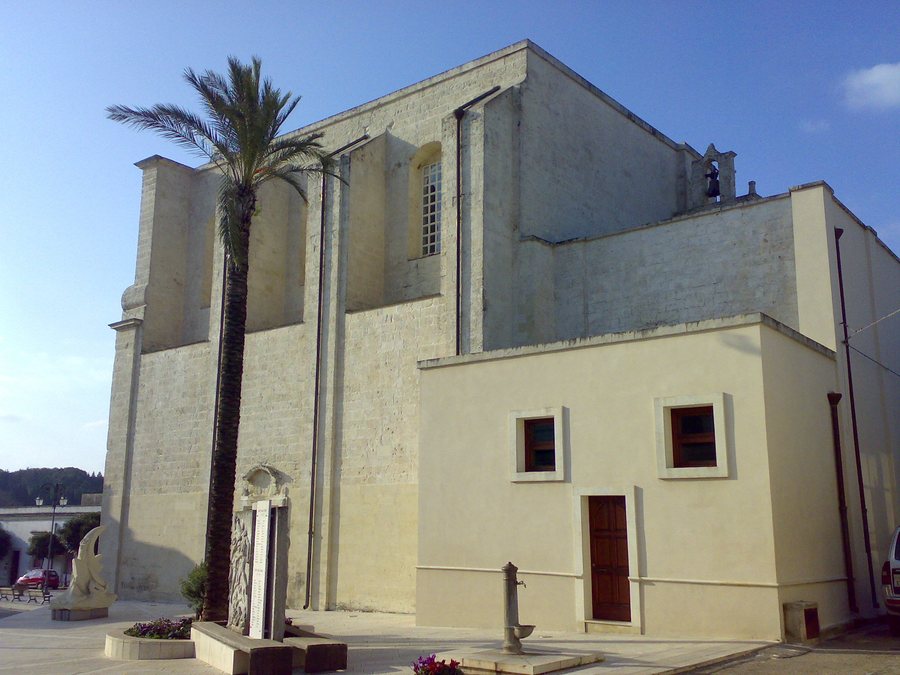
A holiday apartment in Borgagne is an interesting choice if you would like to discover a place with military architecture, historic courtyard houses, olive landscapes, and an official cycling route. Borgagne combines several holiday themes: history is reflected in the townscape, while the surrounding area is characterised by centuries-old olive trees and a 25.6-kilometre cycle route passing through several towns.
Castello Petraroli and Historic Buildings
Castello Petraroli forms a distinctive focal point of the town’s history. The first, circular tower was built in 1497 to protect Borgagne from raids by Turkish corsairs. The rest of Castello Petraroli was built during the first decades of the 16th century. It is surrounded by a moat and arranged around a central courtyard with a rectangular layout. The visible remains include the original tower at the north-eastern corner, the moat visible only on the eastern side, decorative corbels on all sides, and a machicolation above the main gate.
Palazzo Sciurti also forms part of Borgagne’s military history: it was built in the 16th century as an important defensive element of the town. The Cappella Madonna del Carmine di Borgagne was built in 1619. The chapel contains a partially damaged 17th-century fresco depicting the Virgin Mary with the Child, which was once located on the altar of the Madonna of Constantinople.
Courtyard Houses, Casa-torre, and Olive Mill
There are eight courtyard houses in Borgagne’s historic centre, some of which have been fully restored. Typical courtyard houses characterise the centre and illustrate the town’s medieval heritage. At Via IV Novembre 32, there is a recently restored courtyard integrated into a characteristic Casa-torre. These Casa-torre houses are fortified residences that became widespread from the 16th century onwards and feature defensive elements such as machicolations, openings for dropping objects, and loopholes.
Another historical feature is the Sciurti olive mill. It was reused during various historical periods and is not entirely underground, but rather built partially underground.
Olive Landscape and Cycling Route
The area around Borgagne includes landscapes characterised by centuries-old olive trees. Olio della Terra d’Otranto is produced there. Borgagne is also the first stop on the Itinerario Ulivi Monumentali. On the outskirts of the town stands an old olive tree with extraordinary shapes, adding a particularly vivid detail to this landscape theme. The historic centre and the outskirts therefore form two different points of reference: the courtyard houses here, and the old olive tree of Borgagne there.
For active days during your holiday, an official cycling route is documented: the 25.6-kilometre route covers Melendugno–Borgagne–Sant’Andrea–Masserie. At 25.6 kilometres, the official cycling route has a clear and specific length that can be used as a fixed reference when planning your day locally.
Discover More Places
For further orientation, you can also compare Matino, Alessano, Posto Rosso, Felline, Montesano Salentino, Marina Di Ugento, San Cassiano and Seclì.
For the higher-level travel overview: Lecce.
Check prices, availability, and amenities for your travel dates directly on Booking.com.
View Accommodation and OffersAdvertisement · Affiliate link to Booking.com
