
Discover Balatonszabadi: History and Viticulture
Accommodation in Balatonszabadi
Balatonszabadi can be explored through several tangible traces of its history: the Kossuth statue in the district of Siómaros, the Reformed Church and the ruins of a medieval church near Pusztatorony. At the same time, significant viticulture continues in the outskirts. The town’s history thus brings together memorial sites, religious architecture and viticulture as distinct themes. If you are looking for a holiday apartment, you can consider which of these aspects is of particular interest to your travel group.
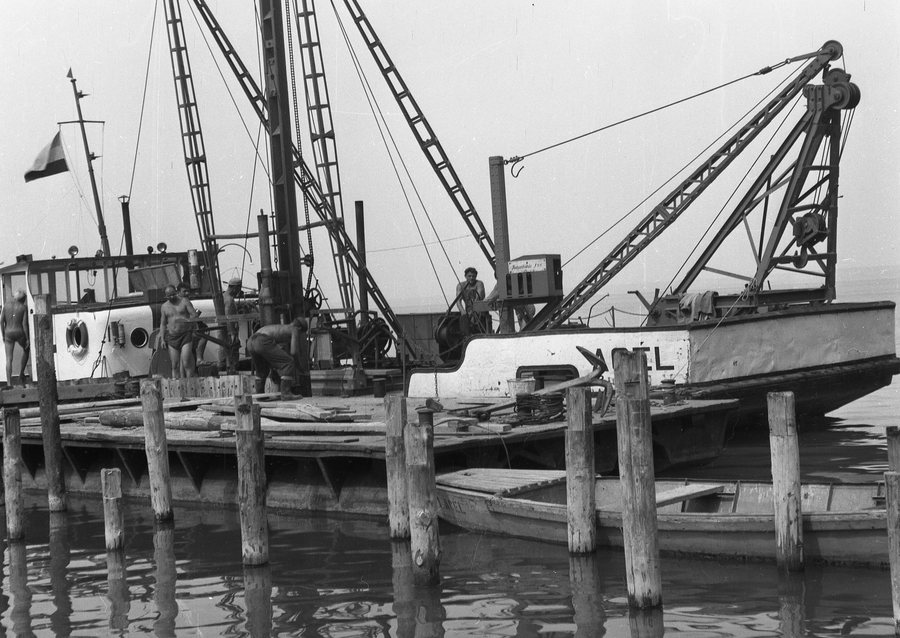 File:Balatonszabadi, az Acél nevű cölöpverő hajó. Fortepan 29477.jpg
Photo: FOTO:Fortepan — ID 29477 : Adományozó/Donor: Korenchy László. via Source, CC BY-SA 3.0
The Kossuth Statue in Siómaros
The statue was unveiled in 1894 as Hungary’s first public statue of Kossuth. It was erected using voluntary donations from local residents. On 26 June 1894, it was brought to Siómaros, where it still stands today at the intersection of Kossuth Lajos utca and Enyingi utca. Its face is turned towards Enying. These details connect the monument’s prominence throughout the country with a precisely identified location and a local fundraising initiative.
Siómaros is now part of Balatonszabadi. Those interested in history and public monuments will find a tangible point of reference here: the statue commemorates Kossuth and, at the same time, the community effort that funded its construction. It can be included as a cultural highlight in your travel plans without conflating it with the churches or the medieval ruins.
The Reformed Church and Its Historic Furnishings
A Reformed church was built in Siómaros, now a district of Balatonszabadi, in 1800. The Reformed Church in Balatonszabadi preserves furnishings from the late 18th century: a Moses seat, a built-in pulpit and church pews. The dates refer to different aspects: 1800 is the year the church was built, while the late 18th century refers to the age of the furnishings listed.
The church is a protected monument and is considered one of the municipality’s most significant historic and religious buildings. The specific furnishings bring its religious architectural history to life: rather than simply naming a church as a destination, you can identify the Moses seat, pulpit and pews as individual elements of its historic interior. For travellers interested in churches and religious history, this is a distinct topic alongside the Kossuth monument.
The Church Ruins near Pusztatorony
Near Pusztatorony, the ruins of a medieval church stand on a hill that rises distinctly above the surrounding area. The building dates to the mid-12th century. It was a single-nave church with a semicircular apse. “Single-nave” means that the church had one main nave; the apse is the semicircular end of the building. These features give the ruins a different architectural profile from the Reformed Church.
The medieval church was 20 metres long and 5 to 6 metres wide. Those interested in historic architectural forms can consider the building’s dimensions and the shape of its end, as well as its date. Pusztatorony thus represents a much older architectural history than the Reformed Church, built in 1800.
Wine-Growing Areas in the Outskirts
Viticulture is also part of the area’s character. Four vineyards or wine-growing areas lie in the outskirts of Balatonszabadi: Külső-hegy, Öreg-hegy, Józan-hegy and Pusztatorony. Significant viticulture continues there to this day. The four names show that this is not just a single vineyard, but several named areas. Viticulture is also a distinct focus alongside the historic buildings and monument.
If your travel group has a range of interests, these themes offer different points of interest without reducing the town to a single attraction.
Discover More Destinations
If you would like to include more destinations in your holiday plans, you can also visit Nagyberény, Balatonszéplak, Siofok, Som, Ádánd, Töreki, Balatonendréd and Sosto.
For the main travel overview: Siófoki.

