
Discover Kaposújlak
Accommodation in Kaposújlak
Kaposújlak is brought into focus by several clearly identifiable cultural landmarks: an ecumenical bell tower at a crossroads in the village center, a marble plaque bearing the names of the victims of the World Wars, and a copper relief with its own unveiling date. These three references emphasize different aspects: the tower’s location and commemoration, and the relief’s artistic design and unveiling event. For your travel planning, they provide a good starting point for distinguishing the village itself from the broader regional perspective.
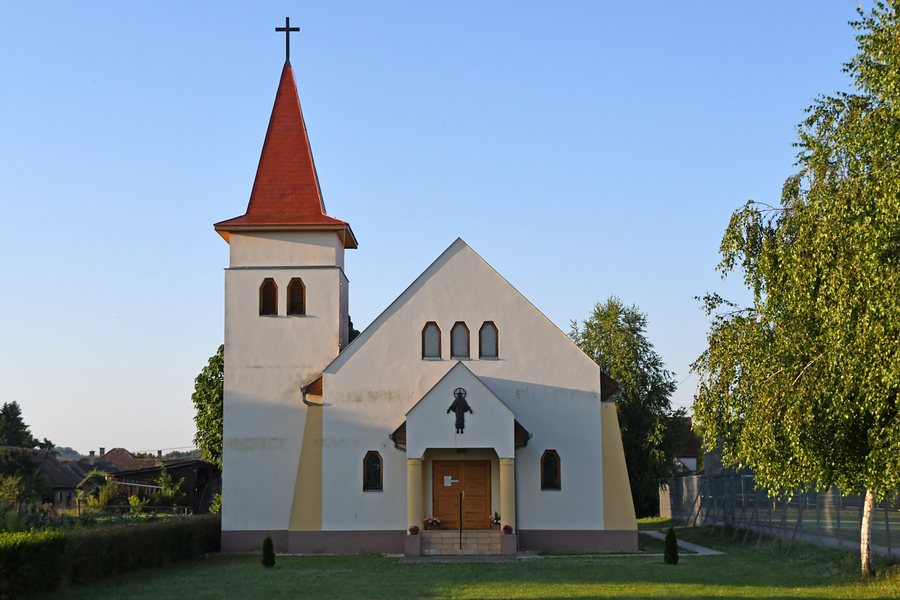 File:Kaposújlak, római katolikus kápolna 2023 01.jpg
Photo: Pasztilla aka Attila Terbócs via Wikimedia Commons, CC BY-SA 4.0
Bell Tower and Remembrance in the Village
The ecumenical bell tower stands at a crossroads in the village center of Kaposújlak. “Ecumenical” refers to an interdenominational connection; the tower therefore bears a religious designation that extends beyond a single denomination. A marble plaque bearing the names of the victims of the World Wars is located on it. The structure, its precise location, and the plaque thus bring together two distinct themes: the ecumenical connection and remembrance by name. The names direct attention to individual victims rather than expressing remembrance only in abstract terms.
A Copper Relief with a Set Date
Another cultural landmark is the copper relief “Mesebeli Falu” by Dabóczi József, which was ceremonially unveiled on August 19, 2010. The title, artist’s name, and date provide concrete points of reference for placing the work in Kaposújlak’s cultural history. A relief is a three-dimensional representation in which forms stand out from a background; “copper relief” also identifies the material. This cultural reference therefore differs from the bell tower: the tower’s location and commemorative plaque are central, while the relief’s work, creator, and unveiling event take center stage. Those interested in local culture can thus consider two different forms of expression.
The Regional Natural Setting: Southern Lake Balaton
The broader destination of Southern Lake Balaton offers a different perspective. In 2009, the Zselici Tájvédelmi Körzet received the title of International Dark Sky Park because of its low light pollution; the Zselici Csillagpark was established in the heart of the protected area. This brings together the reason for the designation and a specifically named park within the protected area. Two different scales are relevant when making travel plans: Kaposújlak’s local cultural landmarks and the nature-related attractions of the wider Southern Lake Balaton region.
Somogy County includes, among other places, Kis-Balaton, Zselici Tájvédelmi Körzet, Barcsi Ősborókás, and Babócsai Basakert. Baláta lies between Kaszó and Szenta and is considered one of Somogy’s particularly valued natural assets. The supraregional Dráva network also includes stops for water tourism along its stretch in Somogy County. Individual facilities may change as development progresses, so check the details for each stop before planning your trip.
Choose the Right Search Area
When looking for a holiday rental, it helps to decide on your main focus first: are you primarily interested in Kaposújlak’s cultural landmarks, or in nature and water tourism in the broader destination of Southern Lake Balaton? This lets you consider local village culture and regional attractions separately before deciding where to stay.
Discover More Destinations
Discover more destinations: Kaposfő, Hencse, Szenna, Kaposszerdahely, Bárdudvarnok, Zselickisfalud, Kaposmérő, Nagybajom
To the broader travel overview: Kadarkúti.

