
Waddeweitz: Roundhouses, Countryside and Crafts
Accommodation in Waddeweitz
The municipality of Waddeweitz lies in the Elbhöhen-Wendland Nature Park, amid quiet, wooded rolling hills. Gently rising hills, extensive forests, green meadows and flowering fields shape the landscape; nestled among them are Wendland’s roundhouse villages, hidden by trees. As you explore Waddeweitz, you’ll encounter the stories of this landscape and its villages at various places throughout the municipality. Here, views of nature go hand in hand with tangible impressions of architectural history, crafts and village design.
Landscape and Village Design
The landscape is not the same everywhere: the village of Kröte lies on the edge of the Elbufer-Drawehn nature reserve. In Diahren, by contrast, the village’s layout takes centre stage. The elongated roundhouse village is laid out in a horseshoe shape; an oval village green sits at its centre, with an access road leading into it. Anyone interested in the structure of traditional villages will find an illustrative example here of how the village green, building forms and access road combine to create a distinctive village scene.
The surrounding area offers more than a single point of interest. Forests and meadows are as much a part of the landscape as its characteristic roundhouse villages. This combination can influence your choice of holiday focus: you might prioritise a walk through the countryside, or instead explore the layout and history of individual villages. When looking for a holiday apartment in Waddeweitz, it’s worth first considering which of these perspectives matters most to you during your stay.
Architectural History, Art and Crafts
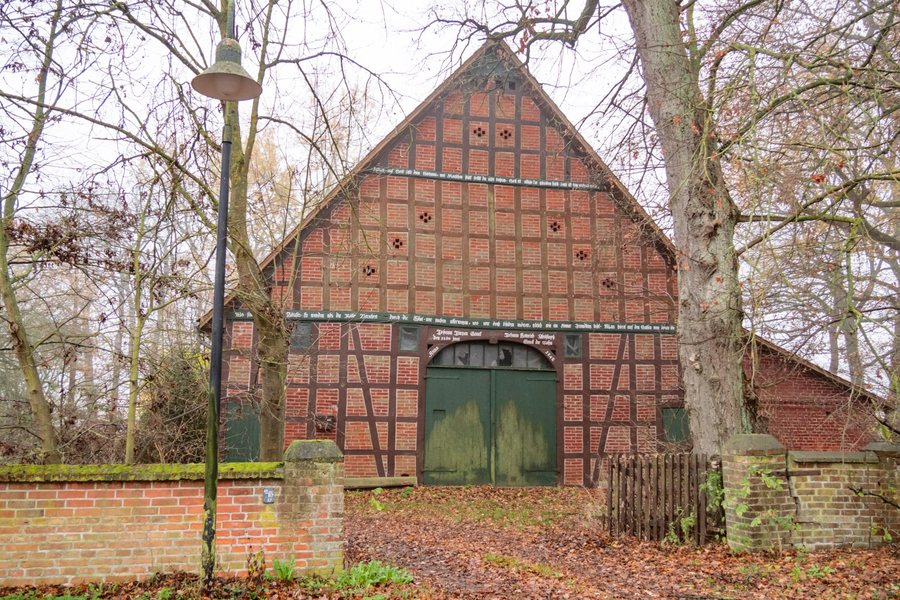
In Kukate, a listed two-post farmhouse dating from 1786 tells an unusual story: it was dismantled in the neighbouring village of Zebelin and rebuilt in Kukate. The historic building can be understood not only in terms of its age, but also through its relocation and reconstruction. Kukate is also home to the listed Werkhof, a seminar centre for art and crafts.
A goldsmith and visual artist works at Kunst Maddau. Visitors can arrange a visit by calling 05849/971168 or simply ring the doorbell spontaneously. The vintage tractor pulling event in Klein Gaddau is another special occasion in the municipality. According to the municipality, it takes place every two years.
Natural Swimming Pool in Groß Wittfeitzen
The natural swimming pool run by the Waldbad Wittfeitzen Friends Association is located in Groß Wittfeitzen. It adds swimming to the area’s landscape and village attractions, although public access is seasonal: the 2026 public swimming season at Waldbad Wittfeitzen has ended.
More Places to Explore in Lüchow-Dannenberg
The wider destination of Lüchow-Dannenberg also offers its own nature and culture attractions. The Wendland Roundhouse Museum in the roundhouse village of Lübeln presents a farmstead as an open-air museum. Traditional crafts are brought to life there in the pottery, smithy, bakehouse and wheelwright’s workshop. The Göhrde offers a distinctive natural landscape: it is the largest continuous mixed forest area in northern Germany. Its many protected areas provide habitats for rare and endangered species. On request, the Naturum Göhrde offers forest experience programmes and guided walks on a range of topics.
Those interested in early history will find an open-air museum at the Hitzacker Archaeological Centre, on a site that people were already using around 4,000 years ago. Three reconstructed longhouses and numerous interactive stations explore the everyday lives of people in earlier times. In Dannenberg, the Waldemarturm displays finds and exhibits about the town’s early history, temporary art exhibitions and a permanent exhibition on flooding. These examples complement the municipality’s village and craft attractions with distinctive regional themes of their own.
Another cultural highlight is the Kulturelle Landpartie: since 1989, artists and craftspeople in Lüchow-Dannenberg have opened their farmyards and studios every year for twelve days between Ascension Day and Pentecost, presenting their work. Exact dates vary from year to year. During the event, visitors can follow suggested cycling routes to reach numerous exhibitions and theatre performances directly. For holiday planning, this offers a clear distinction between exploring the villages and countryside of Waddeweitz and enjoying a broader cultural programme in Lüchow-Dannenberg.
Choose your holiday apartment based on the themes you’d like to shape your stay: the countryside, the distinctive village layout, or art and crafts. If you’re planning a wider trip around Lüchow-Dannenberg, its museums, forest attractions and Kulturelle Landpartie may also be part of your plans.
Discover more destinations: Lübbow, Leisten, Lemgow, Schnega, Wehningen, Luckau, Küsten, Gusborn.
See the overview of the wider destination: Lüchow-Dannenberg.

