
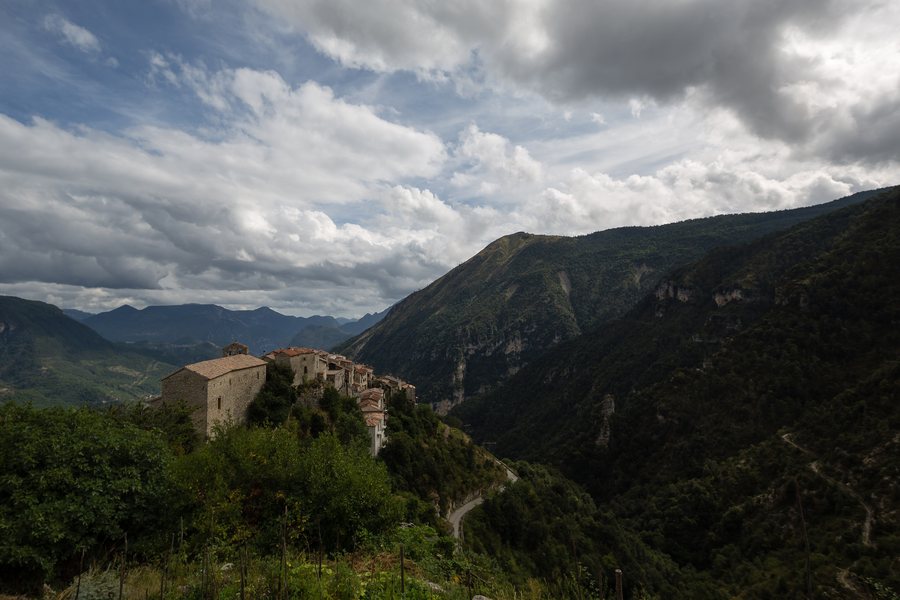
Anyone wishing to rent a holiday apartment in Bairols is planning a stay with Bairols as their destination.
Bairols has a circular route linking the three chapels of Saint-Roch, Saint-Martin and La Madonne.
Nature and Landscape
The Bairols sector is characterised in particular by matorral with Phoenician juniper (Juniperus phoenicea) and Mediterranean annual grasslands. The Bairols sector also includes a chestnut grove with centuries-old trees, which is of great interest to bats.
The road to Bairols offers a new panorama at every bend.
Culture and History
Bairols is first mentioned around 1040 in a deed of donation, in which the place is referred to as “Bairolo”. At the beginning of the early modern period, Bairols developed on a rocky promontory. The village has a linear layout, paved streets and houses built along the fortification walls.
The Church of Sainte-Marguerite has an asymmetrical façade and stands on the edge of a precipice.
Bairols has cool alleyways, vaulted passageways, covered passages and steep stairways; every step opens up a remarkable view of the valley.
In 1259, a Benedictine priory dedicated to Saint Martin and belonging to Lérins Abbey was mentioned in Bairols.
More pages about localities: Andon, Lucéram, Peymeinade, Cantaron, Châteauneuf-D'entraunes, Cimiez, Châteauneuf-Grasse, Saint-Sauveur-Sur-Tinée.

