
When planning a stay in Sainte-Osmane, some travellers prioritise finding and renting a holiday apartment.
Church and Heritage Monument
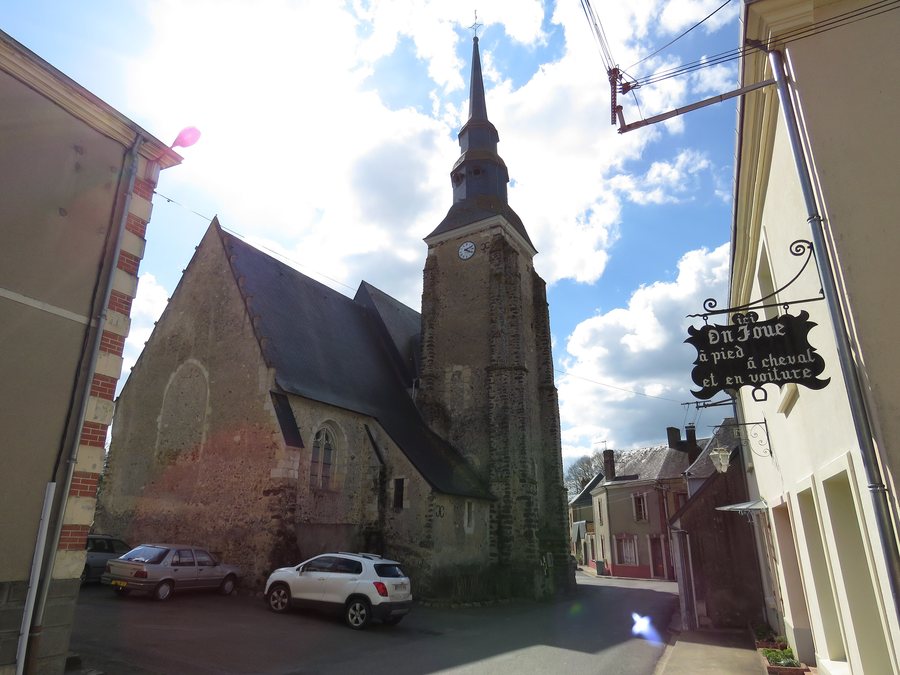
The Sainte-Osmane church has been protected as a historic monument since 16 February 1926; the protection covers the church. Inside, there is a group of three statues: John the Evangelist, Christ on the Cross and Our Lady of Sorrows. The three statues come from a rood beam. The group was classified as a historic monument as a movable object on 6 September 2002.
The western Renaissance porch is made of tuff stone and features an entablature, a gable and niches. A cartouche on the gable wall bears the year 1542. The nave has a boarded vault that slopes sharply down towards the entrance and is supported by four roof trusses. A long inscription in Roman capitals bearing the year 1612 is carved into the wood of the second roof truss.
Relics of Saint Osmane were buried in the altar in 1685. A gilded wooden statue of the Virgin and Child stands in the central niche of the high altar.
Local Details
La Buissonnière is a communal creative workshop at 83 Rue de la mairie in Sainte-Osmane that invites people to participate. A sculpture of Saint Osmane with a wild boar, carved from sequoia wood, also survives from the 2003 cantonal agricultural show.
Sainte-Osmane has been awarded three flowers as a village in the regional floral awards.
Historic Washhouses
The Lavoir du Gué lies in the direction of Montreuil-le-Henri, about 1 kilometre from the village centre. It was rebuilt in 1954/55 with a concrete foundation, wooden cladding and a sheet-metal roof.
In 1821, the Lavoir de la fontaine was returned to the municipality so that residents could continue to use it, as they had, according to local tradition, “since time immemorial”. After the Second World War, the Lavoir du bourg stood at the end of a path leading to the river and was still used by four or five washerwomen.
Trails and Events
“Entre tuffeau et grès roussard” is an approximately 12-kilometre, moderately difficult circular hiking route with an average walking time of 3 hours and a connection to Sainte-Osmane. The 34-kilometre cycling route “De rivières en vallons – variante 1” passes through Sainte-Osmane via a shortcut.
RANDO ZIK 2026 is scheduled to take place in Sainte-Osmane on 26 June 2026 from 7 p.m. The fifth edition comprises three hikes accompanied by music, covering 9, 10.5 and 13 kilometres.

