
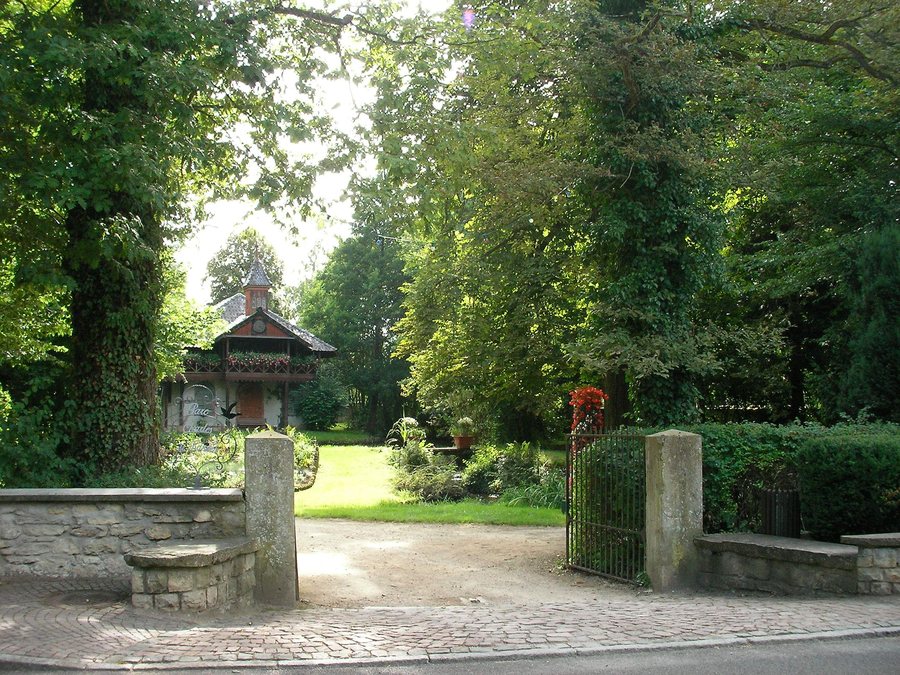
Those choosing Hirtzbach as a holiday destination can include their wish to rent a holiday apartment in their plans.
Culture
The Parc de Reinach is listed as a historic monument in its entirety, including the surrounding wall and architectural elements; it was listed by decree dated 5 September 1996. Hirtzbach is also home to a restored waterwheel, considered the last surviving relic of a former mill.
The churches also preserve various traces of history. The ceiling of the nave of Saint Maurice Church is decorated with a fresco by Carlos Limido (1902–1957). It depicts Christ in glory with angels and the Instruments of the Passion, as well as a Trinity. Sainte-Afre Church was first mentioned in 1303 and again in 1441, and remained a parish church until the French Revolution. The Château des Reinach in Hirtzbach was built in two main construction phases in the first and fourth quarters of the 18th century.
Nature
The Le Hirtzbach stream was restored in a very open, natural style in order to restore biodiversity and improve water quality through better natural self-purification. The marked, 10-kilometre-long Sentier Saint-Léger is a hiking trail with information panels about wildlife, forests, ponds, biodiversity and traces of the First World War front line.
The footpath around Hirtzbach leads to the site of the vanished village of Sankt-Glückern. It also leads to the Landfürstenweyer, the Étang des Princes, a pond with calm waters.
Cuisine
In Hirtzbach’s restaurants, you can enjoy the Sundgau speciality “carpe frite”.

.jpg)