
Culture
The Narona Archaeological Museum displays around 900 finds covering the history of the city from the late 3rd century BC to the 15th century. The Narona Archaeological Collection encompasses the Greek-Hellenistic, Roman, Early Christian and Venetian periods; its chronological span extends from the 3rd century BC to the 14th or 15th century. It provides insights into Narona’s history and everyday life from the Hellenistic period to the Late Middle Ages.
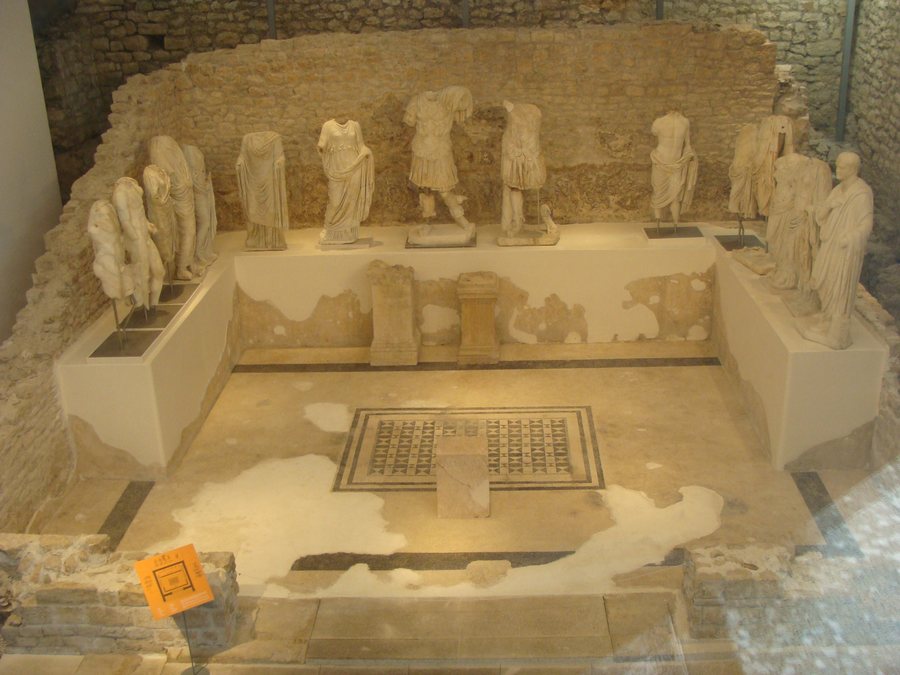
The main hall of the Narona Archaeological Museum contains in situ remains of the Roman temple as well as statues of emperors and their family members above a black-and-white mosaic floor. A mosaic displayed beneath a glass floor most likely belonged to a Roman taberna. The Roman imperial statues in the collection form the largest surviving group of Roman imperial statues known today.
Vid is home to an Early Christian baptistery from the 5th century with an exceptionally well-preserved octagonal baptismal font. The Church of Our Lady of the Snow, locally called Gospa Ledena, stands on Vid Hill at the acropolis of ancient Narona. The Church of St. Vid displays an exhibition of finds from the Early Christian church and the medieval cemetery at this site; architectural remains of the Early Christian church are visible in and around the Church of St. Vid.
Erešove bare is a preserved and presented archaeological site that can be visited as part of a tour along Narona’s city walls in Vid. Erešova kula is an open-air epigraphic museum with Latin inscriptions and other monuments from ancient Narona; this site can also be visited as part of a tour of the city walls.
Visiting
The Narona Archaeological Museum provides access for visitors with disabilities and people who have difficulty with stairs. Advance notice is required so that assistance can be arranged. Outside the museum building, a small archaeological park is part of the complex. The terraces of the Narona Archaeological Museum display stone ritual and funerary monuments. The museum library is available to the public upon request.
To explore Vid and Narona, travelers may wish to rent a holiday apartment.
Events
The Naronitansko Cultural Summer takes place on the outdoor terraces of the Narona Archaeological Museum, featuring theater performances, exhibitions, concerts and book presentations. Rimska noć in Naroni is a recurring event in Vid that combines programs on Roman history with workshops, interactive content, exhibitions, tastings and evening events. The Vid Cultural Society of Narona includes the historical unit Domagoj’s Archers.
Nature
Vid Hill is surrounded by a green valley of reeds and sedges crossed by the Norin, a tributary of the Neretva. Neretva-lađa excursions are described along the Norin near Vid.
Cuisine
The local cuisine associated with Vid includes eel brudet and fried frogs.
Other destination page: Metković.

