
Talachyn District: Hillfort, Monasteries and Estate History
Accommodation in Talachyn District
The cultural and historical diversity of Talachyn District ranges from an early medieval hillfort to churches and country estates from later centuries. There is also Yuzefpolye, a landscape park established in 1890 on the outskirts of Tolochin. If you are travelling with children, these different subjects can offer shared starting points for planning your trip: would you rather explore a fortification, religious buildings or traces of former estates?
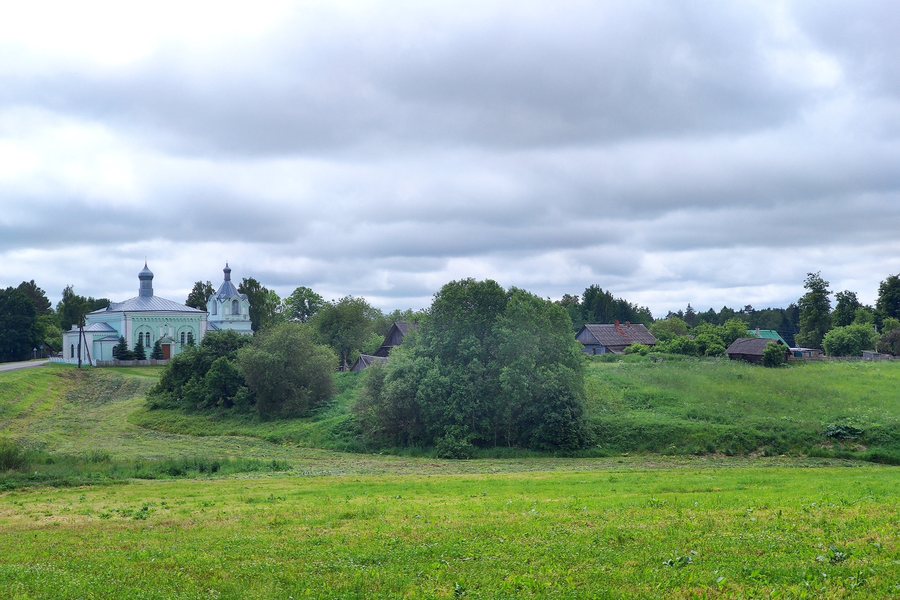 File:2026.06.09 View of Manastyr Talachyn District Vitebsk Region Belarus.jpg
Photo: Skatsubo via Wikimedia Commons, CC0
File:2026.06.09 View of Manastyr Talachyn District Vitebsk Region Belarus.jpg
Photo: Skatsubo via Wikimedia Commons, CC0
Hillfort and Historic Sites
The Drutsk Hillfort is an open-air archaeological monument where all parts of an early medieval hillfort have been preserved. These include the fortified citadel, an outer town, a suburb, earthworks and a moat. The different components make it possible to understand the site as a fortified complex: the preserved features include not only the fortified core but also outer areas and defenses. For families who want to discover history together, this offers a specific topic to choose from, without everyone needing to find the same aspect interesting.
Individual churches and monastic sites also tell of different historical contexts. In Tolochin, the Convent of the Holy Protection is part of the district. The convent’s courtyard is located on the site of the former Boris and Gleb Monastery; restoration of the Trinity Church began there in 2005. In the village of Monastyr, a stone Church of the Holy Trinity dating from the 1890s has been preserved. It formerly belonged to the Boris and Gleb Hermitage in the village of Neklyudovo. The Church of St. Anthony is also listed as a preserved historic religious building in Talachyn District.
Further historical traces can be found in several places across the district. In Reuchye, the ruins of the mausoleum of the Khomentovsky princes have been preserved. In Ratsevo, the surviving Zamoyski estate includes a 19th-century workers’ house, a stable and a forge. The Tyundzevitsky estate in Goloshevo was built in 1897 on the site of an older wooden building. Also near Goloshevo, a stone cross stands on the shore of Lake Glubokoye (Glukhoye). It is believed to date from the 11th or 12th century, is popularly called Baba, and is included in Belarus’s State List of Historical and Cultural Values.
Nature, Crafts and Activities
Alongside the historic buildings, Yuzefpolye offers a different focus: the landscape park was established in 1890 on the outskirts of Tolochin.
Sports and crafts facilities are also part of the district’s character. These include an Olympic reserve school for cycling and a House of Crafts. Near Tolochin, a riding school teaches show jumping and elements of classical higher horsemanship; equestrian tourism is also practised there. Hunting tourism is offered on the grounds of the historic estate in Ratsevo.
Getting There and Choosing Accommodation
The Brest–Minsk–Border of the Russian Federation highway crosses Talachyn District. A railway line also crosses the area. When choosing between a holiday apartment and a holiday home, it is helpful to start by prioritising the places and activities that interest you.
The Tolochin State Museum of History and Local Lore is an institution of the Culture Sector of the Talachyn District Executive Committee. It is located at 4 ul. Pionerskaya, Tolochin. If you want to include museum and cultural history in your trip, this gives you a precisely identified place to add to your plans. The other historic destinations are spread across several named locations, so choose your accommodation according to which subjects and places interest you most.
More destinations at a glance: Orsha District, Polotsk District, Ushachy District.
For the broader travel overview: Vitebsk Region.

