
Accommodation in Uzbekistan
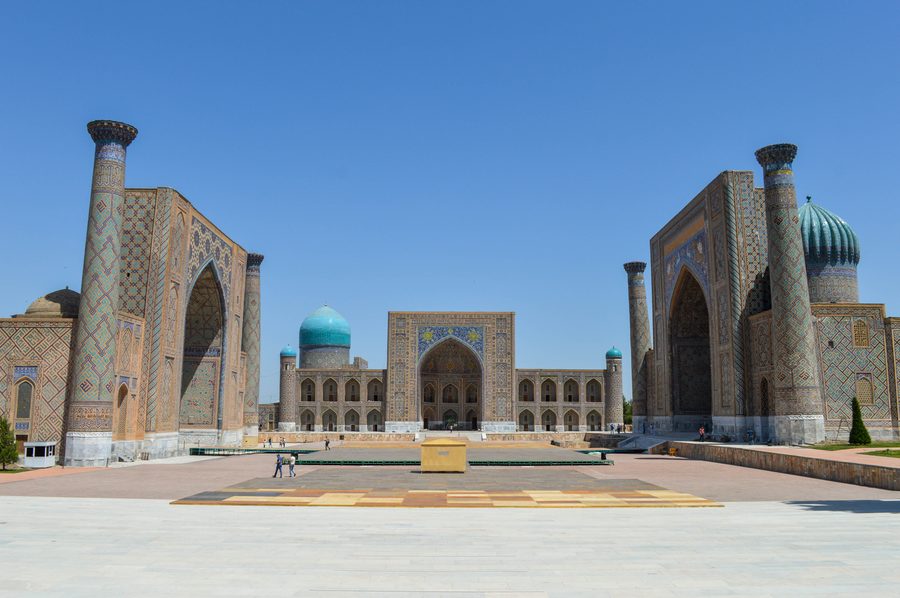 Das Registan in Samarkand zählt zu den prägenden historischen Bauensembles Usbekistans.
Photo: Francisco Anzola via Wikimedia Commons, CC BY 3.0
Das Registan in Samarkand zählt zu den prägenden historischen Bauensembles Usbekistans.
Photo: Francisco Anzola via Wikimedia Commons, CC BY 3.0
Uzbekistan combines impressive Silk Road cities with desert areas, mountain landscapes, and the agriculturally shaped Fergana Valley. Families traveling here can combine very different kinds of trip experiences: historic buildings and city walks, an urban stay in Tashkent, landscape experiences, or shared discoveries around plov, tandyr bread, and tea-house culture.
Short and sweet
- Historic cities such as Bukhara, Khiva, Samarkand, Shahrisabz, and Termez make Uzbekistan a destination with several cultural stops.
- The architecture route also includes old mud fortresses in desert areas.
- The Tashkent region combines capital-city architecture with the Pskem Mountains, waterfalls, and the Charvak reservoir.
- In the south, Samarkand, Shahrisabz, and Termez add to the Central Asian city and culture route.
- The Fergana Valley brings into view an agriculturally shaped travel region with cities such as Fergana, Andijan, Namangan, Margilan, and Kokand.
- Plov is one of the typical main dishes of Uzbek cuisine.
- Flatbread baked traditionally in a tandyr shows how an important staple food is prepared.
- Green tea is part of the country’s tea-house culture.
Historic cities and architecture as a common thread
For a culture-focused trip, Uzbekistan offers a succession of historic destinations with different characteristics. Bukhara, Samarkand, Khiva, Shahrisabz, and Termez are named as historic cities of the country. Religious buildings, madrasas, and other examples of Islamic-influenced architecture give the cities their special character. In desert areas, old mud fortresses change the scenery: a city walk turns into a contrast between monumental architecture and far-reaching landscapes.
Samarkand Province stands for a historic stage in southern Uzbekistan, while Bukhara can be seen as a separate city stop. An accommodation in a city is a suitable planning option when architecture, history, and shared days of discovery are the focus. The two entries Bukhara and Bukhara Province remain independent destinations in the Uzbekistan selection.
Tashkent, mountains, or the Fergana Valley?
A trip does not have to follow only the historic city axis. Tashkent shows religious buildings with turquoise accents alongside Soviet and contemporary architecture. The region also includes the Pskem Mountains, waterfalls, climbing areas, and the Charvak reservoir. This creates a different travel picture from the historic centers: city architecture and landscape highlights can be treated as separate parts of the itinerary. The Tashkent Region is an obvious reference point for this.
The Fergana Valley also provides a clear contrast to desert areas and monumental cities. A large part of the valley lies in Uzbekistan; among the places named are Fergana, Andijan, Namangan, Margilan, and Kokand. Those who want to include this agriculturally shaped region can consider Andijan Province or Ferghana Province as separate regional starting points.
For the western cultural area, Khorezm can be included cautiously in the selection; Khiva is named as one of the country’s historic cities.
Plov, tandyr bread, and tea-house culture
Uzbekistan can be discovered not only through buildings and landscapes. Plov is one of the country’s typical main dishes and can be a shared culinary discovery between two sightseeing stops. Flatbread is also part of Uzbek cuisine and is traditionally baked on the inner walls of a tandyr oven. Shurpa, Naryn, Manti, Laghman, and Halva are named as other typical dishes; you should check local availability or regional variations on site in each case.
Green tea is drunk in Uzbekistan in tea houses. This combination of drink, pause, and everyday culture gives a trip a calmer moment between city sightseeing and landscape experiences. Anyone considering accommodation with a kitchen can still plan local food culture into the day: markets, bread, and traditional dishes create opportunities to discover the trip through shared tastes.
Tailoring accommodation to the planned trip
In Uzbekistan, the question of location is closely tied to the desired travel experience. For a stage focused on historic buildings and city discoveries, a city-based starting point is a sensible planning option. If, on the other hand, you want to combine Tashkent with mountain and reservoir landscapes, the accommodation’s location should match the planned day trips.
For a varied route with historic cities, the capital region, and the Fergana Valley, several stops may make more sense than looking for just one base. The Fergana Valley is a distinct, agriculturally shaped travel region with several named cities and should therefore be viewed as a separate part of the planning. Check the exact location of each accommodation if short distances to a specific part of the itinerary are important for your family.
More regions for your Uzbekistan trip
In addition to the starting points already described, you can also consider Navoiy Province, Jizzax Province, Navoiy Province, Qashqadaryo Province, Surxondaryo Province, and Republic Of Karakalpakstan as additional regional destinations for your search.
Frequently asked questions about Uzbekistan
What shapes Uzbekistan besides its historic cities?
Desert areas with old mud fortresses, the mountain and reservoir landscapes near Tashkent, and the Fergana Valley expand the travel picture beyond the famous historic cities.
Which dishes and traditions make Uzbek food culture tangible?
Plov, flatbread traditionally baked in a tandyr, other dishes such as Manti or Laghman, and green tea in the tea house give the trip concrete culinary and everyday points of contact.
When does a trip with multiple stops make sense?
Multiple stops are especially worth considering when you want to combine historic cities with Tashkent, mountain landscapes, or the Fergana Valley. That way, each stage can have its own cultural or scenic focus.

.jpeg)