
Accessible Holiday Accommodation: Check the Full Route
Accessible holiday accommodation fits a trip only when the route from arrival to the bed, bathroom and planned activities matches the traveller's individual requirements. A label such as “accessible” does not provide the measurements needed for every wheelchair, rollator or other aid. Ask precise questions and keep the answers in writing before booking.
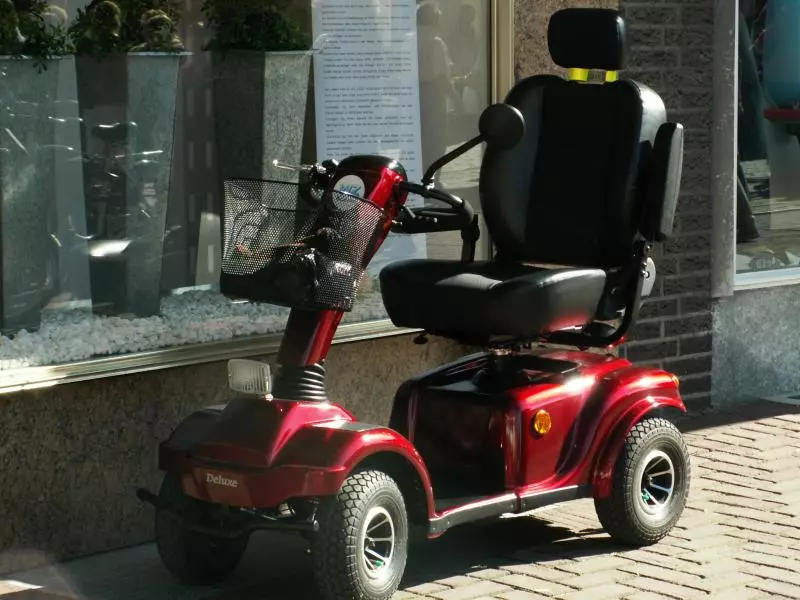 Red electric car scooter on a paved path in front of a shop.
Photo: Voyagemedia - RRinnau
Red electric car scooter on a paved path in front of a shop.
Photo: Voyagemedia - RRinnau
Start with the traveller's requirements
Record the aid used, its dimensions, the required turning space and the features that cannot be compromised. Consider mobility, vision, hearing, balance, assistance animals, medication and the need for personal support. Decide whether every route must be step-free or whether a specific step, slope or transfer can be managed safely.
Useful points to define include clear door widths, threshold height, bed height, bathroom layout, shower access, grab rails, sink clearance, kitchen work surfaces, lift dimensions, parking and storage for equipment. General information from the Federal Agency for Accessibility can explain terminology, but the provider must confirm the actual property.
Check the route from arrival to the front door
Assess the complete chain: station or airport, transfer, parking space, path, entrance, hallway, lift and apartment door. Ask about steps, thresholds, gradients, surface quality, lighting and the distance for luggage. A step-free entrance may still be impractical if the parking area is on loose gravel or the lift is too small.
For a lift, ask for the internal width and depth, door width, load limit and the floor served. If the property uses a key safe or remote check-in, confirm that it can be reached and operated with the traveller's available movement and strength.
Compare rooms and equipment with measurements
| Area | Question before booking | Useful evidence |
|---|---|---|
| Entrance and corridors | What are the clear widths, threshold heights and turning spaces? | Measurements, floor plan and current photos |
| Bathroom | What are the shower access, turning area, toilet height and grab-rail options? | Measurements and a detailed layout |
| Bedroom | What is the bed height and how much free space is available on the required side? | Furniture plan and measurements |
| Kitchen | Can the traveller reach the table, work surface, hob, sink, refrigerator and storage? | Layout, photos and clear descriptions |
| Parking and storage | Is the space fixed, wide enough and close to the entrance? | Position, dimensions and route description |
Check the surroundings and daily destinations
Accommodation is only practical if regular destinations can be reached. Check the route to shops, restaurants, medical care, public transport, beaches and planned activities. Kerbs, cobblestones, steep sections, construction work and missing toilets can change the suitability of a short route. For a coastal stay, compare the route to the promenade and the information about accessible beach holidays.
Ask precise questions in writing
Instead of asking only whether the property is accessible, name the aid and its dimensions. Ask the provider to confirm each essential point, for example:
“We are travelling with a wheelchair or rollator measuring … Please confirm the clear width of the entrance, bathroom and bedroom doors, the number and height of steps from the parking area, the lift dimensions, the bed and toilet height, and the available turning space.”
Keep the replies, photos and floor plan with the booking confirmation. If important answers remain vague, treat the property as unverified and continue comparing.
Compare price, contract and arrival arrangements
Include final cleaning, linen, deposit, parking, transfers, equipment hire and any special assistance in the total price. The guide to additional holiday-accommodation costs supports this comparison. Check cancellation terms and written promises in the rental agreement and deposit guide.
Allow extra time for parking, luggage, key handover and setting up equipment. If you are travelling without a car, check the final connection and everyday services with the holiday-home-without-a-car guide.
Use a clear decision checklist
- Record the traveller's aid, dimensions and essential requirements.
- Check the complete route, including parking, entrance, lift and accommodation door.
- Compare room measurements, bathroom layout, bed position and equipment.
- Verify the routes to shops, transport, medical care and planned activities.
- Obtain written answers and compare them with the booking information.
- Confirm the total price, cancellation terms, handover and support arrangements.
- Book only when the decisive points are clearly confirmed.
Frequently asked questions
Is “accessible” the same as wheelchair accessible?
No. The wording may refer to only one part of the property. Check the route, doors, turning spaces, bathroom, bedroom, lift, parking and surroundings against the traveller's own requirements.
Are photos enough to assess the accommodation?
Usually not. Photos can hide thresholds, heights, narrow passages and the route outside. Ask for measurements, a floor plan and a description of the complete path.
What should a person using a rollator check?
Check thresholds, lift access, storage, seating, bathroom access, bed height, slopes and the route from parking or public transport to the property.
Can a property with steps still be suitable?
That depends on the traveller, the aid and the available support. Check the number, height, surface, handrails and safe handling of each step instead of relying on a general label.
