
Holiday apartment in Ljusnarsberg – Nature, hiking trails and mining culture
Ljusnarsberg combines vast wilderness, waterways and marked trails with mining and cultural history. At its heart is the large, contiguous wilderness area of Nittälvsdalen, with numerous nature reserves. The Nittälven is an unregulated watercourse and flows into Lake Ljusnaren beside Kopparberg. The valley has marked trails and rest areas for short and long hikes.
Nature
In the Brattforsen Nature Reserve, a landscape of rapids shapes the course of the Nittälven. The watercourse runs through steep slopes and cliffs there, forming waterfalls in several places. A marked trail of approximately 3 km runs around the reserve.
Djupdalshöjden Nature Reserve is one of the highest points in the district. There are approximately 10 km of marked trails, as well as overnight accommodation in shelters and a well-equipped rest hut.
Trails and water
Several longer trails are also part of the landscape of Ljusnarsberg Municipality: three of the 17 stages of the 280 km Bergslagsleden trail pass through the municipality. A connecting trail to the Bergslagsleden starts at Kopparberg Station. The Postleden is a 61 km hiking trail between Hällefors and Kopparberg, while Ljusnaren runt is described as a challenging 26 km hike.
For cycling, the cycle routes start at Kopparberg railway station. At Lake Ljusnaren, Djäken bathing area has a gently sloping beach; canoes or kayaks can be launched there. The orange-marked Kopparstigen is accessible year-round, is 2.5 km long and starts and ends at Ljusnarsbergs kyrka.
Culture
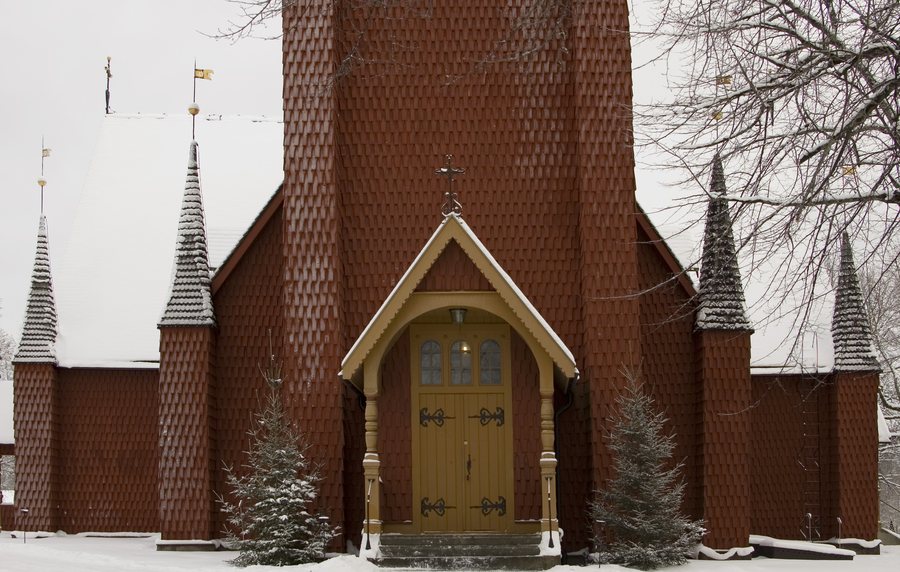
Kopparstigen illustrates how mining shaped Kopparberg from the 17th century onwards. Tingshuset in Kopparberg was built as a mine office in 1641 and served as the mine supervisor’s office, courthouse and meeting place. Ljusnarsbergs kyrka in Kopparberg is a wooden church dating from 1635. Its interior is among the best-preserved interiors of its kind from the late 19th century in Sweden. The church and its entire surroundings are part of an area of national interest for the preservation of cultural heritage.
At Finngruvorna, there are water-filled open-pit mine remnants that appear emerald green due to copper precipitates. The Kaveltorp Mining Museum displays a model of the Kaveltorp mining area, a three-dimensional glass mine map, as well as photographs, tools and various types of ore. Advance reservation by SMS is required to visit the museum.
The museums of Kopparberg cover, among other things, rural folk culture, photography, shoemaking, goldsmithing and postal history. A guided tour of the museums takes about one hour. Sädesmagasinet Högfors houses an early-18th-century granary, one of the oldest surviving buildings in Ljusnarsberg Municipality. It also contains a museum of working life, a photography exhibition and a flea market.
Everyday life and local insights
Dan Andersson’s father was born at Bränntjärnstorpet in 1854. Kopparbergs Krukmakeri och Trädgård has a shop, workshop and garden and is within walking distance of the centre of Kopparberg. The Swedish tradition of earthenware pottery is maintained there; the clay comes from Gotland and the glaze is lead-free.
The local offering also includes the farm shop next to the Rural Museum, which sells smoked fish and local food products.
Other places: Laxå, Lindesberg, Askersund, Örebro, Vintrosa, Degerfors, Degerfors
Check prices, availability and amenities for your travel dates directly on Booking.com.
View accommodation and offersAdvertisement · Affiliate link to Booking.comTo the higher-level travel overview: Örebro.

