
Morag between the Old Town, wetlands and cycling routes
Accommodation in Morag
Morag is known for its historic Old Town and the protected Morąskie Rozlewisko wetland; three cycling routes each start and finish in the town. Those looking to combine culture, nature observation and exercise will find a range of themes to consider when planning their trip. The Gothic town hall, the birdlife at Morąskie Rozlewisko and the three cycling routes each offer a different focus—and give you some pointers on what to look for when choosing a holiday apartment in Morag.
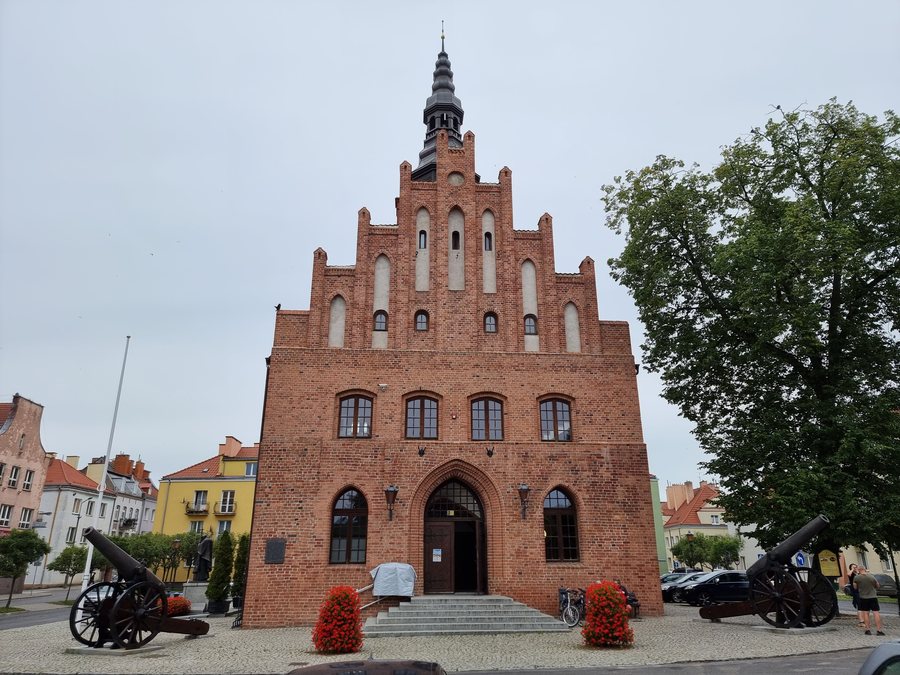
Old Town history and notable buildings
Morąg’s Gothic town hall stands in the centre of the Old Town. Originally built sometime between around 1360 and 1380, the building was damaged by fires and rebuilt several times over the course of its history. Even so, it has retained its medieval character. Today, the town hall houses the tourist information office, an art gallery and the “Ratuszowe Piwnice” Museum. The historic building thus brings together several cultural points of interest under one roof.
A Baroque sundial dating from 1741 stands in front of Dohnów Palace. Made of sandstone, it consists of cubes and spheres stacked on top of one another. The parish church of Saints Peter and Paul also tells a story of a long building history: construction of the Gothic church spanned the period from the early 14th to the early 16th century. Those interested in historic architecture can view these buildings as distinct records of the town’s history.
Another chapter in the town’s history is linked to Johann Gottfried Herder. The present-day monument was unveiled in 1964. An earlier Herder monument had been erected in 1854 and disappeared in 1945; the current monument is a gift from the German Ministry of Culture. Morąg’s water tower dates from 1906 and features Neo-Gothic elements. Today, it houses a café. The town hall, sundial, church, monument and water tower offer a variety of historical points of interest for a cultural itinerary.
Wetlands and birdwatching
Morąskie Rozlewisko is a 121.7-hectare wetland and ecological reserve. Its flora and fauna are typical of wetlands; around 150 bird species occur in the area, including several species unique to Europe. During migration, flocks of bean geese, barnacle geese and greylag geese regularly gather there. Those with a particular interest in nature observation will find a different focus here than in the Old Town.
An approximately 3 km educational trail runs along the southern side of the wetland, with information boards along the way. The boards also make the route an opportunity to learn more about the area’s special features. The approximate length provides a concrete point of reference for planning your day; by itself, it does not indicate how long the walk will take. For a stay focused on birds and wetland ecology, this natural area can be included as a separate activity.
Three cycling routes of varying lengths
There are three routes to choose from for a cycling trip, each beginning and ending in Morag. The green cycling route is 40.3 km long; the estimated cycling time is about 2 hours and 30 minutes, and the difficulty level is two stars. The blue cycling route covers 36.5 km, with an estimated cycling time of about 2 hours and a difficulty level of 1.5 stars. The red cycling route is 37.2 km long; its estimated cycling time is also about 2 hours, and its difficulty level is given as 1.5 stars.
The route details make comparison easier: the blue route is the shortest by distance, the green the longest, and the red falls in between. The estimated cycling time for the green route also differs from the estimates for the blue and red routes. According to the municipal description, all three routes are suitable for trips with children and for gravel or road bikes. You can consider the stated distance, cycling time and difficulty together when planning an active outing.
Discover more places
If you would like to consider destinations beyond Morag, you can find Wielki Dwór, Idzbark, Samborowo, Lubajny, Kretowiny, Ostróda, Dabrowno and Miłomłyn here.
For the broader travel overview: Ostródzki.

