
Klewki between two lakes: a church, a palace and routes
Accommodation in Klewki
Klewki combines a setting between two lakes with buildings from several centuries. The Church of Saints Valentine and Roch, a palace dating from the mid-19th century and two routes offer different starting points for exploring the village. You can discover the area through its architectural history or by following its sequence of lakes, streams and canals.
Between Lake Klebarskie and Lake Linowskie
Klewki was established on a narrow strip of land between Lake Klebarskie and Lake Linowskie. A stream crosses this narrow strip of land and connects the two bodies of water. An isthmus is a narrow stretch of land between bodies of water; in Klewki, the connecting stream is an integral part of this geographical description. Together, the lake, strip of land and stream provide a clear geographical reference point for the village.
Church, palace and chapels
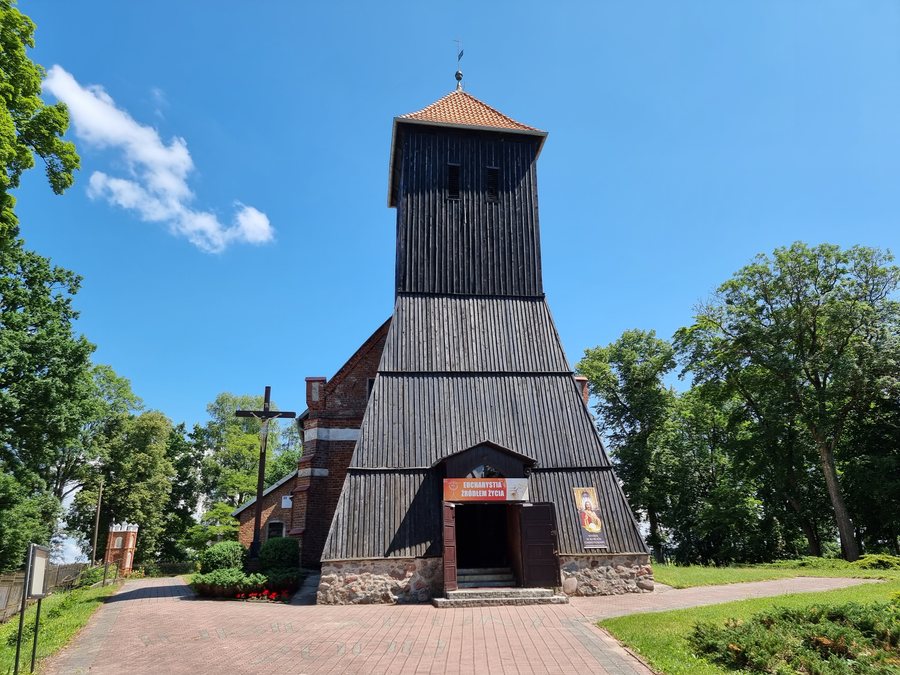
The Church of Saints Valentine and Roch dates from the 16th century and features Baroque polychrome paintings, meaning multicoloured painted decoration. The church also contains a late Gothic crucifix and a folk-style Pietà from the 16th century. The Baroque high altar was created in the late 18th century; in the 19th century, the church was given a wooden tower. These architectural and artistic features reveal several layers of history: the church and two of its artworks date from the 16th century, the altar from the late 18th century and the tower from the 19th century.
Another historical highlight is the eclectic palace dating from the mid-19th century, with its surviving park. Eclectic architecture draws on elements from different styles. In Klewki, the religious buildings are complemented by a palace and park representing a different architectural language.
Klewki’s two chapels are also notable for their design: both have two storeys and are built of red facing brick. The first storey has a small niche and blind niches—shallow recesses in the wall. The second storey has an opening on all four sides. The interplay of brickwork, wall niches and an open upper storey makes the chapels’ structure particularly easy to see.
Two routes, two ways to find your way
The red-marked Szlak 36 route passes through Olsztyn, Szczęsne, Klewki, Klewki PKP, Kaborno, Nowa Wieś, Kopanki and Łajs, and possibly Małszewo. The route is 25.5 kilometres long, moderately difficult and hilly; it is marked along the way. The estimated journey time is listed as 2 hours and 50 minutes. Its length, difficulty and terrain can help you assess the route as part of your planning. If you need up-to-date information on trail conditions, check local conditions before travelling.
The Linowska Struga route starts in the village of Klewki. It passes Lake Linowskie, the Linowska Struga, Lake Klebarskie and Lake Silickie, as well as the Wiktorii Canal and the Kiermas Canal, before reaching Lake Bogdańskie. You can follow its course through the names of the lakes, stream and canals. The two routes therefore offer different ways to plan your trip: for Szlak 36, the specific planning details are its length, difficulty and estimated journey time; the Linowska Struga route is described by its sequence of lakes, stream and canals. Check local conditions before travelling.
Discover more destinations: Włodowo, Giławy, Biesal, Nowe Kawkowo, Myki, Dorotowo, Klebark Wielki, Wadąg.
For the broader travel overview: Olsztyński.

