
Discover Nakomiady: Ceramics and Architectural History
Accommodation in Nakomiady
Nakomiady can be explored through very different traces: ceramics for Pałac Nakomiady, a church with architectural elements from different centuries, and a hill outside the village associated with a Prussian hillfort. Here, craftsmanship, architectural history and an older historical reference point come together. Those who like to look more closely will find not just names on a map, but specific details that reveal the history of the place.
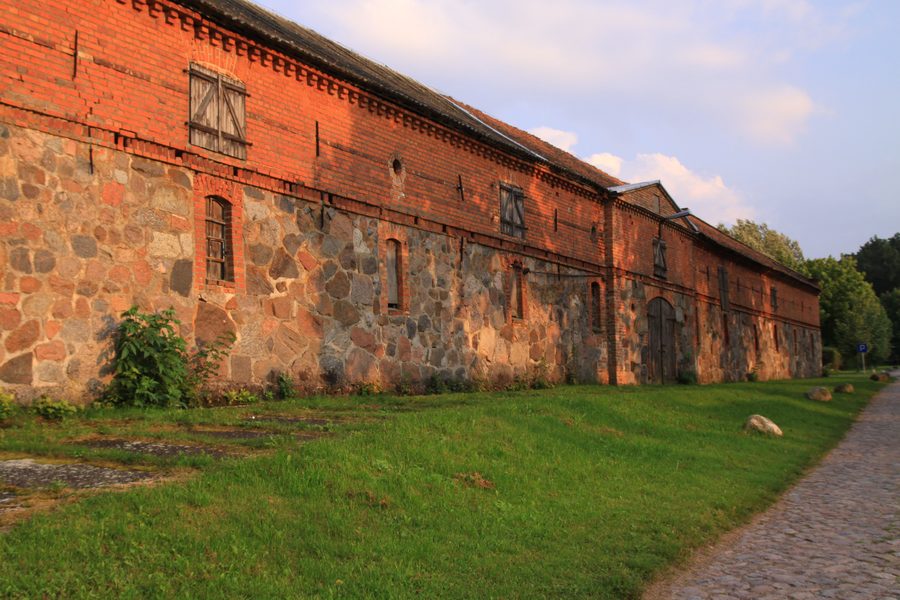 Historisches Gutshofgebäude des Nakomiady-Anwesens, das zum dokumentierten Schloss- und Gutskomplex gehört.
Photo: Grzegorz Gąsior via Wikimedia Commons, CC BY-SA 3.0 pl
Historisches Gutshofgebäude des Nakomiady-Anwesens, das zum dokumentierten Schloss- und Gutskomplex gehört.
Photo: Grzegorz Gąsior via Wikimedia Commons, CC BY-SA 3.0 pl
Ceramic craftsmanship connected to the palace
The ceramics workshop in Nakomiady was established in the early 18th century for the expansion of Pałac Nakomiady. This connection makes the history of the craft particularly vivid: the workshop is part of the palace’s architectural history. Today, it makes replicas of historic stoves and fireplaces. A replica is a reproduction; here, it refers to stoves and fireplaces from earlier times.
The workshop also has a shop. You can buy small ceramic gifts there and order larger pieces. If you would like to include the offering in your plans, check the specific details with the workshop directly in advance. The shop combines a look at the production process with a practical way to discover ceramics more closely, while the replicas show the craft’s historical connection.
Palace park and church history
A chapel built in 1856 stands in the grounds of Pałac Nakomiady. Its underground section housed a family crypt until 1936. The year it was built and the end of this use give the chapel a clear time frame and add a personal connection to the palace’s history.
Pałac Nakomiady describes itself as the “Dom Klasycznego Piękna” (“House of Classical Beauty”) and as a home open to everyone who appreciates peace, beauty of form and content, space, harmony and order. This self-description draws attention to the aesthetics the palace lays claim to. Together with the chapel and the workshop, it offers a way to explore Nakomiady shaped by buildings and design.
St Joseph’s Church also offers specific architectural details. During a major renovation in 1932, it gained a tower that replaced the former freestanding wooden bell tower, as well as a porch and a sacristy. The 17th-century altar was moved so that it stands against a wall. Thus, the church’s history includes changes from the 20th century alongside a much older altar.
A historical trace outside the village
Outside Nakomiady, a hill rises on land that was still covered by a lake in the Middle Ages. It is a remnant of a hillfort from the time of the Prussians. This connection differs from the church and palace history: here, the focus is on a hill beyond the village and the former fortification, not on a building in the village.
The themes can be weighed against one another: the ceramics workshop and palace link craftsmanship with architectural history; the church and chapel lead to specific architectural and historical details; the hill expands the view beyond the village. If you are looking for a holiday apartment in Nakomiady, you can choose your holiday destination according to these interests. Consider which of these traces makes you most curious, and see whether Nakomiady matches the main interests of your trip.
Discover more destinations: Leśny Rów, Czerniki, Swieta Lipka, Kotkowo, Grabno, Łęknica, Aptynty, Biedaszki.
For the broader travel overview: Kętrzyński.

