
Pasłęk: Defensive Walls, Gates and City History
Accommodation in Pasłęk
Pasłęk reveals its history through different periods: a 1,200-metre-long medieval defensive wall surrounds the Old Town, historic gates tell of former entrances, and the Wąska is part of a kayaking route to Lake Druzno. Churches, the town hall and other buildings add to this picture, with dates ranging from the early 14th century to the 20th century. You can focus on the city’s history or connect Pasłęk with the theme of water.
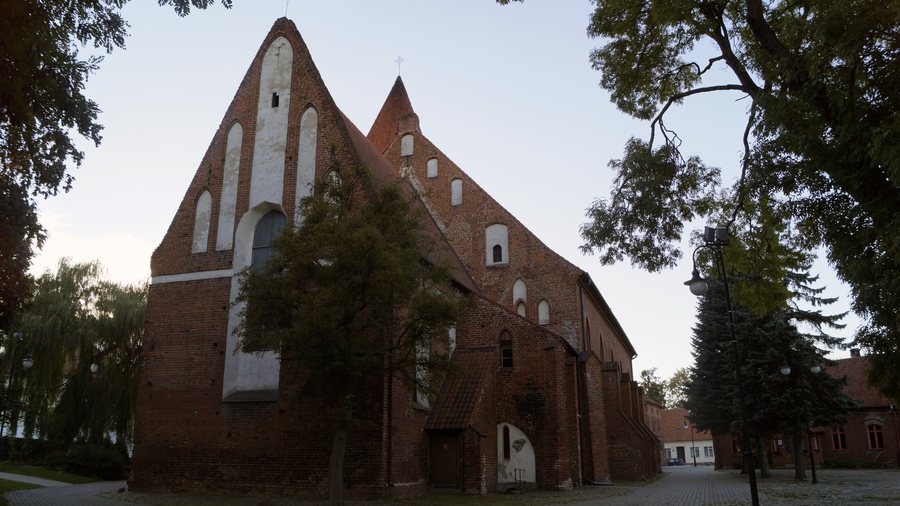 File:Pasłęk, kościół parafialny św. Bartłomieja.jpg
Photo: Anna Denis Aneczka.vip via Source, CC BY-SA 3.0 pl
Defensive Walls, Gates and the Old Town
The surviving defensive walls are among the longest medieval fortifications in Poland; they are the longest surviving ones in the Warmian-Masurian Voivodeship. They enclose the Old Town and give Pasłęk a distinctive historic setting. Two gates illustrate different aspects of the city’s former entrances: the Gothic Brama Kamienna, also known as Wysoka Wieża, was the main gate to the Old Town from the southwest. Brama Młyńska was one of the city’s three former gates. From there, the route led to the castle grounds at the foot of Castle Hill, to the mills and to a landing place on the Wąska.
The church and town hall also mark distinct periods. The Gothic Church of St Bartholomew dates from around 1350. The Gothic-Renaissance town hall, built in 1380, stands in the market square. Together with the defensive walls and gates, these buildings offer a glimpse into different chapters of the city’s history, without confining Pasłęk’s Old Town to a single era.
The castle’s date is deliberately described with some qualification: around 1320, the present north wing was built on a steep hill. The castle was probably erected on the site of an earlier Prussian castle or fortification. The combination of medieval building history and the probable earlier Prussian castle or fortification makes the castle interesting to history enthusiasts.
Further Traces in the Cityscape
Młyńskie Przedmieście lies below the Old Town. Its pre-war buildings are almost entirely preserved; the buildings of the former watermill complex are particularly noteworthy. Restored townhouses stand on Henryka Dąbrowskiego Street. They are among the oldest in the Old Town and date from the turn of the 17th to the 18th century. The Pasłęk water tower adds a later chapter to the town’s architectural history: it was built in 1910 to a design by Gustaw George.
The intervals between these dates make Pasłęk’s architectural history easy to appreciate: the construction of the present north wing of the castle around 1320 was followed by the church around 1350 and the town hall in 1380. The townhouses from the turn of the 17th to the 18th century and the water tower of 1910 mark further, much later periods. If you are travelling with children, these dates can provide an easy starting point for planning together: which buildings belong to the Middle Ages, and which to the following centuries?
City History or a Kayaking Route?
The Wąska flows through Pasłęk, and a kayaking route to Lake Druzno runs along it. This brings two different themes to the fore when choosing your destination: the city’s historic buildings and a route on the water.
If you are looking for a holiday apartment in Pasłęk, first consider which of these themes you want to shape your stay. If you are mainly interested in defensive walls, gates and architectural history, the Old Town is the focus. If the kayaking route on the Wąska is of particular interest to you, the river takes centre stage. This lets you choose Pasłęk based on specific interests, rather than combining the different aspects of the city’s history and the water route into a single itinerary.
Discover more destinations: Plajny, Szymbory, Bogaczewo, Elbląg, Tolkmicko, Gronowo Górne, Godkowo, Kadyny.
Go to the main travel overview: Elbląg.

