
Bodzentyn at the foot of the Pasmo Klonowskie
Accommodation in Bodzentyn
At the foot of the Pasmo Klonowskie, in the Świętokrzyskie Mountains and beside the Psarka River, lies Bodzentyn. The town brings together this landscape and very different traces of its history: church art, remains of medieval defensive walls, a ruined castle and a historic farmstead. When planning your trip, you can therefore choose between different focuses, from nature to architecture and insights into life in a small town in the past.
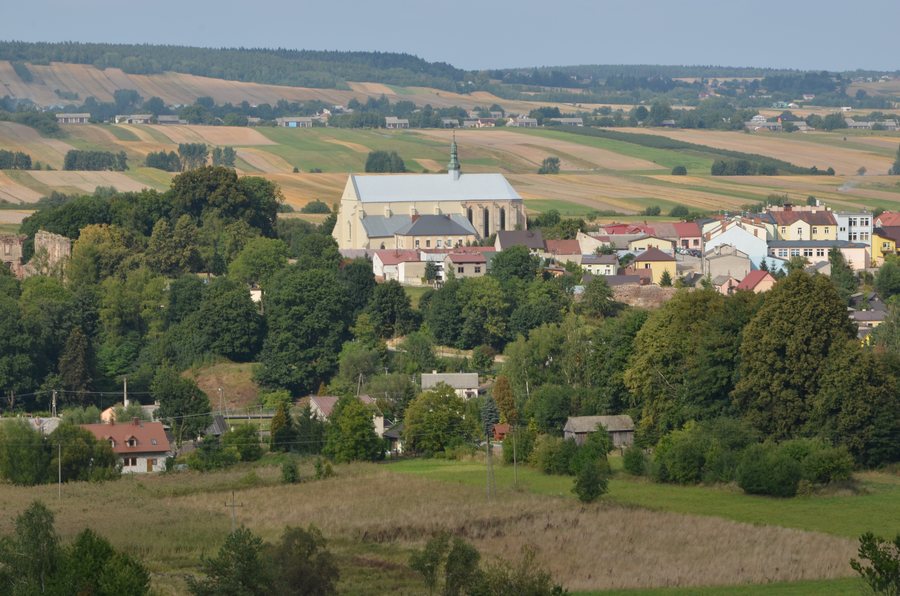 Panorama Bodzentyna z widocznym zespołem kościoła par. pw. św. Stanisława
Photo: Leszek Żmijewski via Source, CC BY-SA 3.0 pl
Panorama Bodzentyna z widocznym zespołem kościoła par. pw. św. Stanisława
Photo: Leszek Żmijewski via Source, CC BY-SA 3.0 pl
Church art with two different origins
The parish church complex in Bodzentyn features two works from different art-historical contexts. The Late Gothic Triptych of the Dormition of the Virgin dates from around 1508 and was donated by Bishop Jan Konarski. A triptych is a three-part work of art. By contrast, the complex’s Renaissance high altar was created between 1546 and 1550 for Wawel Cathedral. The works can therefore be distinguished not only by their period: the bishop’s donation is part of the story of the Triptych of the Dormition of the Virgin, while the high altar was made for a different cathedral.
Wood, shingles and small-town domestic life
The Zagroda Czernikiewiczów showcases historic architecture characteristic of small towns shaped by agriculture. The farmstead includes a house, farm buildings and a carriage shed. Together with the wooden courtyard fence, these form an enclosed ensemble. The buildings are made of fir wood and roofed with shingles; the timber construction and roofing give the complex a different appearance from the church buildings and castle walls.
The exhibition also turns to a different chapter: it reconstructs the living quarters of a multi-generational farming family from the small-town middle class. The first room, hallway and utility rooms show interiors from the mid-19th century. The second room represents a living space from the early 20th century, while the third represents the interwar period. The rooms thus illustrate a progression from the 19th century through to the interwar period.
Castle ruins and surviving defensive walls
The picturesque ruins of Bodzentyn Castle stand on a hill. Surviving features include high walls with window openings and a 17th-century red sandstone portal. In the townscape, these remains stand alongside the remnants of medieval defensive walls and offer another way to explore Bodzentyn’s history. Architecture enthusiasts will find a contrast here with the enclosed farm buildings of the Zagroda Czernikiewiczów: wood and shingles define that ensemble, while the castle is characterized by its high walls and sandstone portal.
Planning your hiking route and journey
A hiking route runs from Święta Katarzyna via Góra Miejska and Bodzentyn to Psary Stara Wieś and Grabowa, then returns to Święta Katarzyna. If you are planning this hike, check the trail’s condition and markings locally. The road connections are another useful point of reference for getting there: Voivodeship roads 752 (Górno–Rzepin) and 751 (Suchedniów–Ostrowiec Świętokrzyski) cross in Bodzentyn. Confirm the route details before setting off.
Your travel interests can help you choose a holiday apartment: would you like to focus mainly on church art, the castle and historic domestic life, or should the hiking route also play an important role? Bodzentyn brings together these different themes without requiring you to focus on just one aspect of the town. As you plan, consider whether local history or hiking will shape your days more, and search for accommodation with that in mind.
Discover more destinations: Lechów, Górno, Milanowska Wólka, Brynica, Strawczyn, Ciosowa, Nowa Huta, Polichno.
For the broader travel overview: Kielce.

