
Zahutyń: Local History, Wooden Church and Nature Reserves
Accommodation in Zahutyń
Zahutyń combines a remarkably specific local history with a wooden church and two named ecological reserves. Visitors interested both in a place’s past and in botanical features will find clearly distinct themes here. They include a royal ownership arrangement from the 14th century, an episode from the 19th century, an image of the Virgin Mary and specific plant habitats. This combination gives Zahutyń a distinctive character, shaped by local history, church art and nature.
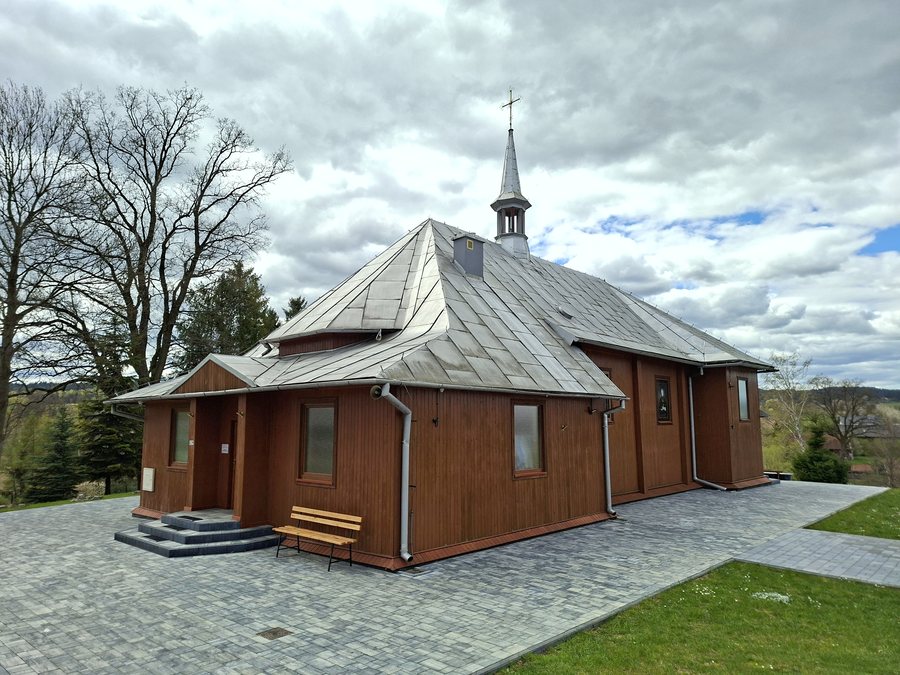 Virgin Mary Queen of Poland church in Zahutyń (2026)a
Photo: Lowdown via Wikimedia Commons, CC BY-SA 4.0
Virgin Mary Queen of Poland church in Zahutyń (2026)a
Photo: Lowdown via Wikimedia Commons, CC BY-SA 4.0
History between royal ownership and an uprising
In the 14th century, Zahutyń was the only place in the Zagórz municipality owned by the king. At that time, Marcin and Pełka of Zahutyń leased the royal property there. Thus, in addition to its status at the time, the local history also includes two lessees who came from Zahutyń. The combination of the ownership arrangement and named local figures makes this medieval chapter especially tangible.
Another chapter belongs to the 19th century. During the Kraków Uprising and the Galician Peasant Revolt, a clash took place in Zahutyń between an insurgent detachment intending to attack Sanok and local peasants. Unlike the medieval history of the lease, the focus here is not on ownership, but on a conflict with a clearly stated objective: Sanok was to be attacked.
Wooden church and image of the Virgin Mary
The wooden Church of Our Lady Queen of Poland was built on the site of a former Orthodox church. Its location thus connects Zahutyń’s church history with an earlier place of worship. The new church has no historically significant furnishings; its only valuable furnishing is a 17th-century image of Our Lady of the Scapular, painted on wood and set in a wooden frame. At the end of May 1956, the image was brought to Zahutyń from the Franciscan monastery in Sanok. For those interested in art history, the image’s provenance offers another way into the local history: alongside the location of the former church building, the transfer of the image can also be dated.
Two reserves named for their botanical features
Zahutyń’s natural features are also described precisely. The ecological reserve “Stanowisko języcznika zwyczajnego w lesie Huteńskim” is located on part of plot no. 750 in Zahutyń and marks a habitat of the hart’s-tongue fern in Huteński Forest. The ecological reserve “Stanowisko języcznika zwyczajnego i tojadu wiechowatego w lesie Zahutyńskim” is located on part of plot no. 735 in Zahutyń and marks habitats of the hart’s-tongue fern and wolfsbane in Zahutyński Forest. Both reserve names mention the hart’s-tongue fern; only the second also includes wolfsbane. The forest names and plot numbers also help distinguish the two areas. This gives the natural side of the place a specific botanical focus.
Considering Zahutyń as a holiday destination
If you are looking for a holiday apartment in Zahutyń, this mix of themes may help you decide whether the place is right for you. Consider whether, during your holiday, you would prefer to explore medieval local history, the history of the church and its image of the Virgin Mary, or the named plant habitats.
Discover more destinations: Tyrawa Solna, Wysoczany, Sanok, Bukowsko, Zagórz, Czystogarb, Mrzygłód, Długie
Return to the main travel overview: Sanok.

a.jpg)