
Rzepedź between the valley, church and Lemko culture
Accommodation in Rzepedź
Rzepedź lies in the Rzepedka Valley. Unwooded heights, a Greek Catholic church and traces of Lemko culture give the place several clearly distinct facets. Its history also spans Jan Kanty Podolecki’s cultural work and a historic forest railway along the Osława. When choosing a holiday apartment, this mix can help you decide what you want to focus on during your trip: landscape, architecture or local history.
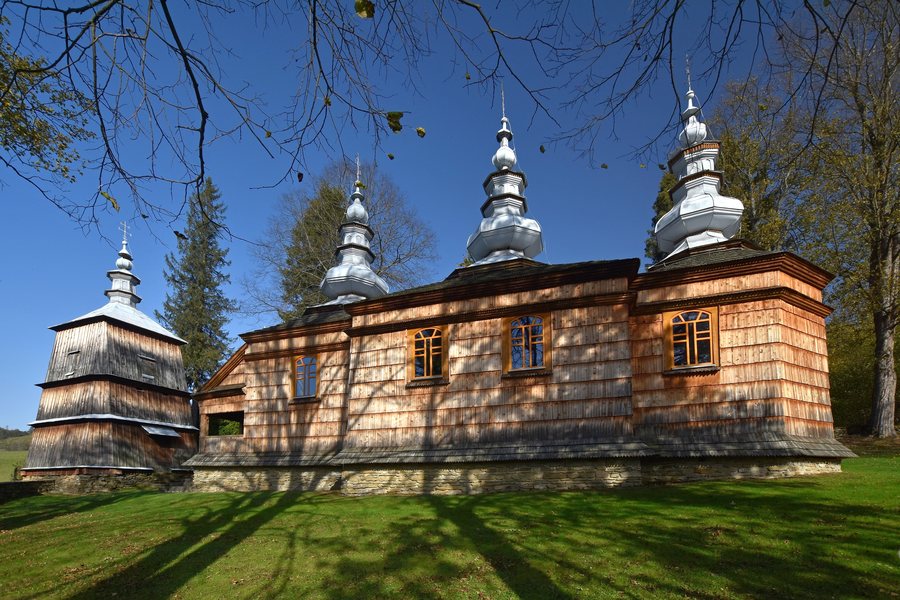 File:Rzepedź, cerkiew św. Mikołaja (HB6).jpg
Photo: Henryk Bielamowicz via Wikimedia Commons, CC BY-SA 4.0
File:Rzepedź, cerkiew św. Mikołaja (HB6).jpg
Photo: Henryk Bielamowicz via Wikimedia Commons, CC BY-SA 4.0
Valley, ridge and open hilltops
The Rzepedka flows into the Osława not far from Rzepedź. To the north of the village, the unwooded Rzepedka ridge rises to 708 metres; to the south are three open hilltops at 508, 500 and 510 metres. The difference in elevation clearly sets the ridge apart from the three lower, closely spaced rises. The valley, river confluence and landforms provide concrete reference points for understanding the character of the landscape.
If the landscape is important to your travel plans, Rzepedź offers more than a single high point: the ridge and hilltops differ in both elevation and character. These landforms give the valley a clear geographical setting, without requiring you to plan any particular hike.
Church and Lemko culture
One cultural landmark is the Greek Catholic Church of St Nicholas. It is enclosed by a rubble-stone wall, which includes a covered entrance gate. Together, the wall, gate and church form an architecturally defined ensemble. The church also represents a type of sacred architecture that developed among Lemko communities. The building can therefore also be viewed in the context of this cultural history.
Another connection between Rzepedź, the landscape and culture is Jan Kanty Podolecki. He lived in the Osława Valley for 20 years and set out on many walks from Rzepedź, getting to know the mountains and their inhabitants. During this time, he collected Lemko folk songs and stories and described the customs and rituals of the Lemkos who lived there. His story adds a personal engagement with the landscape and people of the region to the perspective offered by the church.
Historic traces along the Osława
The forest railway used for forestry is also part of the history of the place. Construction along the Osława towards Duszatyn began in 1921. By 1923, the first ten-kilometre section, from Rzepedź to Duszatyn, had been completed. The start and completion of construction mark two precise stages in the history of this route. The place names, river course and direction make its former alignment easy to follow, without presenting a historical description as a current transport service.
Choose the focus that suits your stay
Rzepedź also has a basketball court, a tennis court and a barbecue area. These provide specific places for leisure in addition to the landscape and culture. When planning your holiday, you can weigh up your different interests: the valley and its landforms, sacred architecture and Lemko history, or the sports and leisure facilities mentioned here.
When looking for a holiday apartment in Rzepedź, you can first decide what you want to focus on during your trip. Are you mainly interested in the landscape, would you like to explore Lemko culture and local history, or are you looking for a stay where local leisure facilities also play a part? Weighing up these options can help you decide whether Rzepedź suits your travel plans before you choose a specific offer.
Discover more destinations
Czystogarb, Wysoczany, Mokre, Wola Michowa, Sanok, Mrzygłód, Bukowsko, Tyrawa Solna
For the main travel overview: Sanok.

.jpg)