
Tyczyn – Town History, Churches and Landscape Park
Accommodation in Tyczyn
Tyczyn reveals several sides of its history: the market square preserves the historic town layout, the parish church brings together architectural forms from different periods, and the palace complex includes a landscape park. Other highlights include the Wodzicki Palace, a Neo-Gothic family tomb chapel and cultural collections. Those looking for a holiday destination with specific cultural and historical themes can get to know Tyczyn through these varied focal points.
 File:Tyczyn, pałac Wodzickich (HB12).jpg
Photo: Henryk Bielamowicz via Wikimedia Commons, CC BY-SA 4.0
Market Square and Landscape Park
Tyczyn’s market square preserves its historic town layout and several townhouses dating from the 18th century. It is not just one building that defines the square: its layout is also one of the town’s historic features. The townhouses add buildings from a specific period, giving the town’s history a tangible architectural dimension.
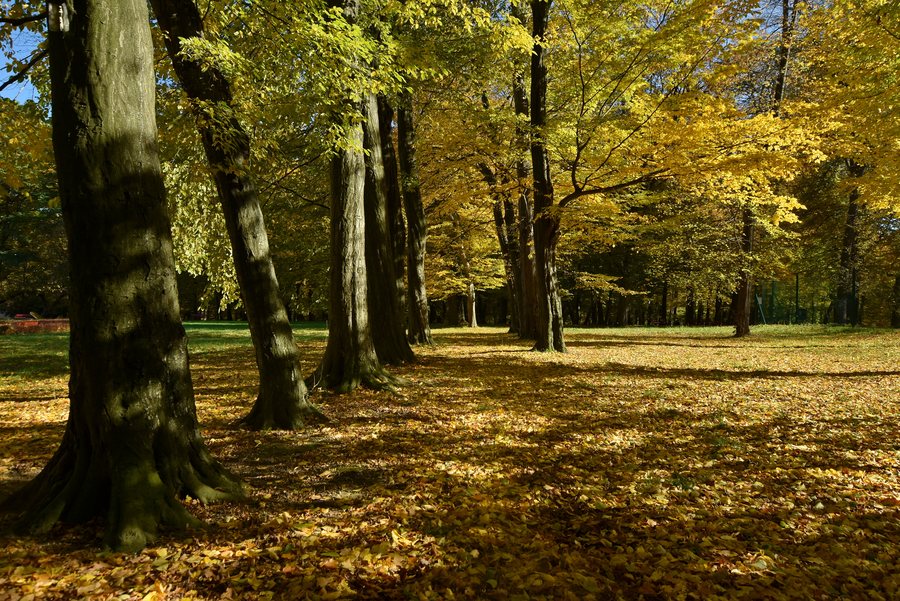
The palace complex is in the central part of town, west of the market square. Its landscape park preserves groups of old trees, including beeches, English oaks and lime trees protected as natural monuments. The named species make the tree population more tangible; their protected status is as much a part of the landscape as their age. In Tyczyn, therefore, the town’s architectural history and the park’s old trees offer different points of interest.
Churches, Residence and Places of Remembrance
Jan Pilecki had the brick parish church built in 1466. It is a three-aisled basilica in the Late Baroque style; at the same time, the walls of the chancel are Gothic. These details describe different features of the church and reveal several architectural layers from different periods. The Church of the Holy Trinity and Saint Catherine of Alexandria also preserves valuable polychrome wall paintings. Polychrome means multicoloured: here, colour is another aspect of sacred art alongside architectural form and style.
The Wodzicki family represents another strand of history. Wodzicki Palace is an eclectic residence built by the family in the mid-19th century. The family’s Neo-Gothic tomb chapel was built between 1877 and 1883 at the instigation of Count Ludwik Wodzicki. Together, the two buildings invite comparison between distinct architectural styles: the eclectic residence from the middle of the century and the later chapel in Neo-Gothic form. Their connection to the family links the two buildings, while their styles and functions differ.
A townhouse on the market square preserves a Jewish Kuczka from the early 20th century, with original polychrome paintings. This brings Jewish heritage into view as a distinct part of the town’s history, alongside the history of the residence and church architecture. In Tyczyn, multicoloured paintings can thus be found in different historical contexts: in the Kuczka and as wall paintings in a church.
Town History and Collections
The Społeczne Muzeum Regionalne in Tyczyn displays exhibits on the history of the town and its surroundings. The Spichlerz serves as a local museum and gallery. These cultural institutions complement the architectural history with a look at the town and its surrounding area. Those who look beyond individual buildings can explore different themes in the town’s history, including the historic market square, religious art, the history of the Wodzicki family and Jewish cultural heritage.
These highlights can help you decide what you want from your holiday. Are you more interested in the historic town layout, church architecture and paintings, or the history of the residence and its old trees? Families who enjoy exploring together and talking about history can also find a variety of conversation starters in these different themes. If you are looking for a holiday apartment, Tyczyn may be worth considering as a destination, particularly if these cultural and historical themes suit your planned holiday.
Discover more destinations: Lubenia, Nowy Kamień, Nienadówka, Rzeszów, Boguchwała, Jasionka, Hyżne, Strażów.
For the overview of the wider area: Rzeszowski.

